Factory Made vs Trading Outdoor Furniture
A delayed pool deck opening rarely comes down to one bad chair. More often, it starts much earlier – with the wrong supply model. When buyers compare factory made vs trading outdoor furniture, they are really deciding how much control they want over quality, lead time, customization, and project risk.
For a hospitality rollout, a residential compound, or a multi-zone commercial terrace, that choice affects more than unit price. It shapes specification accuracy, finish consistency, replacement planning, and how quickly a supplier can respond when a layout changes mid-project. If you are sourcing at scale, the difference is practical, not theoretical.
What factory made vs trading outdoor furniture really means
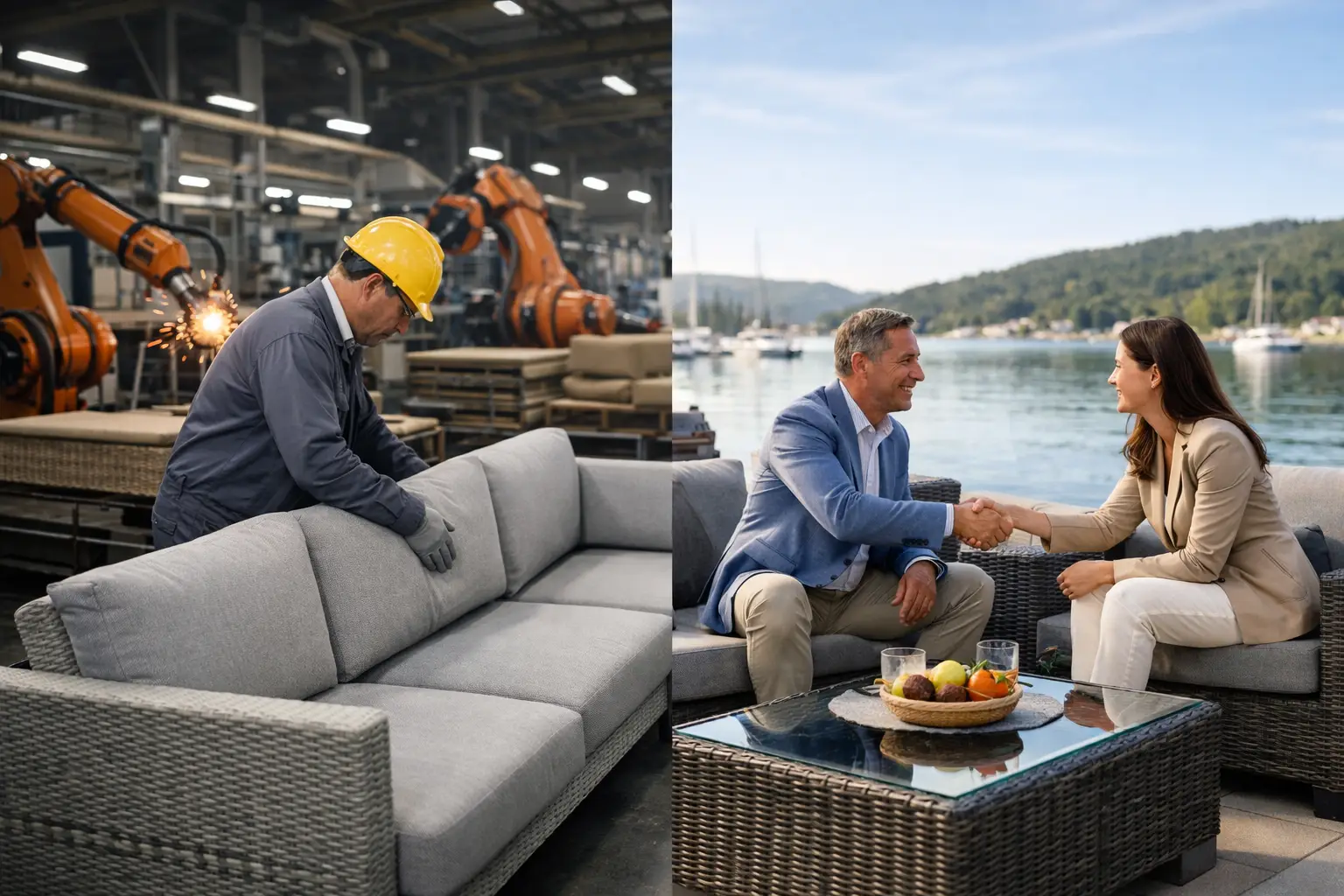
Factory-made outdoor furniture comes from a supplier that controls production directly. That usually means in-house design coordination, material sourcing oversight, manufacturing equipment, skilled labor, finishing processes, and packaging standards under one operating structure. In stronger models, it also means closer control over mock-up approvals, production scheduling, and quality checks before goods leave the facility.
Trading outdoor furniture is supplied by a company that buys from one or more third-party factories and resells those products. Some trading companies are organized and useful, especially for fast sourcing across many categories. But they do not own the same level of production control. Their strength is often market access. Their weakness is that execution depends on external factories, external schedules, and external quality discipline.
That distinction matters most when a project has custom dimensions, specific material requirements, phased delivery windows, or commercial-use performance standards. The more variables involved, the more valuable direct control becomes.
Why B2B buyers feel the difference on real projects
On paper, both models can look similar. You receive a catalog, a quotation, lead times, and material options. The difference shows up when the project starts moving.
If an architect needs a dining chair adjusted to fit a tighter restaurant plan, a factory-backed supplier can usually evaluate feasibility faster because the people quoting the job are closer to production. If a procurement team needs a finish sample revised after a client presentation, that request moves through fewer layers. If a hotel operator needs replacement pieces months later, there is a better chance of matching the original specification when the source factory is part of the same operation.
With a trading model, every adjustment can pass through another handoff. That does not always create failure, but it often creates drag. Lead times can become less predictable. Finish interpretation can vary. Accountability can blur when a problem appears after delivery.
For small-volume, standard-item purchasing, that may be acceptable. For larger outdoor packages across lounge, dining, poolside, shade, and accessories, the margin for misalignment gets smaller.
Quality control in factory made vs trading outdoor furniture
Quality is where buyers often discover the true cost of a sourcing decision.
A factory-made model gives better visibility into how frames are built, how wicker or rope is applied, how powder coating is handled, how teak is selected, and how upholstery is prepared for outdoor use. It also improves the chance of consistent inspection across batches. For commercial and hospitality environments, that consistency matters because one weak production run can disrupt an entire opening schedule.
A trading company may still offer good products, but quality assurance is less direct. Inspections may happen after goods are completed rather than throughout production. If the trader works with multiple factories, one SKU may perform well while another arrives with different tolerances or finishing standards. That can be manageable for low-risk purchases, but it becomes harder to absorb when an entire rooftop lounge or resort pool deck needs a uniform look and long service life.
This is also where vertical integration has practical value. A supplier with design, manufacturing, and project support under one structure can flag problems earlier, whether that means a frame profile that will not support contract use or a fabric choice that does not suit heavy sun exposure.
Lead times are not just about speed
Many buyers assume trading companies are always faster because they source from existing stock. Sometimes that is true, especially for standard models with no design changes. If the job is simple and the goods are ready, a trader can be the quickest route.
But for projects that require customization, quantity scaling, or repeatable delivery across phases, factory-made supply can be more dependable. A factory can allocate production slots, plan material purchasing, and coordinate packaging for project-specific sequencing. That gives procurement teams a more stable planning basis.
The key issue is not only how fast the first shipment leaves. It is whether the supplier can maintain the delivery promise once approvals, revisions, volume changes, and installation deadlines enter the picture. Reliable lead time is usually more valuable than an optimistic lead time.
Customization, mock-ups, and specification control
Outdoor furniture projects rarely stay static. Designers refine dimensions. Developers adjust budgets. Operators ask for easier maintenance. Hospitality teams request branding details or finish alignment across multiple zones.
This is where factory made vs trading outdoor furniture becomes a strategic decision rather than a sourcing preference. Factory-based suppliers are better positioned to support custom dimensions, material substitutions, finish development, mock-up production, and approval cycles. They can usually provide more precise feedback on what is feasible, what affects cost, and what may extend lead time.
A trading company can coordinate customization, but often through an indirect chain. That can work for modest modifications. It becomes harder when the project requires several rounds of technical review or detailed specification matching.
For B2B buyers, specification control is not a luxury. It protects design intent, keeps procurement aligned with commercial requirements, and reduces expensive surprises at delivery.
Pricing: cheaper upfront does not always mean better value
Trading companies can sometimes quote lower initial prices, especially when they are aggregating standard products from price-competitive factories. If your priority is filling a small outdoor area with ready-made pieces and minimal changes, that may be enough.
But total value is broader than the first quote. Buyers should weigh pricing against consistency, defect risk, replacement availability, communication speed, and the cost of delays. An inexpensive chair becomes expensive if it arrives with finish variation across a full venue or if replacements cannot be matched later.
Factory-made supply may carry stronger value in projects where long-term consistency matters. Direct manufacturing control can reduce rework, simplify approvals, and improve cost predictability over the life of the project. For commercial buyers, that is often the more useful measure.
When trading outdoor furniture makes sense
There are cases where trading is the right fit. If the requirement is highly standardized, quantities are low, and the project does not need custom engineering or finish development, a trader may provide adequate speed and flexibility. Traders can also be useful when buyers want access to a wide mix of sourced products without committing to bespoke production.
The point is not that trading is inherently weak. It is that trading works best when complexity is low and tolerance for variation is higher.
When factory-made outdoor furniture is the stronger choice
Factory-made supply is usually the better model when the job includes contract-grade requirements, custom specifications, phased rollouts, repeat orders, or brand-sensitive environments. It is especially valuable when buyers need one supplier to support multiple categories while keeping design consistency and delivery discipline intact.
That is why vertically integrated partners matter in the GCC and other project-driven markets. Buyers are not only purchasing furniture. They are managing timelines, approvals, stakeholders, and post-installation expectations. A supplier with manufacturing depth, design support, and logistics coordination can remove friction across the full process.
For firms handling villas, hotels, restaurants, rooftop lounges, pool areas, and large residential or commercial developments, the best supplier is usually the one with fewer operational gaps. That is the advantage of a model built around direct control, broad category coverage, and project execution from drawing to delivery.
PNZ Space Global operates in that lane – combining factory capacity, design coordination, customization, and project fulfillment for buyers who cannot afford guesswork.
The smartest sourcing decision usually comes down to one question: when something changes, who can actually do something about it? If the answer is the same team that designs, builds, checks, and delivers the furniture, your project is already on firmer ground.