Outdoor Furniture 3D Drawings That Win Approvals
A rooftop lounge looks perfect in a mood board until someone asks the questions that stall the job: Will the sectional block the egress path? Do the chaise lengths crowd the pool edge? What happens when umbrellas open into the circulation lane?
That gap between “looks great” and “approved for purchase” is exactly where an outdoor furniture 3D drawings service earns its keep. For B2B buyers, the value is not pretty pictures. It is decision speed, fewer revisions, fewer surprises at installation, and a cleaner procurement trail that your stakeholders can sign off on.
What an outdoor furniture 3D drawings service actually does
For contract outdoor environments, 3D drawings are a working document. They translate a concept into a buildable plan that accounts for real constraints: dimensions, clearances, sightlines, and how people move through the space.
At a minimum, you want 3D views that show furniture scale in context. For procurement and installation, you typically also need layout plans with dimensions, product callouts, and finish references. If you are furnishing multiple zones – dining, lounge, pool, shade – the drawings become the coordination layer between design intent and what gets ordered.
The best services do not treat 3D as an isolated deliverable. They treat it as part of a closed loop: drawings that lead to a quote, a quote that matches the drawings, and an order that arrives exactly as approved.
Why 3D drawings matter more outdoors than indoors
Outdoor projects punish small mistakes. Clearances feel tighter because circulation routes are often shared with doors, pool coping, planters, and service access. Sun and wind change how a space functions throughout the day, which is why shade placement, umbrella swing radius, and cabana orientation are not “later” decisions.
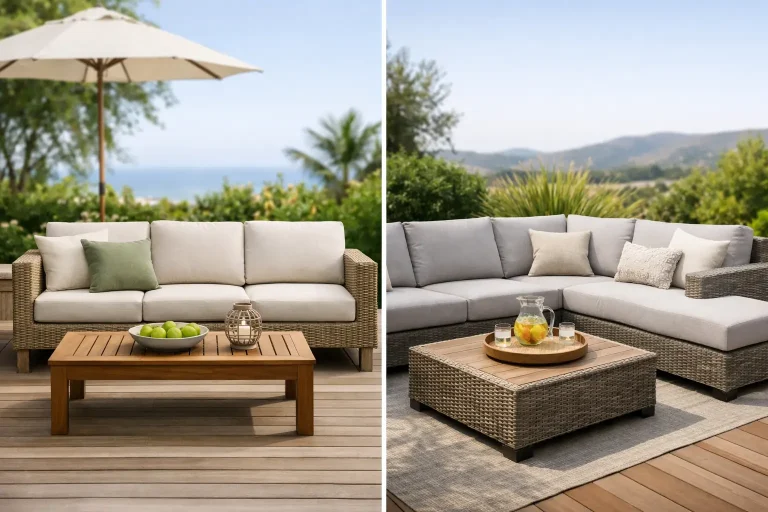
Material performance also raises the stakes. If a seating group looks right but uses the wrong upholstery spec for a coastal environment, the first season will expose it. 3D drawings do not replace material engineering, but they do force earlier conversations about what is being specified and where it is being used.
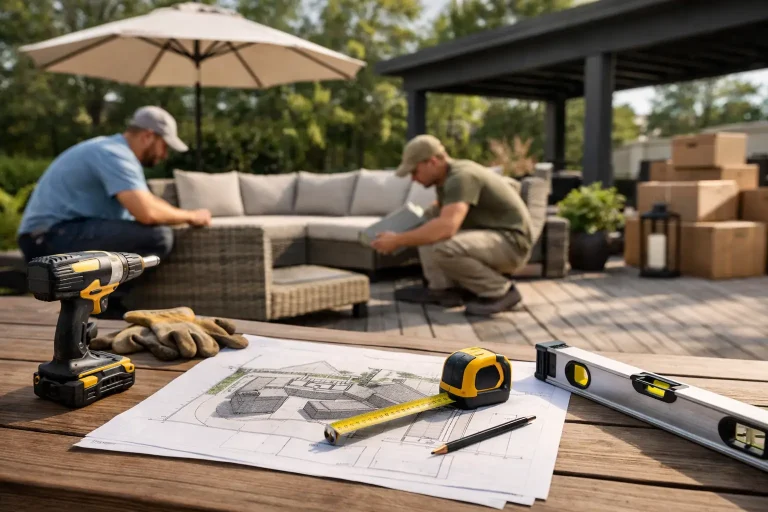
There is also a procurement reality: outdoor furniture frequently ships in larger cartons, may require staging, and is installed across roofs, terraces, and pool decks with limited access. When drawings show exact quantities and configurations, logistics can be planned instead of improvised.
The deliverables you should expect (and ask for)
Not every project needs the same level of documentation. A single villa patio may move quickly with a few perspectives and a clean product list. A resort pool deck with repeated modules across multiple levels needs a stricter package.
3D perspectives that answer buyer questions
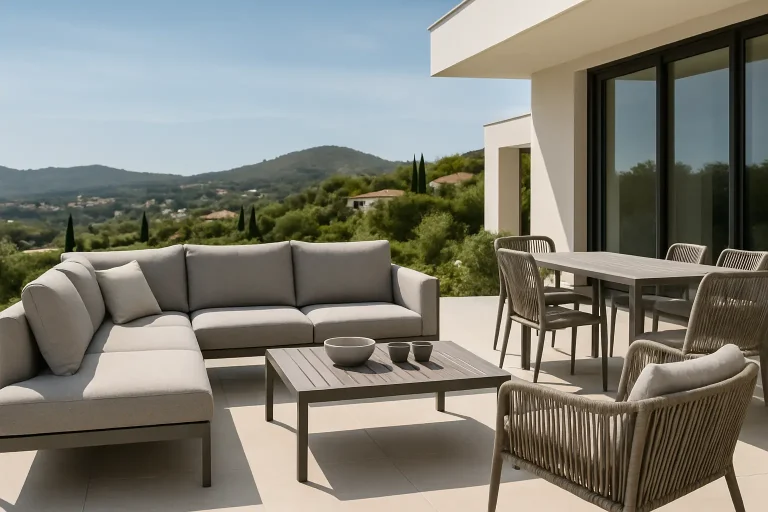
A strong perspective set shows proportions and adjacency. It should make it obvious where the conversation areas are, how many seats you truly have, and whether the layout supports service. If you have a bar or restaurant component, you should be able to see how chairs pull out and how servers move behind occupied seats.
Dimensioned layouts that can be purchased against
If the drawing cannot be used to verify counts, it is not procurement-ready. At minimum, the plan should include overall dimensions, key clearances, and product labels that match the quote. For repeated zones, it should show the typical module and the total quantity.
Finish and material references that reduce substitution risk
Outdoor projects often change late because a finish is discontinued, a fabric lead time stretches, or a material is rejected by an operator. The drawings package should clearly reference finishes and material families so substitutions can be evaluated fast without restarting the design.
Optional but valuable: mock-up alignment
If your project calls for physical mock-up approvals, 3D drawings should match the mock-up configuration. That alignment prevents the classic problem: the approved photo and the ordered configuration are not the same. The closer your drawings mirror what will be mocked and installed, the fewer approvals you have to re-run.
Where 3D drawings remove risk in the procurement timeline
3D is often sold as a design add-on. For procurement teams and project managers, it is a risk-control tool.
First, it reduces revision churn. When stakeholders can see the layout at true scale, objections come earlier and in fewer rounds. Second, it improves quote accuracy. When product callouts and quantities are locked visually, “assumed quantities” drop out of the process. Third, it clarifies responsibility. If the drawing and the quote reference the same labeled items, it becomes harder for miscommunication to sneak in.
The trade-off is time. A detailed drawing set takes more coordination up front. If you are furnishing a small area with standard sets and no constraints, you may not need a heavy 3D package. If you are managing multiple zones, custom finishes, or a hospitality timeline that cannot slip, the extra effort at the front end is usually cheaper than a change order later.
How to brief a 3D drawing request so you get usable output
The fastest projects are the ones with a clean brief. You do not need a 40-page document, but you do need to remove ambiguity.
Start with the site reality: a measured plan, critical dimensions, and any fixed elements like doors, planters, rails, steps, pool edges, and service corridors. Then define the operational intent. Is the space for quiet lounging, event overflow, all-day dining, or high-turn pool traffic? Usage drives spacing.
Next, be specific about the procurement constraints: target lead time, budget range, and whether you need contract-grade performance (you probably do for commercial and hospitality). If you already have preferred materials – aluminum frames, teak accents, resin wicker, quick-dry foam, performance sling – call them out early so the drawings do not propose an unrealistic mix.
Finally, clarify what “approval” means on your side. Some clients need a brand standard review, others need a property owner sign-off, and some need a consultant to approve egress or spacing. When the service team understands who is approving, they can tailor the views and annotation to match what that stakeholder actually checks.
What to look for in a provider: it’s not just design talent
A portfolio matters, but for B2B outdoor furnishing, execution matters more.
You want a provider that can control spec accuracy. That usually means they have direct access to the furniture dimensions, finish options, and packaging constraints – ideally because they design and manufacture, not because they are guessing from images.
You also want supply-chain realism. A stunning layout that depends on long-lead custom pieces is not helpful if your opening date is fixed. A strong provider will steer you toward configurations and materials that can be produced and delivered on schedule, and they will tell you when a request adds risk.
Lastly, you want communication cadence. Drawings fail when feedback loops are slow. Ask how revisions are handled, what the typical turnaround is, and how the drawing labels map to SKUs and quotes.
How PNZ Space supports 3D drawings in the real workflow
For buyers who want a single partner from concept through delivery, PNZ Space Global supports outdoor projects with in-house 3D drawings, mock-up approvals, and design consultation, backed by vertically integrated manufacturing and project fulfillment. That combination matters when you are specifying across lounge, dining, poolside, shade, and accessories and need the drawings to match what is actually produced, packed, shipped, and installed.
Common friction points – and how to prevent them
Most outdoor furniture drawing revisions come from three predictable issues.
The first is spacing that looks fine in render but fails in plan. This shows up around dining chairs, chaise lounges, and tight corridors near pools. Prevent it by insisting on dimensioned clearance checks in the plan view, not only 3D perspectives.
The second is shade conflicts. Umbrellas and pergolas change everything, including wind loading, base placement, and table centering. Prevent it by making shade part of the first drawing round. “We’ll add umbrellas later” is how you end up re-laying the entire deck.
The third is finish drift between design and procurement. A drawing set that says “beige cushion” is not a spec. Prevent it by pinning finishes to named options or swatch references, and by aligning the drawing labels with the quote line items.
When you may not need full 3D (and what to do instead)
If you are ordering standard outdoor sets for a simple space with generous square footage and no operational constraints, full 3D may be overkill. In those cases, a clean 2D layout with key dimensions and a product schedule can be enough, especially if you are repeating proven configurations.
But even then, one or two 3D views can help stakeholders make faster decisions. The point is not to maximize deliverables. It is to minimize decision risk.
The outcome to aim for: drawings that are purchase-ready
A purchase-ready drawing package makes three things obvious: what you are buying, how it fits, and how it performs in the way the space will actually be used. If your 3D drawings do that, approvals stop feeling like a hurdle and start functioning like what they are supposed to be – a controlled handoff from design to execution.
Closing thought: the best outdoor projects are the ones where the drawings tell the truth early, so the site does not have to teach it later.