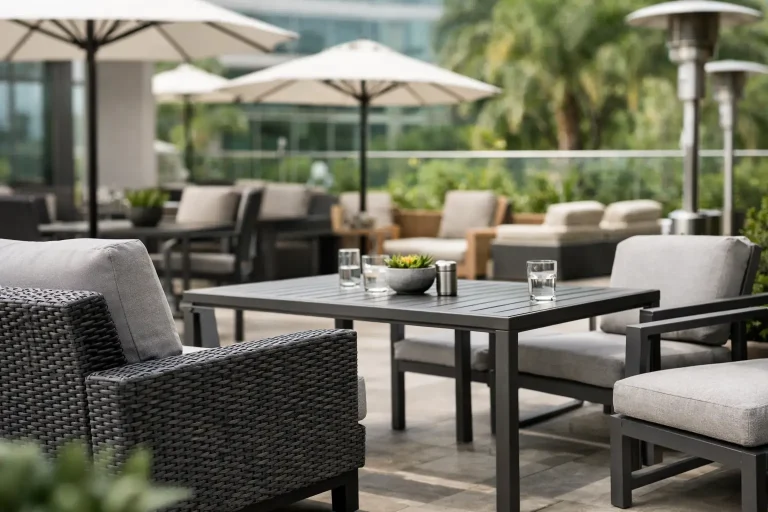
Choosing a Contract-Grade Outdoor Supplier
A pool deck looks perfect on handover day. Six months later, the reality shows up in the details – a table that rocks on pavers, sling fabric that bagged out, powder coat that chalked, teak that split at the joint, glides that failed and started staining stone. For procurement teams and designers, that gap between “photo-ready” and “project-ready” is exactly why the contract conversation matters.
If you are sourcing at scale, a contract grade outdoor furniture supplier is not just selling chairs. They are selling spec control, repeatability, and the ability to deliver consistent outcomes across sites, climates, and timelines. The best partners bring the same discipline you apply to finishes, MEP coordination, and schedule management – and they support it with manufacturing, QA, and logistics that can handle real-world complexity.
What “contract grade” should mean in outdoor
Contract grade gets used loosely. In practice, it should signal that the product is engineered and built for frequent use, public exposure, and maintainable performance. That starts with structure (frame strength, joinery, fasteners), extends to surface systems (powder coat, anodizing, sealants), and ends with what happens after install (spare parts, touch-up pathways, refresh cycles).
There is a trade-off: true contract products typically cost more upfront than light residential pieces. But when you compare lifecycle cost – replacements, labor to swap items, guest complaints, downtime, and rushed reorders – contract-grade usually wins. The bigger the project and the higher the traffic, the faster that math becomes obvious.
Where projects fail: the supplier side, not the chair
Most outdoor failures are not mysterious. They come from one of three gaps.
First is unclear specification. A “black metal chair” is not a spec. Is it aluminum or steel? What pretreatment? Which powder system? What thickness? What salt exposure assumptions? Without clarity, bids become apples-to-oranges, and the site becomes the testing lab.
Second is inconsistent production. Even a well-designed item can drift if the factory cannot hold tolerances, maintain coating processes, or track component changes across batches. This is where vertical integration and documented QC matter more than marketing language.
Third is logistics and installation friction. Outdoor furniture gets damaged in transit, mixed across zones, or delivered out of sequence. If the supplier cannot stage, label, and support white-glove placement, the site team absorbs the cost.
How to evaluate a contract grade outdoor furniture supplier
The fastest way to qualify a supplier is to evaluate them like a project partner, not a showroom.
Manufacturing control and capacity
Ask who actually makes the product and how capacity is managed when your timeline collides with someone else’s. A supplier with owned production can control materials, tooling, and QA checkpoints, and can react faster when you need an approved change or an additional batch.
Capacity is not just square meters or headcount. It is whether the supplier can repeat the same finish and build quality across high-volume orders, and whether they have the machinery to keep fabrication consistent. If your project is multi-site, you want to see proof that the supplier can hold a standard across waves of delivery.
Material honesty (and climate realism)
Outdoor specs fail when materials are chosen for looks rather than exposure. Coastal environments punish metal finishing and fasteners. Desert heat punishes plastics, adhesives, and low-grade powder. High humidity challenges wood stability and cushion drying.
You do not need one “best” material. You need the right material for the setting.
Aluminum is common for good reason – it is lighter than steel and resists rust, but it still needs the right pretreatment and coating to avoid corrosion at cut edges and welds. Stainless hardware matters, especially where water sits. Synthetic weave can perform well, but fiber quality and UV inhibitors make or break longevity. Teak and other hardwoods can be excellent, but only if the joinery is engineered for movement and the client understands patina and maintenance expectations.
A credible supplier will talk openly about these trade-offs and align them to your cleaning plan, exposure, and service level. If a supplier promises “maintenance-free” outdoor across every environment, treat that as a red flag.
Finish systems and touch-up pathways
Outdoor finishes are systems, not colors. For powder coating, you want clarity on pretreatment steps, coating type, and thickness targets. For wood, you want clarity on sealing approach and what happens when pieces get scratched in service.
On a live property, the practical question is: can your operations team maintain the look without replacing the whole item? A supplier that supports touch-up paint, replacement glides, spare slats, and cushion cover programs reduces downtime and keeps your spaces consistent.
Testing and documentation you can use
Procurement and consultant teams often need documentation that supports approvals and reduces risk. Depending on your market and operator standards, this can include load performance, UV resistance expectations, foam and fabric specs, and commercial use statements.
The goal is not paperwork for its own sake. The goal is decision-grade information that helps you defend the selection and avoid surprises after install. The more complex the project, the more you benefit from a supplier who can package specs cleanly and respond quickly when the consultant asks for clarifications.
Project support: drawings, mock-ups, and approvals
Contract outdoor is rarely a single SKU. It is a system across zones: dining, lounge, poolside, cabanas, and terrace edges, often with custom finishes, mixed materials, and different cushion kits.
This is where a supplier’s project services become a real differentiator. 3D drawings help teams confirm scale, circulation, and sightlines before you commit. Mock-up approvals reduce risk on color, weave, and comfort, especially when decision-makers are remote. Design consultation helps solve the common problem of “we like it, but it doesn’t quite work for this layout.”
When these steps are built into the supplier’s process, you get fewer late-stage changes and cleaner procurement packages.
Logistics that match construction reality
Outdoor furniture is one of the last scopes to land, and one of the easiest to damage if deliveries are rushed. Ask how the supplier handles packaging, labeling by zone, consolidation, and staged deliveries.
For hospitality projects, white-glove placement is not a luxury. It is how you protect finishes, control punch lists, and open on time. A supplier who can coordinate delivery windows, site access, and placement reduces site labor and prevents the all-too-common “furniture pile-up” that leads to scratches and missing parts.
Sourcing by zone: a procurement-first way to specify
A catalog-first approach helps teams specify faster and reduce vendor fragmentation.
For lounge seating, focus on frame stability, seat comfort over time, and cushion construction. High-traffic lounges benefit from replaceable cushion covers and standardized insert sizing so operations can refresh without reordering entire sets.
For dining, prioritize wobble control, durable tabletops, and stackability where storage is tight. On pavers, glides and leveling tolerance matter as much as the chair design.
For poolside, choose materials and fabrics that tolerate chlorine, sunscreen, and constant sun. Quick-dry cushion strategies and breathable sling options often reduce maintenance headaches.
For shade solutions and accessories, evaluate wind considerations, base weights, and replacement pathways. Accessories look minor until one missing piece breaks the visual consistency of a terrace.
When one supplier can cover these categories with coordinated finishes, you gain a cleaner aesthetic and a simpler reorder path.
Customization: where it pays off (and where it can backfire)
Customization is valuable when it solves a real constraint: brand color alignment, dimension adjustments for circulation, or material upgrades for climate exposure. It can also support value engineering by holding the silhouette while adjusting material choices.
It backfires when changes are made late, when too many unique SKUs are created, or when custom parts lack a spare strategy. A disciplined supplier will help you standardize where possible and customize where it actually improves performance or guest experience.
What “one-stop” should look like in practice
A one-stop supplier is not just a broad product list. It is a coordinated process that reduces procurement friction: consistent lead times, shared finish libraries, a clear approvals workflow, and a service team that understands the difference between a villa terrace and a 300-key resort.
For teams managing multiple stakeholders, the value is simple: fewer handoffs, fewer mismatched finishes, and fewer schedule surprises.
One example of this model is PNZ Space Global, which pairs a large outdoor catalog across lounge, dining, poolside, shade, and accessories with in-house project support like 3D drawings, mock-up approvals, and logistics built for high-volume delivery.
The decision that protects your schedule
The right supplier choice is the one that stays predictable when the project gets messy – when a finish needs approval fast, when a shipment must be split across sites, when you need an additional quantity without drifting color, when operations asks for spares before opening.
Ask the questions that reveal operational strength, not just product appeal. Then select the partner who treats outdoor furniture like a scope that has to perform, look right, and arrive on time – because your opening date will not move for a chair.