Swing Seating for Outdoor Lounges That Performs
A standard lounge layout can look complete on paper and still feel forgettable in person. That is usually where swing seating for outdoor lounges changes the outcome. It introduces movement, creates a natural focal point, and gives designers and operators a feature that guests actually remember after the first visit.
For trade buyers, that visual lift is only part of the decision. A swing seat has to hold up under traffic, weather, cleaning cycles, and installation constraints. In hospitality and large residential projects, the right piece needs to do more than photograph well. It needs to meet the brief, support the layout, and arrive on schedule with the right materials, finishes, and hanging specifications already aligned.
Why swing seating works in outdoor lounge design
Swing seating succeeds because it adds function and atmosphere at the same time. In a rooftop lounge, it softens a hard architectural envelope of stone, metal, and glass. On a resort terrace, it gives guests a more relaxed posture than a fixed club chair. In a private villa, it can turn an underused corner into the most occupied seat in the space.
There is also a planning advantage. A swing introduces vertical interest without requiring a large footprint. That matters in projects where circulation is tight and every square foot has to justify itself. A well-positioned hanging chair or daybed can act as a destination piece while keeping the overall lounge plan open.
That said, swing seating is not automatically the right answer for every site. If the space has constant high-volume movement, limited structural support, or strict operational rules around suspended furniture, a fixed lounge chair may be the better specification. The value comes from using swing seating where it improves the experience, not where it complicates it.
Swing seating for outdoor lounges in commercial settings
In commercial environments, swing seating has a different job than it does in a private residence. It has to support the brand image of the property, perform in public use, and fit into a repeatable procurement strategy. For hotel groups, restaurant operators, and developers, this means looking beyond the silhouette.
The first question is usually use case. Is the seat intended for short-form social use in a café terrace, longer dwell time in a hotel lounge, or a hero position near a pool deck? A compact hanging chair may work well for one or two users in a conversational setting. A larger suspended daybed may be better suited to a resort or premium club environment where guests stay longer and the furniture is part of the amenity offering.
The second question is throughput. A beautiful swing that slows cleaning access or creates a bottleneck in service circulation can become a problem fast. In hospitality, specification should always account for staff movement, visibility lines, and maintenance routines. The most successful pieces are the ones that feel distinctive to the guest but practical to the operator.
What to specify before you approve a swing seat
A swing seat should be evaluated like any other contract-grade outdoor product – through materials, structure, finish performance, and installation detail. This is where many projects either stay on track or start creating avoidable delays.
Frame and structural support
The frame material matters, but the support system matters just as much. Some swing seats are designed for stand-alone frames, which can simplify installation and reduce dependence on site structure. Others are suspended from overhead beams or integrated architectural elements, which may create a cleaner look but require closer coordination across design, engineering, and site teams.
For procurement teams, this decision affects everything from freight dimensions to installation sequencing. Stand-mounted units can be easier to deploy across multiple sites. Ceiling-mounted designs may offer a more custom appearance, but they usually demand earlier technical review.
Outdoor materials and finish durability
Not all outdoor materials perform equally in heat, humidity, and salt exposure. Powder-coated aluminum, synthetic wicker, teak, and performance upholstery each bring different advantages depending on the project environment. A coastal property may prioritize corrosion resistance and easy cleaning. A high-end residential terrace may place more emphasis on texture and finish detailing.
Cushion specification deserves the same scrutiny as the frame. Quick-dry foam, UV-stable fabrics, and removable covers can make a major difference in long-term maintenance. If the project is in a harsh climate, materials should be selected for performance first, then refined for aesthetics. The reverse approach often looks good at handover and creates issues six months later.
Load capacity and user comfort
Swing seating has to feel secure. That sounds obvious, but comfort and confidence are directly tied to engineering. The right pitch, seat depth, suspension balance, and load rating all affect how the piece is used. If the motion is too loose, some guests will avoid it. If the seat feels too upright or too deep, dwell time drops.
For commercial use, it is worth confirming user profile early. A lounge intended for family villas, adults-only hospitality, or public mixed-use spaces may need different proportions and performance criteria. One size does not serve every project equally well.
Design considerations that affect layout
A swing is never just a chair. It creates a movement zone around itself, and that zone must be accounted for in the plan. Designers should allow enough clearance for safe use, visual balance, and nearby furniture placement. The piece needs room to move without interfering with side tables, planters, banquettes, or pedestrian flow.
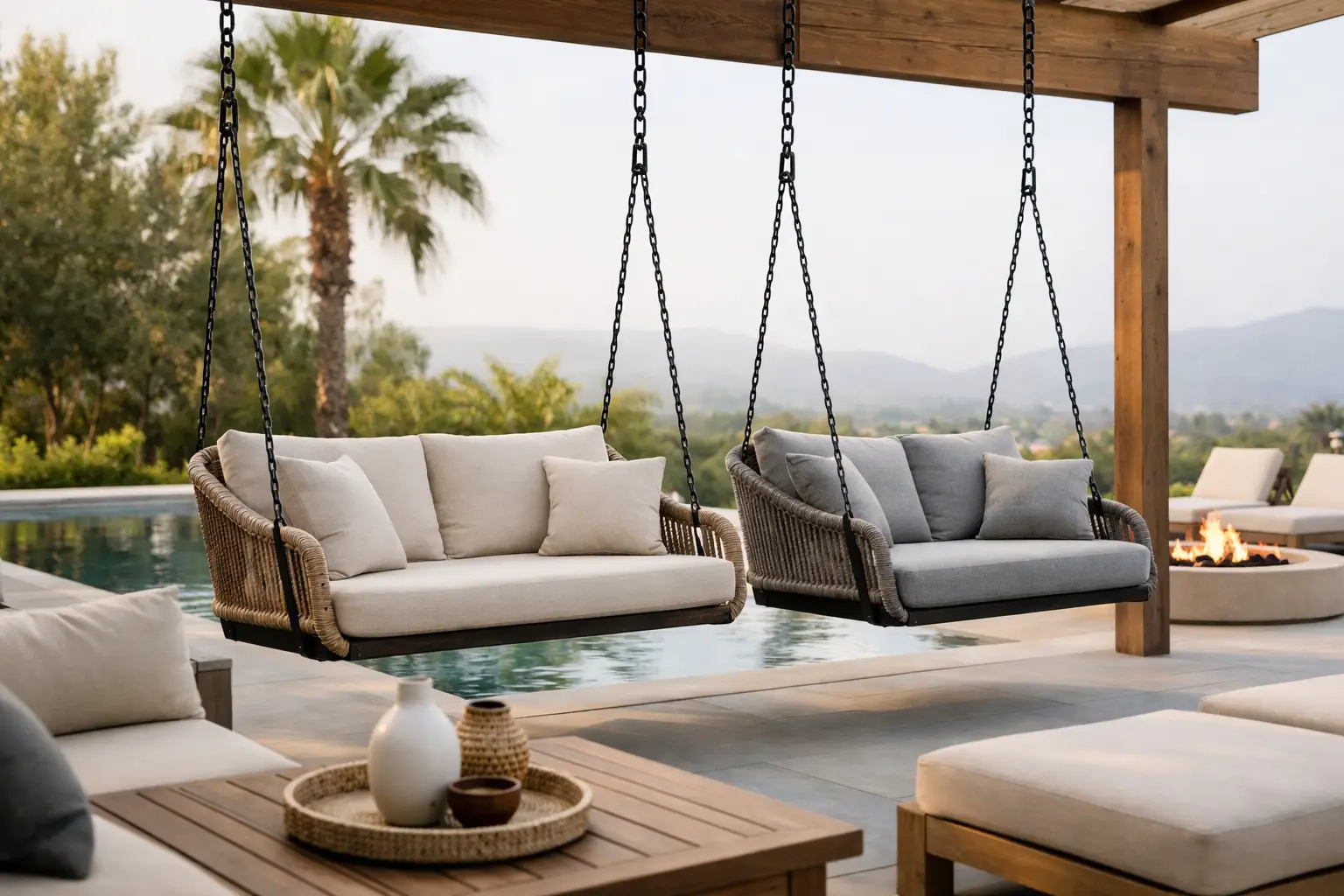
Sightlines also matter. Swing seating often performs best when it faces an asset – a skyline, pool, garden edge, or fire feature. Placed well, it anchors the lounge and draws people in. Placed poorly, it can feel disconnected or ornamental.
Scale is another common issue. An oversized suspended daybed can dominate a compact terrace. A small hanging chair can disappear in a large hospitality deck with tall architecture and broad paving joints. Matching the swing to the proportions of the site is what makes it feel intentional rather than added late.
Where swing seating delivers the most value
Some settings consistently justify swing seating better than others. Rooftop lounges benefit because the furniture adds personality without blocking views. Poolside environments benefit when the swing becomes a premium relaxation point rather than just another seat in a row. Resort and hospitality projects gain from the guest appeal and visual identity that a strong suspended piece brings to marketing photography and on-site experience.
Large residential projects also see strong value when the swing seat helps define a lifestyle zone within a broader outdoor plan. In expansive villas, it can break up a terrace and create a quieter lounge moment. In smaller homes, it can replace multiple pieces by delivering comfort and impact in one footprint.
The common thread is simple: swing seating works best when it is treated as part of a broader lounge strategy, not as a novelty item.
Procurement advantages of a coordinated supplier
For project teams sourcing at scale, the furniture itself is only one part of the decision. The specification process is faster and more reliable when swing seating is sourced alongside the rest of the outdoor package – lounge seating, dining, pool furniture, shade, and accessories. That reduces finish mismatches, freight fragmentation, and approval delays.
This is where an integrated supply partner adds measurable value. When design support, mock-up approval, material options, and production control sit under one roof, teams can resolve details earlier. That is especially useful for swing seating, where small changes in frame finish, rope detail, cushion fabric, or mounting configuration can affect both aesthetics and lead time.
PNZ Space Global approaches these projects with that full-scope mindset – combining design support, manufacturing control, and white-glove delivery for complex outdoor furnishing programs. For buyers managing villas, hospitality spaces, or multi-site commercial developments, that kind of coordination reduces procurement friction and protects the install schedule.
How to make the right specification choice
The best swing seat is not always the most dramatic one. It is the one that fits the traffic level, climate exposure, user profile, and design language of the project. In some cases, that means a compact hanging chair with easy-care cushions and a self-supporting frame. In others, it means a custom suspended daybed built to carry the visual weight of the entire lounge.
A good specification process starts with three clear questions: what experience the seat is meant to create, what conditions it needs to withstand, and how it will be installed and maintained over time. Once those answers are clear, product selection becomes far more efficient.
Swing seating for outdoor lounges earns its place when it performs on every level – visually, structurally, and operationally. Specify it with the same discipline you apply to every other contract-grade category, and it stops being an accent piece. It becomes one of the strongest assets in the entire outdoor scheme.