Spec Outdoor Fabrics That Perform on Site
A fabric spec can look perfect on a tear sheet and still fail on a pool deck.
The misses are rarely dramatic – they show up as seam slippage after a few months of housekeeping, color shift on the sun-facing cushions, mildew odor in a humid storage room, or a “cleanable” fabric that turns into a maintenance problem once sunscreen and F&B stains hit it every day. If you are furnishing outdoors at scale, fabric is not a finish. It is a performance system.
How to specify outdoor furniture fabrics without rework
Outdoor fabric specification is easier when you treat it like any other contract decision: define the environment, define the duty cycle, then select construction, finish, and documentation to match. “Outdoor” alone is not a requirement – a shaded terrace in Scottsdale and an uncovered pool deck in Miami demand different answers.
Start by writing the conditions into your spec package. Is seating fully exposed or under a canopy? Is it poolside with constant wet swimwear? Is it a rooftop with high wind and airborne dust? Will cushions be stored daily or left in place? Are you designing for a hotel where upholstery is cleaned every shift, or a residential villa where cleaning is intermittent and sun exposure is the main threat?
When you document those variables up front, you avoid the most common procurement friction: a fabric sample approved for “outdoor use” that is not actually fit for the site’s UV load, staining profile, or cleaning chemistry.
Define the project category: lounge, dining, pool, or mixed use
Most outdoor spaces are a mix of zones, and each zone drives different fabric priorities.
Lounge seating typically means deeper cushions, longer dwell time, and more body oils, sunscreen transfer, and beverage spills. Here, stain resistance and cleanability can matter as much as UV.
Dining seating sees higher abrasion at edges and seams, more frequent wipe-downs, and more exposure to sauces and acidic spills. A fabric that looks great in lounge may not hold up to daily cleaning cycles at a restaurant.
Poolside is its own category. Chlorine mist, salt air, wet towels, and heat buildup all stack the deck against the wrong construction. If you only do one thing differently for pool, specify for moisture management and mildew prevention, not just “UV resistant.”
Mixed-use hospitality spaces often need a standardized palette across all zones. That is achievable, but it works best when you select a small family of fabrics in the same visual direction with different performance tiers – so the look stays consistent while each zone gets what it needs.
Choose fiber and construction based on failure modes
A spec that reads like “solution-dyed acrylic” or “olefin” is a start, not a decision. Fiber type affects colorfastness and hand feel, but construction and finish usually determine how the fabric behaves in real use.
Solution-dyed acrylic is a common go-to for high-UV environments because the color is integral to the fiber. It performs well when UV is the dominant stressor and you want a soft, textile hand. The trade-off is that not every acrylic construction is equally stain resistant, and some can hold onto oils unless the finish is right.
Olefin (polypropylene) can be an excellent value-performance choice, often with strong stain resistance and fast drying characteristics. The trade-off is that some olefin styles can feel less “residential” in hand, and certain constructions may show abrasion or pilling sooner depending on weave and cleaning frequency.
Polyester, including many performance outdoor polyesters, can deliver strong aesthetics and a wide design range. For demanding outdoor use, look for versions built for UV and moisture exposure and confirm the finishing package. The trade-off is that performance varies widely by mill and finish, so documentation matters.
Vinyl and coated fabrics can be the right answer for high-turn dining, beach clubs, and any place where wipeability is the primary requirement. The trade-off is heat retention, comfort, and the visual feel. Vinyl can also show damage if cleaning agents are too aggressive or if the material is not formulated for UV.
The best way to decide is to ask, “What will cause failure first here – sun, stains, mildew, abrasion, or cleaning chemistry?” Then specify the construction to resist that failure mode.
Put UV and colorfastness into measurable terms
Design intent lives or dies on color stability outdoors. Don’t accept “UV resistant” as a checkbox.
For cushions in full sun, request measurable colorfastness performance and the test method used. You also want to confirm whether the fabric is solution-dyed or piece-dyed and whether the finish contributes to UV stability. If the space has partial shade, you may be able to widen your options, but you still need confidence that the lightest colors won’t shift noticeably across elevations and orientations.
A practical spec habit: treat bright whites, saturated reds, and deep blues as “high scrutiny.” These shades can be completely appropriate outdoors, but they deserve tighter documentation, a larger physical approval, and realistic maintenance expectations.
Specify for water management, not just “weatherproof”
Outdoor cushions fail when water stays inside the system. Fabric is only the top layer.
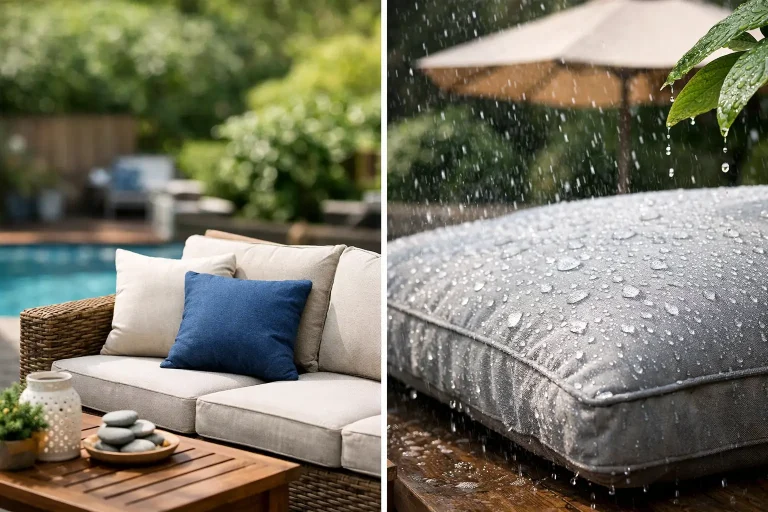
If rain exposure is expected, specify how the cushion should behave: quick-dry for fast turnover, or water-shedding for occasional storms with protected storage. Quick-dry performance depends on the full build: fabric breathability, foam type, wrap, and the ability for water to drain.
For pool and coastal environments, mildew resistance becomes a design requirement. Specify for it directly, and confirm that the fabric finish is compatible with your cleaning plan. Mildew resistance in the lab can be undone by poor ventilation on site or cushions stored damp in a closed room.
Treat cleanability as a contract requirement
Hospitality operators do not have time for precious fabrics. If your fabric spec cannot be maintained with the chemicals and processes the site will actually use, it will be replaced early.
Document cleaning expectations in the spec: spot cleaning, periodic deep cleaning, and what happens after sunscreen season. Confirm whether the fabric tolerates diluted bleach solutions where appropriate, and whether stain resistance is inherent (fiber-based) or finish-based.
Also specify the texture and weave in relation to cleaning. Highly textured weaves can trap sand and debris on rooftops and pool decks, increasing labor. Smooth, tight constructions clean faster, but can show surface scuffs sooner depending on use. It depends on the property’s staffing model and how intensively the seating is used.
Don’t skip abrasion, seam performance, and zipper details
Abrasion numbers get attention, but outdoor wear is often more about seams, edge wear, and the way a cushion is handled daily.
For commercial use, confirm abrasion performance using a recognized method and define the duty cycle: a resort lounge chair that is moved, stacked, and cleaned daily is harder on seams than a residential sofa under a covered patio.
Seam slippage matters for tailored looks, especially on tighter seat decks and box cushions. If you are specifying thin piping, sharp corners, or high-crown cushions, you are increasing stress at the seams. Ask for construction guidance that aligns with the fabric’s stability.
Zippers and closures are a small line item that cause outsized headaches. Specify corrosion-resistant hardware for coastal properties and choose zipper placements that support maintenance without exposing closures directly to UV and splash zones.
Align fabric with fire, indoor-outdoor adjacency, and compliance
Projects often include semi-outdoor spaces and indoor-outdoor transitions where compliance expectations change. If the fabric is being used in areas that may be inspected under commercial codes, you need clarity on flammability performance and the documentation your team will hand over.
The key is consistency: don’t approve a fabric for outdoor lounge and then discover you cannot use it on adjacent covered seating that is treated as an interior by the authority having jurisdiction. This is where early coordination with procurement and your supplier prevents change orders later.
Build a spec package that procurement can execute
A fabric spec is only useful if it is orderable, repeatable, and defensible when substitutions are proposed.
At minimum, your package should include the exact fabric name and code, colorway, width, pattern direction if applicable, and whether the fabric is for cushion, sling, or strap applications. You also want the performance documentation that matters to your project – UV/colorfastness, cleaning guidance, mildew resistance, abrasion method, and any compliance certificates required.
If you are standardizing across multiple sites, add an alternates strategy. Define what counts as an acceptable alternate (same fiber class, same test thresholds, same color tolerance) and what does not. This gives procurement speed without compromising design intent.
Approvals that reduce risk: swatches, mock-ups, and real-light review
Digital renderings are great for alignment, but outdoor fabric approval should happen in physical reality.
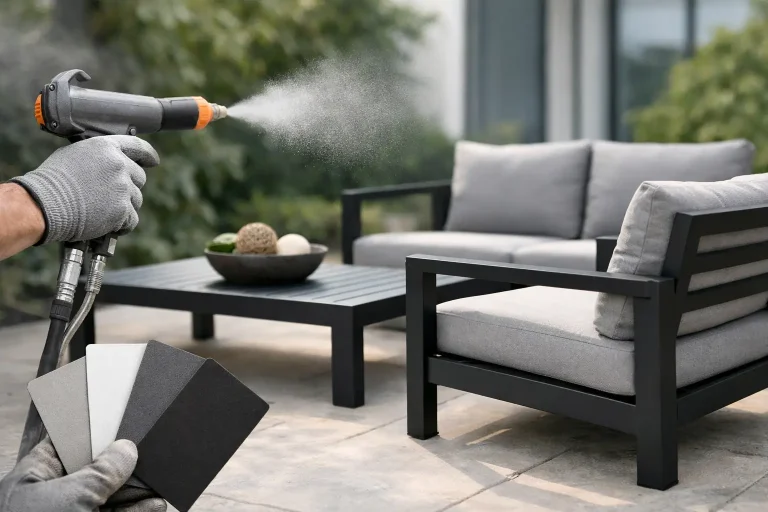
Approve a larger cutting when color is critical, and view it in the actual light conditions where it will live. Sunlight on a rooftop reads differently than shaded light under a pergola, and adjacent materials – teak, powder coat, stone – shift perception.
Mock-ups are where comfort and tailoring get validated. Cushion loft, wrinkling, corner behavior, and how the fabric sits after compression are all easier to judge on a real build than on a swatch. For high-volume programs, a single mock-up can prevent hundreds of units of avoidable rework.
If you need help turning design intent into an executable fabric and cushion spec with drawings and approval steps, PNZ Space Global supports projects with 3D visuals, material options, and mock-up approvals through its vertically integrated production team at https://www.pnzspace.com.
Common spec traps (and how to avoid them)
One trap is specifying a beautiful fabric that performs outdoors, but pairing it with an indoor cushion build. If water cannot drain and foam cannot dry, the fabric will be blamed for a system problem.
Another is approving a fabric based on a showroom swatch and then ordering a large run without confirming dye lot control and lead time. Outdoor programs often require consistency across elevations and phases. Make dye lot expectations explicit.
A third is forgetting the operational reality of the site. If the property uses strong cleaners, your fabric must tolerate them. If staff stacks cushions daily, specify construction and closures that can take handling.
The best fabric specs are not the ones with the most claims. They are the ones that anticipate the way the space will actually be used.
If you want your outdoor environment to look intentional on opening day and still look intentional after a season of heat, cleaning, and guest traffic, specify fabrics like you specify everything else in a contract project: with measurable performance, clear documentation, and an approval process that matches the scale of the order.