Choosing a Hospitality Outdoor Furniture Supplier
A hotel terrace rarely fails because of the concept. It fails when lead times slip, finishes arrive inconsistent, cushions break down under UV exposure, or five separate vendors create five separate problems. That is why choosing the right hospitality outdoor furniture supplier is less about filling a product list and more about protecting the entire project schedule, brand standard, and guest experience.
For hospitality buyers, outdoor furniture is operational infrastructure. It has to perform in heat, wind, chlorinated environments, coastal air, and heavy daily use while still presenting the right visual standard for a rooftop lounge, pool deck, beach club, restaurant patio, or resort villa. The supplier behind that furniture matters as much as the furniture itself.
What a hospitality outdoor furniture supplier should actually deliver
At the hospitality level, supply is not just about inventory. It is about specification control, manufacturing consistency, and the ability to manage complexity from design intent through installation. A dependable partner should be able to support the full scope of an outdoor program – lounge seating, dining tables and chairs, sun loungers, daybeds, umbrellas, side tables, and accessories – without forcing the procurement team to coordinate disconnected sources.
That breadth matters because outdoor projects are rarely purchased one category at a time. A resort expansion may need poolside furniture, shaded dining settings, bar-height seating, and villa terraces furnished under one deadline. A restaurant group may need a repeatable package for multiple sites. A mixed-use development may need different aesthetics across hospitality, residential, and amenity zones while keeping materials and maintenance standards aligned.
In those cases, a supplier with a large SKU base and in-house control creates a real advantage. It reduces substitution risk, shortens approval cycles, and gives designers more room to maintain a coherent visual language across the property.
Why vertical integration changes project outcomes
Not every supplier manufactures what they sell. Some act mainly as resellers, which can work for simple purchases but often introduces gaps when projects become large, custom, or time-sensitive. A vertically integrated hospitality outdoor furniture supplier has stronger control over production planning, quality checks, finish consistency, and delivery timing.
For procurement teams, this matters in practical ways. If a finish sample needs adjustment, if cushion density must be changed for a commercial application, or if dimensions need to be refined to fit a rooftop footprint, direct coordination with a manufacturer-backed supplier is faster and more accountable. There are fewer handoffs, fewer version-control issues, and less uncertainty around what can actually be produced at scale.
Factory scale matters too. A supplier supported by a substantial manufacturing footprint, modern machinery, and skilled artisans is better positioned to handle both custom requests and high-volume output without losing control of quality. That becomes especially valuable for phased openings, multi-site rollouts, and projects where outdoor spaces are critical revenue areas rather than afterthoughts.
Design support is not a luxury in hospitality procurement
Outdoor hospitality projects move faster when design and procurement are aligned early. That is why services such as 3D drawings, mock-up approvals, material swatches, and in-house design consultation are not extras. They are tools that reduce risk.
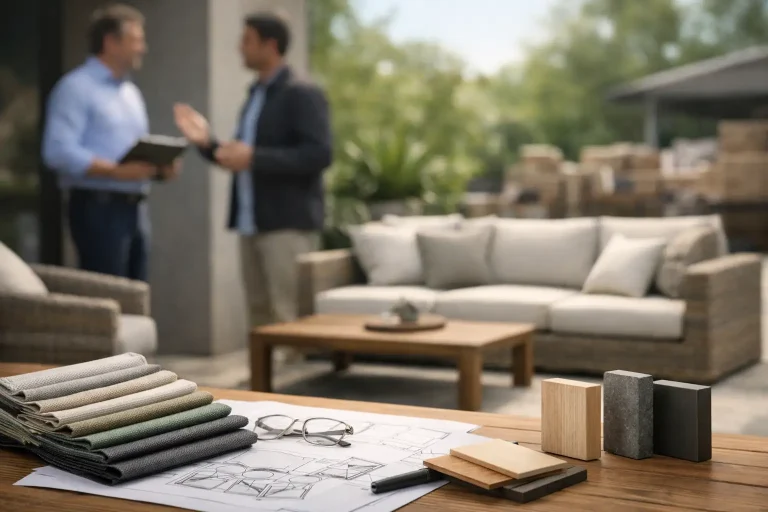
A 3D layout helps operators and designers validate circulation, spacing, and furniture density before orders are locked. Mock-up approvals help confirm comfort, construction, and finish quality in real terms, not just on a spec sheet. Material swatches help teams assess fabric, frame, and tabletop options against sun exposure, cleaning protocols, and the broader interior-exterior palette.
This is where a service-led supplier stands apart. If the team can support selection, visualization, revision, and approval in one process, the project moves with fewer surprises. That saves time during submittals and helps avoid expensive corrections later.
Contract-grade means more than durable-looking
Many outdoor products look suitable for hospitality use until they are exposed to actual hospitality traffic. Contract-grade furniture should be specified for frequent use, environmental exposure, and long-term maintainability. That includes frame strength, weather-resistant finishes, UV-stable materials, commercial-grade fabrics, and construction methods that hold up under repeated cleaning and movement.
The right supplier should be able to speak clearly about materials, not vaguely. Powder-coated aluminum, synthetic wicker, teak, rope detailing, performance upholstery, HPL surfaces, and outdoor-rated foams each have a place, but not every material fits every project. A beachfront venue has different demands than a shaded private courtyard. A pool deck has different cleaning and moisture exposure than a rooftop dining terrace.
There is no single best material for every hospitality project. There is only the right material for the setting, usage pattern, and maintenance reality. A good supplier helps buyers make that call before the order is placed, not after wear patterns appear.
Where buyers should push harder during supplier evaluation
A catalog can look impressive and still leave major execution questions unanswered. Hospitality buyers should evaluate how a supplier performs under pressure, not just how the products photograph.
The first question is capacity. Can the supplier fulfill volume consistently? Can they support repeat orders for future phases or replacement needs? A large and growing product range is useful, but only if it is backed by dependable production planning.
The second question is process. How are approvals handled? Who manages revisions? What happens if quantities shift late in the cycle? How are packing, freight coordination, and site delivery managed? Outdoor projects often fail in these transitions, especially when the supplier is not set up for contract work.
The third question is communication. Hospitality timelines compress quickly. Procurement teams need fast answers, accurate lead times, and visibility on manufacturing status. A supplier that responds well during quoting but becomes vague after deposit creates risk the project cannot absorb.
The fourth question is after-delivery consistency. Multi-property operators and developers need repeatability. If one property opens successfully, the supplier should be able to reproduce that standard for the next site with the same dimensions, finishes, and quality level.
The benefit of a one-stop outdoor program
For many hospitality projects, consolidating categories with one supplier is the simplest way to reduce procurement friction. Instead of managing separate vendors for dining, lounge, pool, shade, and accessories, the buyer can work through one coordinated source with one approval path and one logistics structure.
That approach improves more than convenience. It can also improve planning accuracy. When one supplier understands the full outdoor scope, they can flag conflicts early, recommend compatible materials across zones, and help standardize details that support both aesthetics and maintenance.
This is particularly useful for projects that need a clean handoff from concept to completion. A single-source outdoor package supports design consistency while reducing the administrative load on project managers and procurement teams. For GCC and international projects where timing and freight coordination are critical, that operational clarity has real value.
A hospitality outdoor furniture supplier should support brand positioning too
Outdoor furniture is part of how hospitality brands signal quality. Guests notice whether a pool lounger feels stable, whether a dining chair remains comfortable through a long meal, and whether terrace furniture still looks sharp after months of service. Operators notice whether maintenance teams are constantly chasing repairs and replacements.
The supplier has a direct role in that outcome. Design-forward product matters, but so does the discipline behind it – production control, finish consistency, swatch accuracy, and white-glove delivery that protects the installation standard on arrival.
A supplier like PNZ Space Global is built for that level of execution because the model combines in-house design support, vertically integrated manufacturing, broad outdoor categories, and project-focused logistics under one operation. For hospitality buyers sourcing at scale, that structure removes friction where it usually starts.
What the best partnerships look like in practice
The strongest supplier relationships are not purely transactional. They are operational partnerships. The buyer brings the project vision, brand requirements, and commercial targets. The supplier brings product range, technical guidance, manufacturing capacity, and delivery discipline.
When that relationship works, approvals move faster, substitutions decrease, timelines become more predictable, and properties open with fewer last-minute compromises. That is the real measure of a strong hospitality outdoor furniture supplier – not just whether they can provide furniture, but whether they can help deliver an outdoor environment that performs from day one and keeps performing after the opening buzz fades.
If you are sourcing for a hotel, resort, restaurant, or multi-site hospitality rollout, the smartest question is not who has the nicest catalog. It is who can carry the project from specification to final placement without losing control of quality, timing, or brand intent.