Commercial Outdoor Sectionals That Last
A rooftop lounge can look fully resolved on a rendering and still fail on site if the seating cannot handle traffic, climate, and daily operations. That is why commercial outdoor sectionals are rarely just a styling decision. For hospitality groups, developers, designers, and procurement teams, they are a specification choice that affects layout efficiency, maintenance load, guest experience, and replacement cycles.
In commercial settings, sectionals do more than fill space. They define conversation zones, anchor pool decks, soften large terraces, and help operators create high-value seating areas without custom millwork. The right configuration can increase flexibility across a property. The wrong one can create service bottlenecks, premature wear, and inconsistent aesthetics from one site to the next.
What makes commercial outdoor sectionals different
Residential outdoor seating is often selected for short-term visual impact. Commercial outdoor sectionals have a different job. They need to maintain structure, finish, and comfort under repeated use, frequent cleaning, and exposure to sun, moisture, and temperature swings.
That starts with frame engineering. Contract-grade aluminum remains a common choice because it balances strength, corrosion resistance, and manageable weight for operational teams. In high-humidity or coastal environments, material quality and coating process matter as much as the base metal itself. A sectional that looks similar in photos can perform very differently after a year outdoors.
Cushion construction also separates commercial specification from retail buying. Foam density, drain-through capability, fabric performance, and zipper quality all affect lifecycle cost. If cushions retain water, fade quickly, or lose shape after one season, the seating becomes a visual liability. For hotels, restaurants, and shared amenity spaces, that decline shows up fast.
Then there is joinery and modular stability. A sectional used in a villa terrace may stay in one place for months. A sectional in a hospitality venue may be moved for events, cleaning, or seasonal reconfiguration. Modules need secure connectors, consistent dimensions, and enough structural integrity to perform both as a composed set and as individual pieces when needed.
Where commercial outdoor sectionals perform best
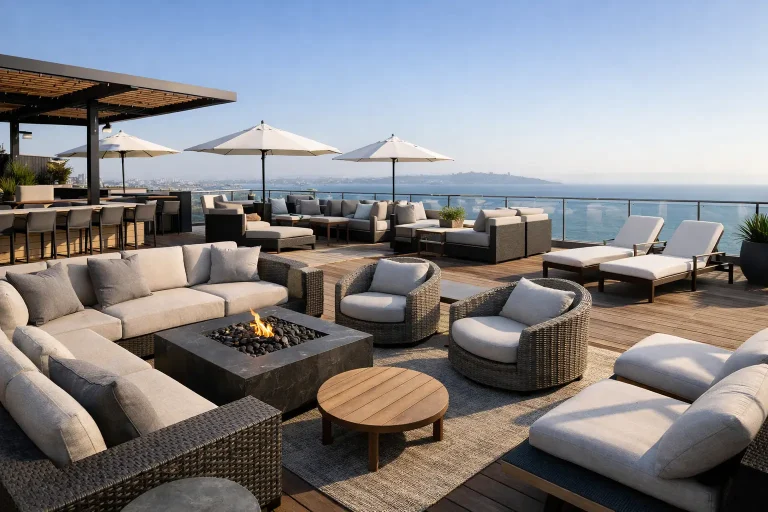
These collections are especially effective in spaces where flexibility and footprint control matter. Rooftop lounges are a clear example. Designers often need to create a premium social atmosphere while working around columns, parapets, and circulation paths. Modular sectionals allow tighter planning than fixed sofas and can be scaled to suit both compact and expansive layouts.
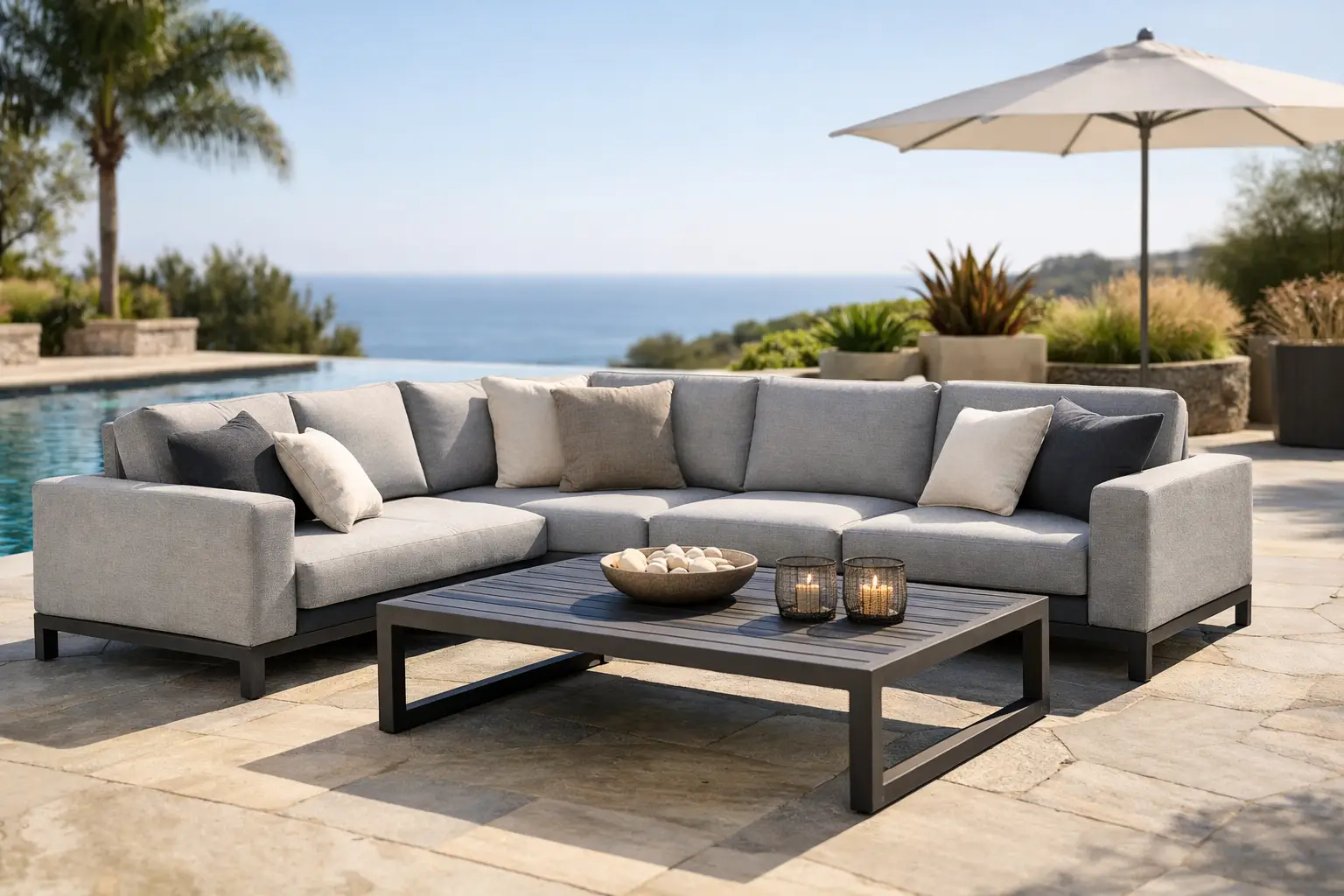
Poolside environments are another strong fit, but they require more scrutiny. Water exposure, sunscreen residue, and intensive cleaning create a punishing operating environment. In this case, low-maintenance finishes and quick-drying upholstery are not upgrades. They are practical requirements.
For hotel courtyards, serviced residences, branded residential projects, and restaurant terraces, sectionals help define zones without hard partitions. That makes the space feel intentional while keeping it adaptable. Developers and operators usually value that balance because usage changes over time. A quiet lounge area during soft opening may later need to support events, overflow dining, or group seating.
How to specify sectionals for project performance
The first question is not style. It is usage intensity. A sectional for a high-turn food and beverage terrace should be specified differently from one intended for a semi-private residential clubhouse. Traffic levels, cleaning frequency, food service exposure, and sun orientation all influence the right product.
Dimensions come next, and this is where many projects lose efficiency. Oversized modules can look impressive in a showroom but reduce real seating capacity once circulation clearances are applied. Commercial planning requires a sharper lens. You need enough depth for comfort, enough arm and back support for long stays, and enough clearance for staff movement, side tables, and accessibility.
Modularity should be evaluated beyond aesthetics. Corner units, armless modules, chaises, ottomans, and end pieces create planning freedom, but only if the system is standardized and repeatable. Procurement teams managing multiple properties usually benefit from families of modules that can be configured differently while keeping a consistent visual language.
Finish and fabric selection should also be treated as operating decisions. Lighter fabrics may support a resort look but can raise cleaning demands. Darker tones can hide stains better, though they may absorb more heat in direct sun. Textured weaves often add depth, but they should still be easy to maintain and aligned with the property’s service reality.
Design flexibility matters, but standardization matters too
Many commercial buyers want customization, and for good reason. Outdoor spaces are increasingly expected to express brand identity, especially across hospitality and mixed-use projects. Tailored dimensions, finish options, and fabric palettes can help a sectional collection feel site-specific rather than generic.
At the same time, too much variation can complicate procurement and after-sales support. If every property uses a different module depth, cushion spec, or frame finish, reorders become slower and replacements become harder to match. The better approach is usually controlled flexibility – a core sectional platform with selected customization points that support design intent without increasing operational friction.
This is where vertically integrated suppliers offer a practical advantage. When design, manufacturing, mock-up review, and project fulfillment are coordinated under one system, buyers gain better visibility into what can be customized, what should stay standardized, and how lead times will be affected.
Why procurement teams look beyond the product itself
Commercial outdoor sectionals are not purchased in isolation. They sit inside a broader project workflow that includes concept development, approvals, shipping schedules, site access, and installation sequencing. A strong product with weak execution can still put the project at risk.
That is why experienced buyers assess supplier capability as carefully as the furniture itself. Can the vendor support material reviews and finish alignment early enough to avoid late changes? Can they provide drawings or mock-up approvals for large orders? Can they produce at volume without introducing inconsistency across batches or locations?
For GCC and international projects, logistics discipline matters even more. Outdoor furniture often lands close to opening dates, when site teams are already managing a compressed schedule. Delays, packaging issues, or incomplete shipments create immediate pressure. Suppliers with manufacturing control, documented production capacity, and white-glove delivery support are better positioned to protect timelines.
PNZ Space Global works well in this environment because the offering is not limited to product supply. The value is in end-to-end coordination – from design consultation and 3D drawings to manufacturing, material flexibility, and project delivery at scale.
Common mistakes when buying commercial outdoor sectionals
The most common mistake is buying on appearance alone. A clean silhouette and attractive fabric story may win initial approval, but if the sectional lacks commercial-grade construction, the property will absorb the cost later through repairs, replacements, and reputation.
Another mistake is underestimating maintenance. Some materials look premium on day one but require too much care for high-use venues. Others perform well structurally yet feel too residential for a commercial brand standard. The right balance depends on the setting, the service model, and the level of use.
There is also a planning mistake that shows up often in larger projects: specifying sectionals too late. When outdoor seating is treated as a final furnishing layer rather than part of the spatial strategy, teams lose opportunities to optimize layouts, accessory coordination, and circulation. Sectionals affect how people gather, how staff move, and how adjacent pieces such as lounge chairs, fire tables, and shade solutions should be placed.
A smarter way to buy for scale
The strongest sectional programs are built with repeatability in mind. That means selecting collections that can flex across villas, rooftop lounges, resort terraces, and pool decks while maintaining a coherent look and predictable lead time. It also means working with a supplier that can support broader outdoor categories so the seating does not feel disconnected from dining, poolside, and accessory selections.
For architects, designers, and procurement leaders, the goal is not simply to source a sectional. It is to specify a system that performs visually, operationally, and commercially over time. That requires clear product taxonomy, credible factory capacity, dependable communication, and enough customization to support the project without compromising delivery.
Commercial outdoor spaces are judged quickly. Guests notice comfort. Operators notice maintenance. Owners notice replacement cycles. When commercial outdoor sectionals are specified with that full picture in mind, they stop being a soft-goods decision and become a smarter asset for the property.