Commercial Parasol Review Guide for Buyers
A parasol that looks right on a rendering can fail fast on a live site. The issue is rarely style alone. In a real commercial setting, shade systems deal with wind uplift, chlorine exposure, repeated opening cycles, cleaning chemicals, and guests who do not use them gently. That is why a commercial parasol review guide matters most at the specification stage, before procurement locks in the wrong frame, base, or canopy grade.
For hospitality operators, developers, and design teams, the goal is not simply to buy shade. It is to specify a parasol that matches the use case, survives the environment, and fits the service model of the property. A rooftop lounge, a beachfront restaurant, and a pool deck may all need umbrellas, but they should not be reviewed by the same criteria.
How to use this commercial parasol review guide
Start with site performance, not catalog photography. A good review process asks four practical questions first: how often the unit will be opened and closed, what kind of wind exposure the area gets, how much clearance is available around furniture layouts, and who will maintain it after installation.
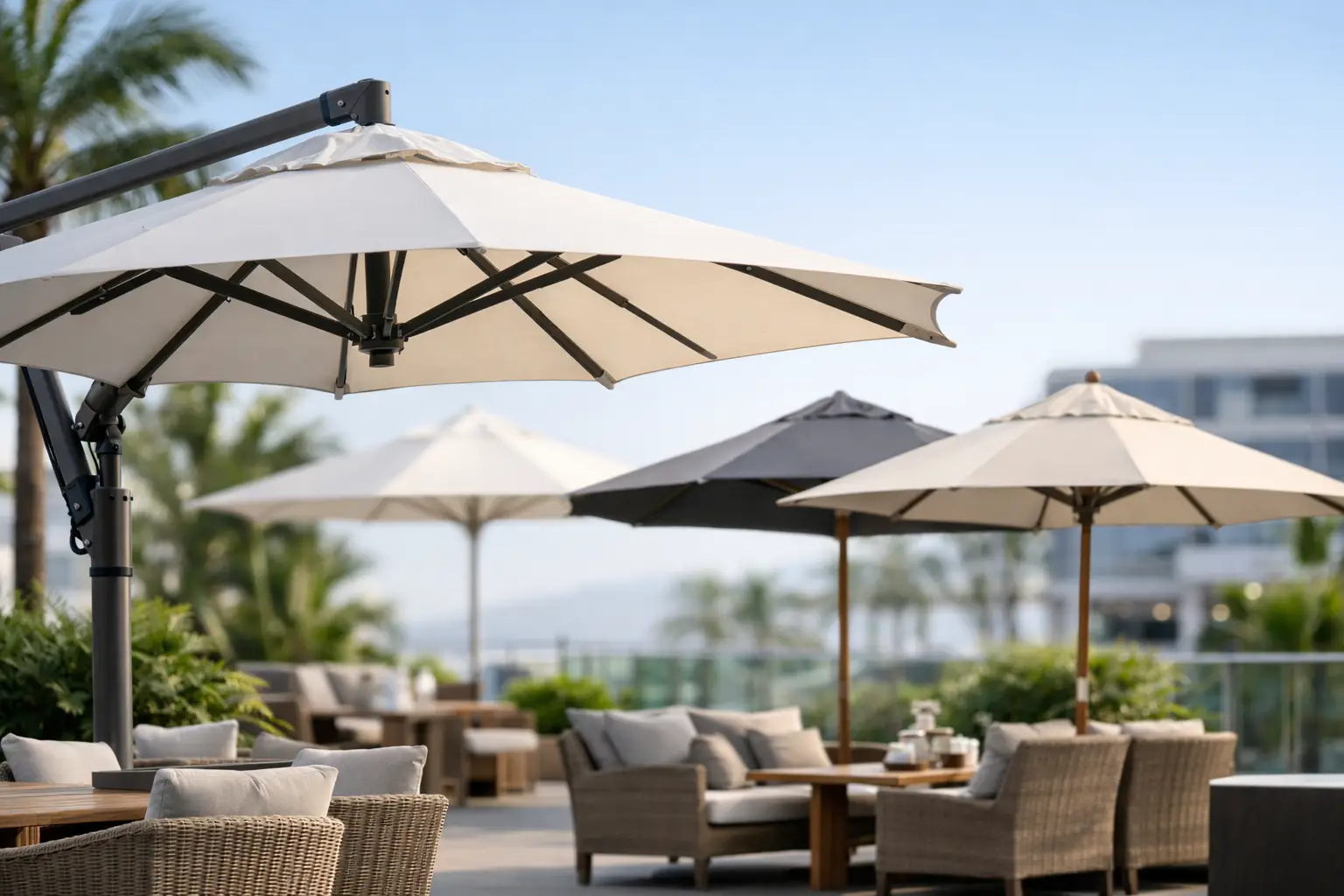
This changes the buying conversation immediately. A center-pole parasol may be the right answer for compact café tables, while a cantilever system may serve premium lounge seating better by keeping the footprint clear. Neither is universally better. The correct choice depends on circulation, service access, and the visual hierarchy of the space.
Frame construction is where commercial quality starts
In commercial parasol evaluation, frame material deserves more attention than most buyers give it. Aluminum is typically the strongest all-around option for hospitality and contract use because it balances corrosion resistance, manageable weight, and structural stability. Powder-coated aluminum also gives specifiers cleaner control over finish consistency across larger projects.
Wood can still be appropriate, especially for properties pursuing a warmer or more residential look. But wood requires a stricter maintenance culture and tighter climate matching. In high-humidity, poolside, or coastal settings, it often creates more upkeep than operators expect. If the property team does not have the labor discipline to inspect and maintain it properly, wood becomes a design decision with an operational cost attached.
Fiberglass ribs are worth considering in wind-prone areas because they flex better than rigid alternatives. That flexibility can improve resilience, but only if the rest of the frame is engineered to the same standard. A strong rib on a weak hub does not solve much.
Canopy fabric should be reviewed like an exterior material
Too many umbrella decisions come down to color swatches alone. In practice, canopy performance should be reviewed the same way you would review outdoor upholstery or awning fabric. UV stability, water resistance, fade resistance, mildew behavior, and cleanability all affect lifecycle value.
Solution-dyed acrylic remains a strong benchmark for commercial work because it holds color well and performs reliably in sun-heavy environments. Polyester can reduce upfront cost, but the trade-off often appears later in fading, surface wear, and a shorter replacement cycle. For a low-traffic café with seasonal use, that may be acceptable. For a resort terrace or hotel pool deck, it usually is not.
Stitching and edge reinforcement matter just as much as the fabric itself. A premium canopy material can still underperform if the seams are weak or the corners are poorly finished. Review the full assembly, not just the textile specification.
Base systems are not an accessory
If there is one part of a commercial parasol review guide that gets underestimated, it is the base. In procurement terms, the base is not an add-on. It is a structural component that directly affects safety, code compliance, and long-term usability.
Freestanding bases work well where layout flexibility is important, but they need to be correctly sized for canopy span and local wind conditions. Underspecifying base weight is a common project mistake, especially when buyers want a cleaner look or easier movement. That decision can create liability fast.
Built-in anchoring or floor-fixed solutions often make more sense for rooftops, exposed decks, and high-traffic hospitality zones. They reduce shifting, improve stability, and support a more permanent furniture plan. The trade-off is lower flexibility if the layout changes later. For operators who reconfigure often, that matters. For fixed-concept dining and pool programs, stability usually wins.
Opening mechanism affects labor and guest experience
Commercial buyers should review how the parasol opens, closes, and rotates with the same seriousness they give to finish and color. A parasol used twice a day across dozens of units creates real labor demand. Poor mechanisms slow staff down, increase wear, and lead to rough handling.
Manual pulley systems can be fine for smaller spans and lower-use settings. Crank systems offer better control and are often more practical at scale. For larger cantilever models, the quality of the tilt and rotation hardware becomes especially important because these moving parts carry more stress over time.
If staff need excessive force to operate the umbrella, damage tends to follow. A smooth mechanism is not a luxury feature. It is part of operational efficiency.
Wind performance needs honest review
Every buyer asks whether a parasol is wind rated. Fewer ask under what conditions, with what base, and in what configuration. That distinction matters. Wind performance claims are only meaningful when reviewed against the exact installation method and canopy size being specified.
An umbrella that performs well in a sheltered courtyard may not be suitable for a rooftop or waterfront venue. This is where project support becomes valuable. Reviewing shop drawings, furniture layouts, and base options together leads to better decisions than selecting from a product sheet in isolation.
For exposed commercial sites, it is worth planning operating protocols as part of the purchase decision. The best parasol for the project may still need to be closed at a certain wind threshold. That does not mean the product is weak. It means the operator is managing risk correctly.
Design fit still matters, but it should follow function
A well-specified parasol should support the design language of the space without creating procurement friction. Shape, valance detail, edge profile, finish color, and canopy tone all contribute to the guest impression. But these should be layered onto a sound performance specification, not used to replace one.
Square canopies often suit modern hospitality layouts because they align efficiently over modular seating and dining grids. Round profiles can feel softer and more classic, especially in resort or café settings. Cantilever formats create a premium visual effect and free up usable floor space, but they require more engineering discipline and more room for safe operation.
This is where vertically integrated suppliers have an advantage. When design, manufacturing, and project coordination are connected, it becomes easier to adjust finish options, material details, and layout requirements without losing timeline control.
What commercial buyers should compare before approval
A productive review compares parasols across six categories: frame material, canopy grade, base engineering, operating mechanism, maintenance demand, and site fit. If one option is cheaper, identify exactly where the savings come from. Sometimes it is a smart value decision. Sometimes it means thinner aluminum, lighter bases, lower-grade fabric, or hardware that will not hold up under daily use.
For large projects, consistency matters as much as individual product quality. A parasol may look acceptable as a sample piece but become difficult at scale if lead times vary, finish matching is inconsistent, or replacement parts are hard to source. Buyers specifying across hotels, restaurants, villas, or multi-site developments should review replenishment capability before approval, not after the first damage claim.
This is also where PNZ Space Global’s model aligns well with commercial shade procurement. For teams managing broader outdoor packages, a supplier with in-house design support, mock-up capability, manufacturing control, and white-glove delivery can reduce coordination risk across the full site, not just the umbrella line item.
Red flags in any commercial parasol review guide
Be cautious when a supplier cannot clearly explain wind guidance, base requirements, or fabric composition. Be equally cautious when product dimensions are clear but structural details are vague. Commercial shade should be specified with the same discipline as other contract-grade outdoor products.
Another red flag is a parasol that photographs well but has no practical service plan behind it. Canopies may need replacement. Hardware may need maintenance. Finishes may need touch-up coordination. If a product cannot be supported after installation, the initial purchase price becomes less relevant.
The best parasol is rarely the cheapest and rarely the most elaborate. It is the one that fits the site, the operating model, and the lifespan expectations of the project. Buyers who review shade through that lens make better decisions, protect the visual intent of the space, and avoid expensive replacement cycles later.
When you are specifying for commercial use, treat the parasol as working infrastructure with a design role – not as décor with a base attached. That shift in mindset usually leads to the right product faster.