How to Source Outdoor Furniture Bulk
A rooftop launch gets delayed, a resort opening slips, or a villa package stalls for one simple reason – the outdoor furniture order looked easy on paper and became complicated in production. That is why knowing how to source outdoor furniture bulk matters long before you compare unit prices. For developers, procurement teams, designers, and hospitality operators, the real job is not just buying product. It is securing specification control, predictable lead times, and consistent quality across every site.
What bulk sourcing actually involves
When buyers talk about bulk purchasing, they often mean volume pricing. In practice, sourcing at scale is a project management decision as much as a purchasing one. You are balancing design intent, weather performance, freight planning, packaging, compliance, installation sequencing, and after-sales support.
That is especially true for outdoor environments. Lounge seating for a pool deck, dining sets for a restaurant terrace, and shaded pieces for a rooftop each face different wear conditions. Sun exposure, humidity, coastal air, guest turnover, cleaning chemicals, and storage habits all affect what should be specified. A supplier that only quotes product may not be enough. A supplier that can support drawings, mock-up approvals, finish selection, and delivery coordination usually reduces friction across the entire project.
How to source outdoor furniture bulk without creating delays
The fastest way to create problems is to start with aesthetics alone. Visual direction matters, but commercial outdoor furniture has to perform. A good sourcing process begins with the site, the use case, and the quantity breakdown.
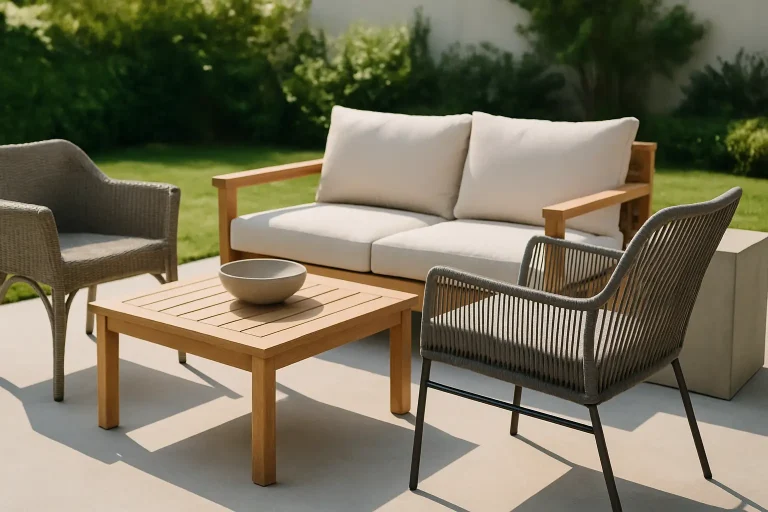
Start by defining each furniture zone clearly. Separate your project into lounge, dining, poolside, shade, and accessory requirements. Then document how each area will be used. A hotel pool deck with daily guest traffic needs a different frame, fabric, and cushion construction than a private terrace. A cafe with frequent chair movement may need stackable or lightweight options, while a luxury residential development may prioritize a broader finish palette and customized dimensions.
Once the functional brief is clear, align it with procurement realities. That means confirming target quantities, delivery phases, budget bands, storage constraints, and installation windows. If the project is opening in stages, the sourcing plan should reflect that. Some items may need to ship earlier than others. Some sites may require white-glove delivery because access is tight or installation has to happen around active operations.
Evaluate suppliers beyond the catalog
A broad catalog is useful, but it should not be the only reason you choose a supplier. Bulk sourcing depends on operational control. You need to know who is designing the product, who is producing it, how quality is checked, and how delivery is managed.
Ask whether the supplier is vertically integrated or coordinating through multiple external factories. That difference affects consistency and speed. When design, manufacturing, and logistics sit closer together, changes move faster and approval cycles are easier to control. It also becomes easier to standardize quality across a large order or repeat a specification for future phases.
Capacity matters just as much as design. A supplier with meaningful factory scale, skilled production teams, and a proven record of high-volume delivery is better positioned to absorb large orders without compromising timeline or finish consistency. This is where buyers should look for concrete proof – manufacturing footprint, SKU depth, production capability, and evidence of fulfilled projects at similar volume.
Communication is another filter that gets overlooked. Bulk orders do not fail only because of bad product. They fail because approvals were unclear, substitutions were not flagged, packaging was not planned, or updates arrived too late. A dependable supplier communicates like a project partner, not just a sales channel.
Material selection is where good sourcing gets serious
If you want to know how to source outdoor furniture bulk professionally, spend more time on materials than on mood boards. Outdoor performance is tied directly to frame construction, surface finish, upholstery specification, and hardware quality.
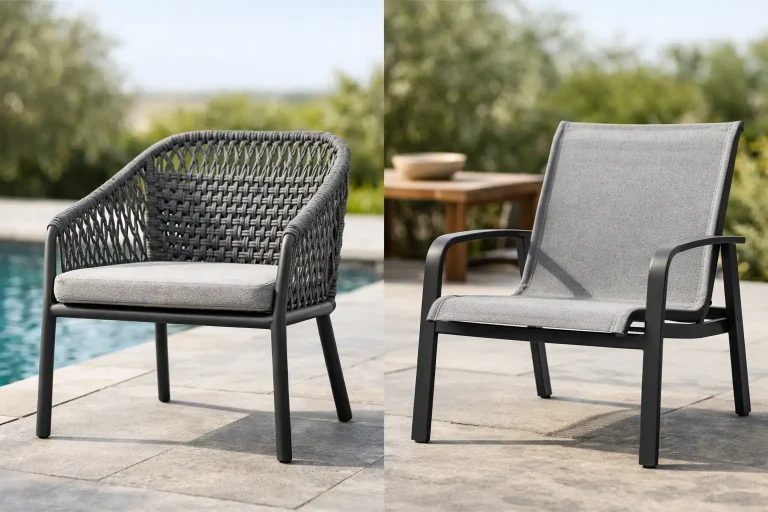
Powder-coated aluminum is often the practical choice for many commercial and residential projects because it balances durability, corrosion resistance, and manageable weight. Teak can be the right fit when natural aging is acceptable or desired, but clients should understand the maintenance trade-off. Synthetic wicker can work well in the right setting, provided the fiber quality and weave consistency are up to commercial use. Rope details, sling constructions, ceramics, sintered stone tops, and performance fabrics all bring different advantages, but they must match the environment they are entering.
This is where coastal and poolside installations need extra scrutiny. Salt air, chlorinated water, and intense UV exposure will expose weak specifications quickly. Cushions that look full and refined in a showroom can underperform outdoors if foam density, drainage, or fabric treatment is not right. The best sourcing decisions are specific. Not just beige cushions, but solution-dyed fabric with the right cleanability, fade resistance, and drying performance for the project.
Use drawings and mock-ups to reduce risk
For large orders, approval by image alone is rarely enough. That approach works until seat heights feel wrong, table scales look undersized, or material tones clash under daylight on site. Serious bulk sourcing benefits from drawings, finish samples, and mock-up approvals before final production.
This is especially valuable for mixed-use and hospitality projects where multiple stakeholders are involved. Designers need confidence in the visual direction. Procurement teams need pricing discipline. Operators need furniture that works in service. A 3D review or physical mock-up helps align all three before the order is locked.
It also protects repeatability. Once the approved specification is documented properly, future phases become easier to execute. That matters for developers furnishing multiple properties or operators standardizing brand environments across locations.
Price should be analyzed as a project cost, not a unit cost
Bulk buyers are trained to compare price, but unit price alone is a poor decision tool. Lower upfront pricing can become expensive when products arrive damaged, finishes vary between batches, or installation teams lose time correcting avoidable issues.
A better approach is to compare total procurement value. That includes packaging quality, lead time reliability, customization capability, replacement part support, freight coordination, and how much internal project management your team still has to do after placing the order. A one-stop supplier with broad outdoor categories can often reduce hidden cost because fewer handoffs mean fewer errors.
There is also a practical advantage in consolidating categories. If lounge, dining, shade, and accessories are sourced through separate vendors, your team inherits the coordination burden. Finish matching becomes harder. Delivery windows compete. Claims take longer to resolve. For many commercial projects, the best savings come from reducing complexity, not only from negotiating lower piece pricing.
Plan logistics early, not after production
Many furniture orders are considered complete once production begins. In reality, logistics can determine whether the project feels successful. Bulk outdoor orders require packaging discipline, loading plans, delivery sequencing, and realistic site access review.
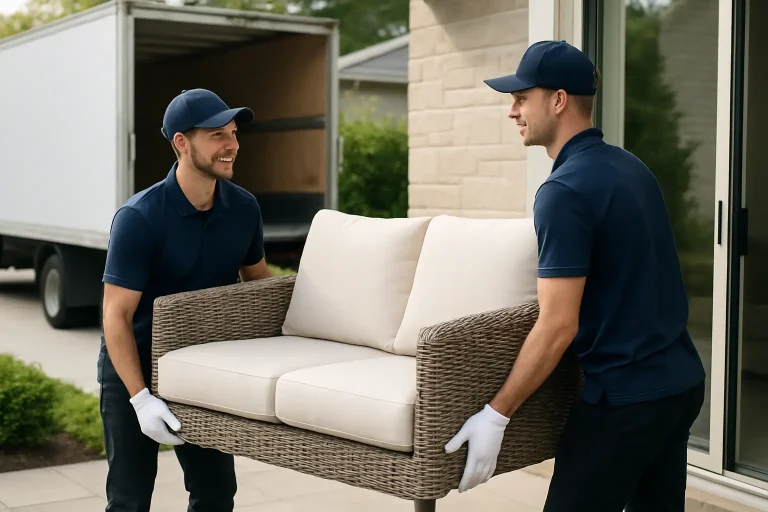
Ask early how products will be packed, labeled, and delivered. Are items assembled, semi-assembled, or flat-packed? Will the site receive by zone, by item type, or by installation sequence? Is there a need for white-glove delivery, debris removal, or placement support? These questions matter when projects include towers, resorts, rooftops, or multi-villa developments.
International and multi-site projects need even tighter control. Customs timing, final-mile coordination, and phased unloading should be part of the sourcing conversation before the order is approved. The strongest suppliers think through delivery as part of execution, not as an afterthought.
What experienced buyers look for before they commit
The best buyers ask a simple question: if something changes, can this supplier absorb it? Changes happen. Quantities shift, finishes get revised, approvals take longer than expected, and opening dates move. A capable partner responds without losing control of quality or schedule.
That is why experienced procurement teams look for a combination of design support, manufacturing depth, and delivery discipline. They want broad product coverage, but they also want a supplier that can provide material flexibility, produce at scale, and maintain communication throughout the order lifecycle. For many projects, that level of control is what separates a smooth rollout from weeks of avoidable rework.
PNZ Space Global operates in that lane by combining contract-grade outdoor categories with in-house design support, mock-up approvals, factory-scale production, and project-led fulfillment. For buyers managing larger outdoor environments, that integrated model usually creates more certainty than stitching together multiple vendors.
Bulk sourcing works best when every decision serves the full project – not just the purchase order. If your supplier can hold the line on specification, timing, and execution, the furniture does more than fill a space. It helps the project open the way it was intended to.