How Long Does Custom Outdoor Furniture Take?
If you are furnishing a rooftop lounge, pool deck, restaurant terrace, or multi-villa development, the question is rarely whether to customize. It is how long does custom outdoor furniture take when approvals, finishes, production slots, and site deadlines all need to line up. The short answer is that most custom outdoor furniture programs take anywhere from 6 to 16 weeks, but the real answer depends on scope, materials, engineering complexity, and how quickly decisions move on the client side.
For procurement teams and design firms, that range matters. A simple finish adjustment on an existing frame can move much faster than a fully bespoke hospitality collection with mock-up approval, COM coordination, and phased delivery across multiple sites. The more accurately you define the project early, the more predictable the schedule becomes.
How long does custom outdoor furniture take in practice?
In practice, the timeline usually breaks into four stages: design alignment, technical approval, manufacturing, and logistics. Smaller customizations on standard catalog pieces may sit closer to the 6 to 8 week mark. Full custom programs often land in the 10 to 16 week range, especially when they involve new tooling, multiple material combinations, or large order volumes.
This is why experienced buyers do not ask for one blanket lead time. They ask what is being customized, how much of it is new, and which approvals are required before production can start. A custom powder coat color is one timeline. A new sectional system engineered for coastal hospitality use is another.
What actually determines the timeline?
The biggest factor is the level of customization. If the product already exists and the request is limited to a fabric swap, sling color, tabletop finish, or cushion detail, production tends to move faster because engineering is already complete. The factory is adapting a proven product rather than creating one from the ground up.
When the request includes custom dimensions, altered frame geometry, new weaving patterns, or mixed-material construction, additional technical work is required. That can include CAD revisions, load review, material sourcing, and prototype confirmation. For architects, developers, and hospitality operators, this stage is where lead times are won or lost.
Order size also changes the answer. A custom run for a small private terrace may fit into the line more quickly than a resort-wide package covering lounge seating, dining, poolside furniture, shade solutions, and accessories. Larger projects benefit from production scale, but they also demand more planning, more QA checkpoints, and more shipping coordination.
The early stage most buyers underestimate
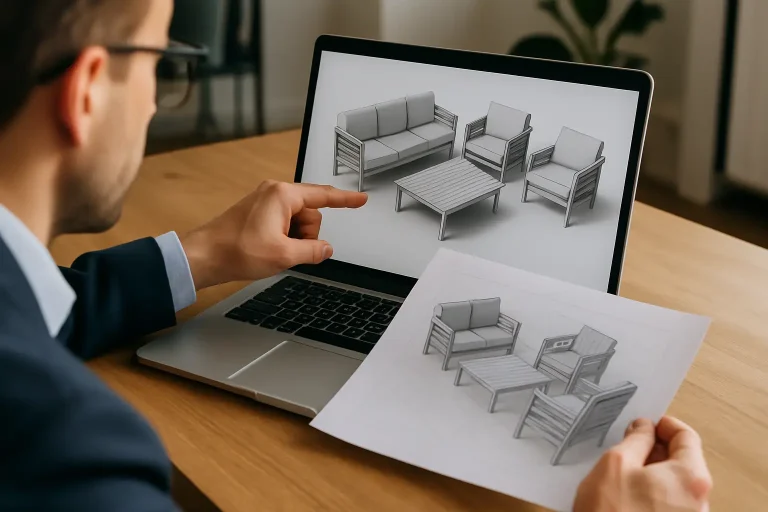
Many delays happen before manufacturing begins. Design development, shop drawing review, 3D render approval, swatch confirmation, and mock-up signoff can add days or weeks depending on the speed of communication. If five stakeholders are reviewing each change, the calendar stretches even when the supplier is ready.
This is especially true on commercial and hospitality projects, where spec compliance matters as much as appearance. Seat height, cushion density, finish performance, UV resistance, stackability, and maintenance requirements all need to be aligned early. Rushing this step can create bigger delays later if approved details need to be reopened.
A vertically integrated supplier has an advantage here because design, manufacturing, and project coordination sit closer together. Instead of passing information across multiple vendors, the team can move from concept review to technical validation more efficiently. That does not eliminate approval time, but it reduces handoff friction.
Typical lead times by type of custom request
Not every custom order should be treated as a bespoke manufacturing project. If you are specifying at scale, it helps to separate light customization from full custom development.
A light customization usually includes changes like fabric selection, finish options, tabletop materials, cushion specifications, or matching an existing design language across outdoor categories. These requests are often more predictable because the frame platform already exists. In many cases, this can be completed in roughly 6 to 10 weeks.
A moderate customization may involve dimension changes, material substitutions, adapted joinery, or hospitality-specific performance upgrades. This often pushes the timeline into the 8 to 12 week range, depending on sampling and approvals.
A full custom program usually includes original design work, new engineering, mock-up development, revised prototypes, and larger-scale production planning. For these projects, 10 to 16 weeks is common, and highly complex programs may run longer.
Why material selection can speed things up or slow them down
Material choice is not just a design decision. It is a schedule decision.
Aluminum programs with standard powder coating options are often easier to plan because the raw material and production process are well established. Custom rope colors, specialty teak grading, sintered stone tops, custom glass, and specialty outdoor upholstery can add sourcing and quality-control time. If a project calls for unusual finishes or mixed materials across categories, each component may have a different readiness date.
For GCC and international projects, climate performance also matters. Buyers may request higher UV stability, corrosion resistance, marine-grade hardware, or contract-grade cushions suited to heavy turnover. These are smart decisions, but they can require more technical review and procurement coordination.
The right approach is not to avoid customization. It is to customize selectively, where it adds value without creating unnecessary schedule risk.
How to keep a custom outdoor furniture project on schedule
The fastest projects are usually the most disciplined, not the least customized. Clear specifications at the beginning reduce back-and-forth later. That means confirming dimensions, finishes, fabric direction, quantities, packaging requirements, compliance needs, and delivery phasing before production is booked.
It also helps to consolidate categories under one supplier when possible. If lounge, dining, pool, and accessory pieces are being coordinated together, a single project team can manage finish consistency, production sequencing, and delivery alignment. That is often more efficient than splitting the package across multiple vendors with separate lead times and approval chains.
For larger projects, mock-up approvals should happen on a fixed calendar. If mock-ups are requested, decision-makers should already know who signs off and what criteria they are using. Open-ended review cycles are one of the most common causes of delay.
Another practical move is to distinguish between must-have custom elements and nice-to-have changes. If a finish match is critical to the brand concept, prioritize it. If an optional detail adds complexity without meaningful project value, it may be worth standardizing.
The role of factory capacity and operational control
When buyers ask how long does custom outdoor furniture take, they are often really asking whether the supplier can control the variables. Factory scale, in-house production capability, QA structure, and logistics management all shape the answer.
A supplier with real manufacturing depth can generally provide better schedule visibility because production, finishing, assembly, and inspection are managed within one operating system. That matters even more for multi-site developments and hospitality rollouts, where partial deliveries, replacement contingencies, and installation timing need to be coordinated carefully.
PNZ Space Global approaches this from a vertically integrated model, which is exactly what complex procurement programs require. With in-house design support, 3D drawings, mock-up coordination, and large-scale manufacturing capacity, the process is built to support both customization and delivery discipline. For buyers managing specifications across multiple outdoor zones, that operational control is often the difference between a planned launch and a missed opening.
When should you start the process?
Earlier than most teams think. If the furniture is tied to a hotel opening, seasonal launch, or handover milestone, custom development should begin as soon as the layout and design intent are reasonably stable. Waiting for every site detail to be perfect often creates more pressure than clarity.
A good rule is to start supplier discussions while the project is still in the design validation phase. That gives enough time for drawings, material recommendations, budget alignment, and manufacturing planning before the deadline becomes urgent. It also creates room for smart substitutions if one material or detail threatens the schedule.
Custom outdoor furniture does not have to be slow. It has to be managed with the same discipline as any other critical package. The teams that get the best result are the ones that treat lead time as a design, production, and logistics question all at once.