Developer Bulk Furniture Sourcing Example
A missed furniture decision rarely looks serious in week one. By week twelve, it can hold up mock-up approvals, delay handover, and push procurement teams into expensive substitutions. That is why a strong developer bulk furniture sourcing example matters – not as a theory piece, but as a working model for how large outdoor packages actually get specified, approved, produced, and delivered.
For developers, the challenge is rarely just finding furniture. It is coordinating design intent, durability standards, budget controls, and project timing across multiple areas at once. A rooftop lounge does not have the same functional demands as a pool deck. A hospitality terrace does not carry the same wear profile as private villa balconies. Bulk sourcing works when those differences are managed early, not when they are discovered after purchase orders are already in motion.
A practical developer bulk furniture sourcing example
Consider a mixed-use residential and hospitality project with 180 apartments, 12 penthouses, a shared podium deck, two pool areas, a restaurant terrace, and furnished show units. The developer wants one supplier to support the outdoor package across all these zones to reduce coordination risk. The brief includes lounge seating, dining sets, sun loungers, umbrellas, side tables, daybeds, and accessories, with a target installation window tied to phased handover.
At first glance, this sounds like a standard volume buy. It is not. The project has different stakeholders with different priorities. The design team wants a cohesive look across the property. Procurement wants pricing discipline and clean documentation. Operations wants materials that can withstand heavy use, sun exposure, and routine cleaning. The developer wants all of it delivered without schedule drift.
In a successful sourcing model, the first step is not product selection. It is scope definition. That means breaking the project into furniture packages by zone, use case, and performance requirement. The shared pool deck may need contract-grade loungers with quick-dry cushions and easy-maintenance frames. The penthouse terraces may allow for more customized finishes. The restaurant terrace may need tighter table spacing and chair weights that balance stability with ease of movement.
Without that zoning exercise, teams often over-specify low-traffic areas and under-specify commercial ones. Both create cost problems. One wastes budget. The other creates replacement cycles much sooner than expected.
What the sourcing process needs to solve
A real developer bulk furniture sourcing example should show how decisions get made under pressure. In large projects, furniture sourcing must solve for four things at once: specification control, approval speed, production capacity, and delivery sequencing.
Specification control matters because outdoor furniture is exposed to weather, cleaning chemicals, and repeated use. Materials, finishes, foam density, fabric performance, and hardware quality all affect lifecycle value. If one item is approved based on appearance alone, and another based on engineering and finish testing, the package becomes inconsistent. Developers pay for that inconsistency later in maintenance complaints and replacement requests.
Approval speed matters because furniture is often treated as a late-stage item, even when it should be locked earlier. If 3D drawings, material swatches, and mock-up reviews are not part of the process, decisions get delayed until stakeholders can physically compare options. That creates bottlenecks. A supplier that can support design consultation and pre-production approvals shortens that cycle significantly.
Production capacity matters because a well-priced quote is meaningless if the supplier cannot manufacture at volume while maintaining finish consistency. This is where vertical integration changes the equation. When design, manufacturing, and quality oversight sit within one operating structure, there is less room for disconnect between what was approved and what gets produced.
Delivery sequencing matters because furniture does not arrive to a blank canvas. Sites are still closing out construction, common areas may open in stages, and storage conditions are not always ideal. A supplier that can align deliveries with installation windows reduces damage risk and avoids site congestion.
How the example works in practice
In this example, the developer creates a master furniture schedule by zone. The supplier then groups products into four practical categories: lounge, dining, pool, and accessories. That sounds simple, but it improves decision-making because each category can be reviewed against its own technical and commercial criteria.
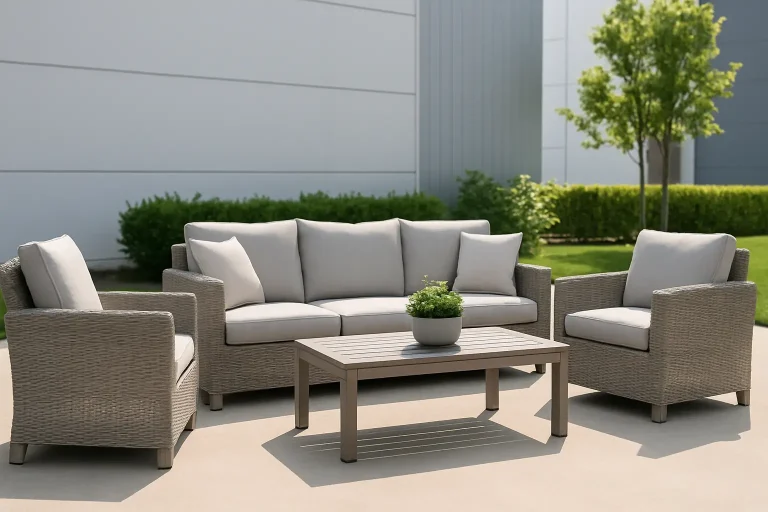
The lounge package covers rooftop seating clusters, podium social spaces, and penthouse terraces. Here, the design team prioritizes profile, comfort, and finish palette. Procurement focuses on frame material, lead time, and volume pricing. The supplier responds with coordinated collections that allow visual consistency without forcing every space into identical layouts.
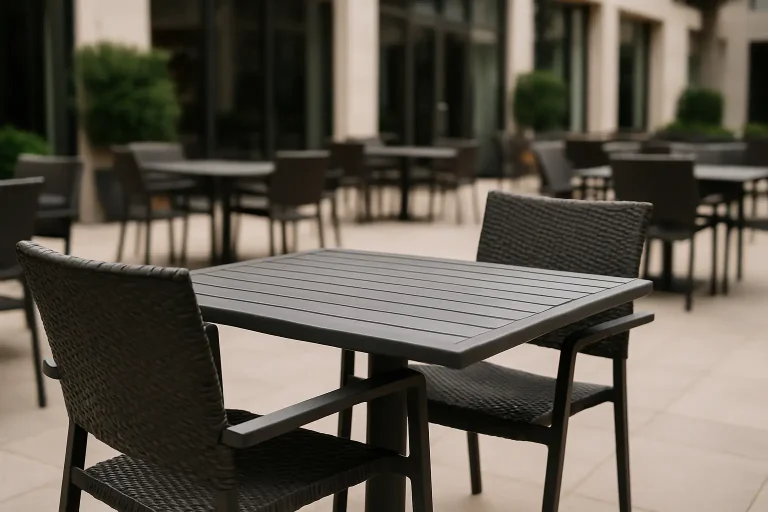
The dining package serves restaurant terraces, private balconies, and communal dining zones. In these areas, dimensions and stacking or movement requirements become more important. The best sourcing outcome is often not the most dramatic design. It is the one that preserves circulation, withstands frequent use, and can be reordered later if the operator expands capacity.
The pool package requires the most discipline. Sun loungers, side tables, umbrellas, and shaded daybeds need commercial-grade performance, especially around water and chemical exposure. Cushions need fast-dry construction. Frames must resist corrosion. Replacement parts and repeatability matter more here than one-off styling flourishes.
Accessories often get value-engineered too aggressively, but they affect the finished environment more than teams expect. Planters, side tables, storage pieces, and decorative outdoor elements should be treated as part of the operating package, not as afterthoughts. In many projects, these smaller items are also where last-minute substitutions create the most visible inconsistency.
Where projects usually go off track
The weak point in bulk furniture procurement is usually not price negotiation. It is fragmented decision-making. One team approves aesthetics, another reviews budget, and a third raises technical concerns after samples are already signed off. That sequence creates rework.
A better process ties approvals together. The supplier issues 3D layouts or zone-based visuals, presents material options with clear performance notes, and provides mock-up pieces or sample sets before full production. This gives the developer one coordinated approval path instead of multiple disconnected ones.
Another common problem is treating all units and amenities as though they should receive the same furniture specification. That is rarely efficient. A show unit, a rental apartment terrace, and a high-exposure hospitality deck have different priorities. Standardization helps, but over-standardization can hurt both budget and function. The right answer is usually a controlled mix of repeatable core items and selective customization.
Why supplier structure changes the outcome
This is where many sourcing examples become too generic. They describe choosing products, but not the operating model behind them. For developers managing large outdoor packages, supplier structure matters as much as catalog range.
A vertically integrated supplier can offer tighter control over drawings, material selection, sample approval, production planning, and quality consistency. That is especially important when orders include multiple finish options, phased deliveries, or project-specific modifications. It reduces the lag between design intent and manufacturing execution.
It also creates accountability. If the same partner supports concept development, mock-up approval, factory production, and final delivery coordination, there are fewer handoff failures. For procurement teams, that means fewer surprises. For developers, it means a better chance of hitting opening dates with the right product installed in the right sequence.
For firms sourcing at scale across villas, hospitality terraces, rooftop lounges, and pool environments, a partner with manufacturing depth and project support services can materially reduce risk. That is one reason buyers working on complex outdoor programs often look to suppliers such as PNZ Space Global, where product breadth and operational control sit under one roof.
What this example shows developers clearly
The lesson in any useful developer bulk furniture sourcing example is straightforward: volume alone does not create efficiency. Structured specification does. Projects move faster when outdoor furniture is handled as a coordinated package with design review, technical validation, and delivery planning built in from the start.
That approach also protects value. Lower unit cost can look attractive early, but if it introduces approval delays, uneven quality, or poor fit across zones, the total project cost rises elsewhere. Developers do better when they compare not just product price, but sourcing capability, customization control, and delivery reliability.
The strongest outdoor furnishing programs are not built on reactive purchasing. They are built on a clear package strategy, contract-grade product discipline, and a supplier model that can support complexity without slowing the job down.
If you are planning a large outdoor package, the smartest early move is to define the zones, the performance standards, and the approval path before the first SKU is shortlisted. That single step tends to save more time than any negotiation that comes later.