Outdoor Furniture Procurement Guide for Developers
A rooftop launch slips by six weeks, and the delay is not caused by steel, glass, or paving. It is caused by outdoor seating that was specified too late, approved too slowly, or sourced from too many vendors. That is why an outdoor furniture procurement guide for developers matters early in the project, not after the landscape package is nearly closed.
Developers are not just buying chairs, loungers, and dining sets. They are buying timeline protection, specification control, and a finished environment that photographs well, performs in climate, and holds up under daily use. In multifamily, hospitality, F&B, and mixed-use projects, outdoor furniture procurement sits at the intersection of design intent, commercial durability, logistics, and installation sequencing. Get it right, and the outdoor area feels resolved. Get it wrong, and the punch list grows fast.
Why outdoor furniture procurement for developers starts with project intent
The procurement process should begin with a simple question: what is this outdoor space expected to do? A rooftop lounge for resident socializing has a different requirement than a hotel pool deck or a restaurant terrace turning tables at high frequency. Usage drives everything that follows, from material selection and cushion specifications to stacking needs, maintenance planning, and replacement strategy.
This is also where many projects drift into avoidable cost. A developer may approve a design language without aligning it to operational reality. Low-profile lounge seating may look strong in a rendering but perform poorly in windy rooftop conditions. Upholstered dining chairs may elevate the visual tone yet create maintenance pressure in high-turn hospitality settings. The right procurement approach balances aesthetics with performance from the beginning.
For that reason, the best procurement teams work in categories, not isolated items. Lounge, dining, poolside, shade, and accessories should be specified as part of a complete environment. That creates consistency in finish, scale, and lead time, and it reduces the friction that comes from managing multiple vendors across one site.
Build the specification before you request pricing
Developers often move to quote requests too early. Price matters, but price without a complete specification is not a reliable planning number. Before sourcing begins, the project team should define the commercial use case, target quantities, required dimensions, preferred materials, finish direction, stacking or storage needs, and any code or brand requirements.
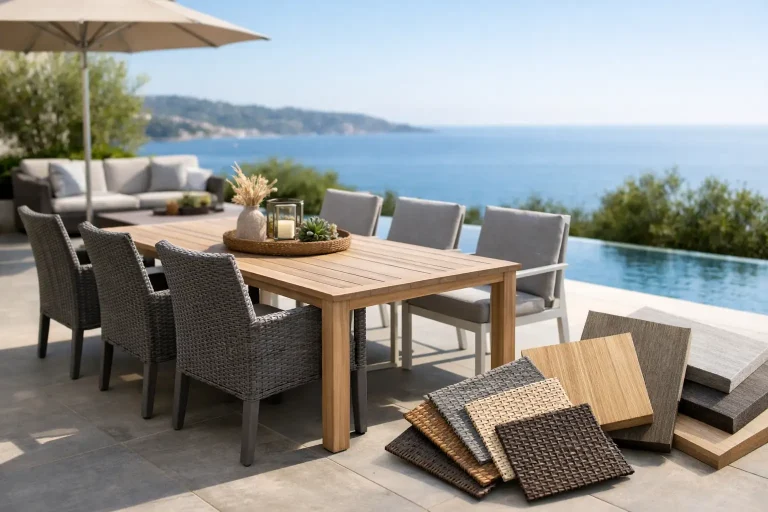
Material decisions deserve special attention. Powder-coated aluminum is often the practical default for many GCC and coastal-adjacent environments because it offers good corrosion resistance, manageable weight, and a broad finish range. Teak can add warmth and value perception, but it requires a clear maintenance strategy if the project wants to preserve original appearance. Synthetic wicker can work well in the right setting, especially for certain hospitality aesthetics, but quality varies widely, and not all woven products perform equally under heavy exposure. Sling and performance fabrics simplify drying and daily use, while thick cushions can improve comfort but increase operational upkeep.
A strong specification package should also address what buyers typically discover too late: cushion density, foam type, fabric grade, UV resistance, hardware quality, replaceable components, and packaging method for site delivery. These details affect lifecycle cost more than many developers expect.
The approval path is where schedules are won or lost
Most outdoor furniture delays do not happen at the concept stage. They happen in approvals. A finish is nearly right but not signed off. A mock-up is requested after production timing is already tight. A consultant asks for an updated drawing once quantities are locked. None of this is unusual, but it does need structure.
For larger developments, a disciplined approval path should include 3D drawings or product visuals, material swatches, finish confirmation, and where needed, a physical mock-up or mock set. This is especially important when multiple stakeholders are involved, including developer teams, architects, operators, and owners. The goal is not just signoff. The goal is preventing interpretation gaps between design intent and delivered product.
This is where a vertically integrated supplier has a practical advantage. When design support, manufacturing control, and project coordination sit under one roof, there are fewer handoff points and fewer opportunities for version confusion. That matters when approvals need to move quickly and changes still need to be absorbed without derailing the program.
Outdoor furniture procurement guide for developers: choose suppliers for control, not just catalog depth
A large catalog is useful, but it is not enough. Developers should evaluate suppliers based on operational control. Can the supplier support contract-grade requirements at scale? Can they produce consistent finishes across lounge, dining, and pool categories? Can they manage custom dimensions or material adjustments if the design team needs them? Can they commit to realistic delivery windows and support installation sequencing?
This is where procurement gets more strategic than product selection. A one-stop supplier can reduce coordination complexity, but only if that supplier has the manufacturing depth and project discipline to handle volume. Factory footprint, machinery, skilled labor, quality checkpoints, SKU breadth, and delivery history are not background details. They are leading indicators of whether the supplier can execute under pressure.
Developers should also test communication structure before awarding. Ask who owns submittals, who manages approvals, who updates production status, and who coordinates delivery windows. A beautiful collection is less valuable than a clear escalation path when site conditions change.
Balance customization with schedule risk
Customization is attractive for branded residences, upscale hospitality, and signature amenities. It allows developers to align furniture with architecture, finish palettes, and market positioning. But custom work introduces decisions, and decisions take time.
That does not mean custom should be avoided. It means custom should be targeted. The smartest projects customize where it creates visible impact and use standardized pieces where performance and lead time matter more. For example, a developer might customize hero pieces for a lobby terrace or premium cabanas while keeping dining and poolside inventory within proven contract-grade lines.
This balance protects both design value and schedule integrity. It also simplifies replenishment later. If every item is fully bespoke, replacements can become expensive and slow. If the project mixes custom focal points with dependable core categories, long-term operations become easier to manage.
Logistics can erase good buying decisions
A strong buying decision on paper can still fail during delivery. Outdoor furniture arrives late, arrives in the wrong sequence, or arrives in packaging that does not suit site access. That is why logistics planning should be part of procurement, not a final-step conversation.
Developers should confirm delivery phasing based on construction readiness and storage realities. There is no benefit in shipping pool furniture before the deck is protected and accessible. The same goes for rooftop installations where lift planning, loading restrictions, and final access routes need to be coordinated in advance. White-glove delivery has real value in these scenarios because it reduces site friction and limits damage risk during the final handoff.
For multi-site or overseas programs, the margin for error gets smaller. Consistent labeling, packaging discipline, batch control, and delivery communication become essential. A supplier that has handled high-volume fulfillment before is usually better equipped to keep those variables under control.
Think in lifecycle cost, not unit cost
Procurement teams are always under pricing pressure, but outdoor furniture should be evaluated on total ownership cost. Lower first cost can create higher replacement frequency, more maintenance calls, and more visible wear in amenity spaces that help sell or operate the property.
The better question is not simply, what does this chair cost? It is, what will this seating program cost over three to five years under actual use? Contract-grade construction, replaceable parts, stronger finishes, and higher-quality fabrics may increase upfront spend while reducing disruption later. For hospitality and high-traffic residential assets, that trade-off is often worth making.
This is also where standardization helps. If a project uses a coordinated assortment from a capable supplier, replenishment becomes more predictable. Finish matching is easier. Spare parts are easier to source. Future phases can stay aligned with the original visual strategy.
What a dependable procurement process looks like
The most effective outdoor furniture programs follow a simple rhythm. First, define how each outdoor zone will be used and what performance level it needs. Next, build a specification package detailed enough for accurate pricing and informed review. Then move through drawings, swatches, and mock-up approvals without leaving key decisions open. After that, align production and logistics with the site schedule, not the other way around.
For developers managing complex projects, the real advantage is not just finding product. It is reducing variables. That is why many buyers prefer a supplier that can support design consultation, provide 3D drawings, manage mock-up approvals, manufacture at scale, and execute delivery with accountability. PNZ Space Global is built around that model because large projects do not need more vendor noise. They need control.
Outdoor spaces are rarely treated as secondary by buyers, operators, or residents. They are photographed first, used heavily, and judged quickly. Procure them with the same discipline you apply to core building packages, and they will perform like part of the asset, not an afterthought.