Outdoor Furniture Supplier for Property Developers
A rooftop amenity deck can photograph beautifully at handover and still become a warranty problem six months later. Cushions fade, frames corrode, replacement pieces do not match, and procurement teams end up managing issues that should have been solved before the first PO was approved. That is why choosing the right outdoor furniture supplier for property developers is less about filling a schedule of quantities and more about protecting timelines, specifications, and long-term asset value.
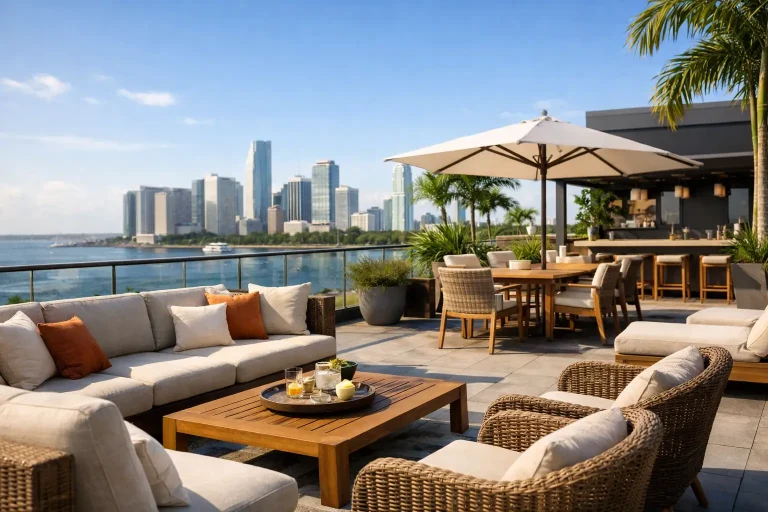
For developers, outdoor furniture sits in a difficult category. It is visible enough to shape first impressions, but technical enough to create expensive downstream problems when the supplier is not built for contract work. Residential towers, hospitality-branded residences, mixed-use projects, villas, resort pools, and rooftop lounges all demand a supplier that can move from concept to installation without losing control of quality or delivery.
What property developers actually need from a supplier
At project level, furniture decisions are rarely just about style. The brief usually includes brand alignment, durability in a harsh climate, budget discipline, compliance with the design intent, and a delivery schedule tied to practical completion. A supplier that only sells product is often not enough.
Developers typically need a partner that can support specification work early, adjust finishes during review, and maintain consistency across larger quantities. If the project includes multiple outdoor zones such as poolside seating, dining terraces, shaded lounges, balconies, and accessories, the value of working with a single source increases quickly. It reduces coordination across vendors and lowers the risk of mismatched lead times.
This is where vertical integration matters. When the supplier designs, manufactures, and distributes under one operating structure, there is usually better control over material choices, production scheduling, mock-up approvals, and final delivery. That does not eliminate every risk, but it does create more accountability.
How to evaluate an outdoor furniture supplier for property developers
A strong supplier should be measured on operating capability as much as product appearance. Good catalogs are easy to find. Reliable execution at scale is not.
Start with manufacturing control. If a supplier is dependent on a shifting network of third-party factories, every revision can create delays. Material substitutions, finish inconsistencies, and uncertain lead times become more common. By contrast, a vertically integrated operation can usually provide clearer answers on what is feasible, what needs engineering review, and how long production will actually take.
Next, look at category breadth. Developers rarely procure only lounge chairs or only dining sets. Outdoor schemes often require coordinated lounge seating, dining furniture, poolside pieces, umbrellas or shade solutions, and accessories that bring consistency across shared spaces. A broader assortment helps preserve design cohesion while simplifying approvals and logistics.
Then consider project support. For contract buyers, support services are not extras. They are part of risk management. 3D drawings, mock-up approvals, material swatches, and design consultation help teams validate scale, finish, and usability before mass production begins. Those steps matter most when deadlines are tight and late changes are expensive.
Finally, assess logistics discipline. Outdoor furniture arrives late often enough to disrupt photography, leasing launches, hotel openings, and site readiness. White-glove delivery, installation coordination, and responsive communication are not soft benefits. They directly affect handover.
Design value has to survive real use
Developers are under pressure to create memorable amenity spaces. Buyers, tenants, guests, and investors all respond to outdoor environments that feel considered and complete. But the right look is only part of the job.
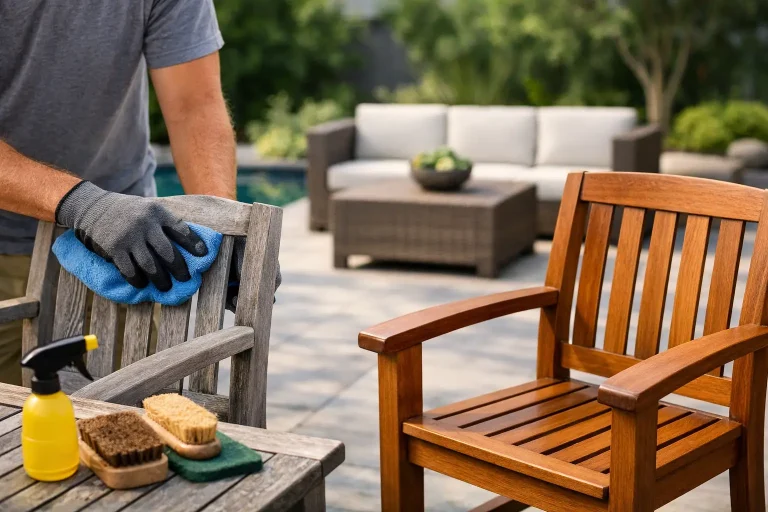
A contract-grade supplier should understand how furniture performs under repeated use, UV exposure, pool chemicals, coastal air, and cleaning protocols. Materials need to be chosen for the actual project conditions, not just a showroom floor. Aluminum may suit many applications because of its corrosion resistance and lighter handling. Teak can deliver warmth and visual richness, but maintenance expectations need to be clear. Rope, sling, and upholstery each offer different trade-offs in comfort, drainage, drying time, and wear.
There is no universal best material. A family-focused residential pool deck has different demands than a rooftop restaurant or a private villa terrace. The right supplier should be able to explain those trade-offs without overselling a single solution.
Why catalog depth matters on multi-zone projects
Outdoor spaces are now treated as core revenue and lifestyle assets, not leftover square footage. That shift has increased the need for suppliers with clear product taxonomy and scalable choice.
When a project includes lounge, dining, pool, and accessory packages, procurement becomes easier if all categories sit within one organized offering. Designers can build a consistent language across the property while procurement teams manage fewer approvals and fewer vendor relationships. It also becomes easier to phase deliveries by area instead of piecing together product from multiple sources.
Catalog depth also supports customization. Developers often need finish flexibility, fabric options, or dimensional adjustments to suit a branded concept or regional preference. Customization is valuable, but only if the supplier has the manufacturing discipline to deliver it without introducing chaos. A large SKU base paired with factory control is usually a stronger model than promising full custom work on every line item.
The real cost of choosing on price alone
Low unit pricing can look attractive during value engineering, especially when outdoor packages cover large common areas. But price-only decisions often ignore replacement risk, maintenance burden, and operational friction.
If a lower-cost supplier cannot maintain consistency across batches, later top-ups may not match the original install. If lead times slip, site teams absorb the pressure. If warranty claims are slow to resolve, operators inherit the problem after opening. Those costs rarely appear in the initial comparison sheet, but they affect the asset all the same.
Developers should instead look at total procurement value. That includes product life, approval support, packaging quality, shipping coordination, installation readiness, and the ability to reorder matching items. The right supplier may not always be the cheapest on a line-by-line basis, but often proves more efficient across the life of the project.
What good project support looks like in practice
The difference between an ordinary vendor and a dependable project partner usually appears before production starts. Strong suppliers ask sharper questions early. They want to understand traffic levels, intended users, climate exposure, maintenance teams, storage conditions, and opening dates.
From there, the process should become structured. Design consultation helps align furniture selections with the wider architectural and interior concept. 3D drawings allow stakeholders to review layouts and proportions before committing. Mock-up approvals reduce uncertainty on finish, feel, and construction details. Material swatches help procurement and design teams sign off with more confidence.
This kind of workflow is especially valuable for overseas or multi-site developments, where in-person review may be limited and decision cycles can involve developers, operators, consultants, and ownership groups. Clear documentation and consistent communication keep the project moving.
Why operational scale changes the outcome
Scale on its own is not a guarantee of quality. But controlled scale is a major advantage for developers furnishing large projects or multiple sites.
A supplier with substantial factory capacity, modern machinery, and skilled production teams is better positioned to handle volume without losing consistency. That matters when the requirement includes repeated furniture types across villas, amenities, hospitality zones, or phased rollouts. It also supports better forecasting and more realistic delivery commitments.
PNZ Space Global operates with this model in mind, combining a 20,000-square-meter factory, in-house design support, broad contract-grade categories, and project fulfillment capabilities for buyers who need more than product supply. For developers, that kind of structure simplifies procurement because design consultation, manufacturing oversight, mock-up review, and delivery coordination sit under one roof rather than across disconnected vendors.
Questions worth asking before you issue the order
Before awarding the package, developers should ask how the supplier manages specification changes, what lead times are based on actual capacity, how replacement parts or repeat orders are handled, and whether delivery includes site coordination. Ask for evidence of high-volume project execution, not just styled photography.
It is also worth testing responsiveness during the bid stage. The way a supplier communicates before award is often the best indicator of how they will perform when schedules tighten. Fast, accurate answers usually reflect a stronger operating backbone.
Outdoor furniture is one of the last categories installed, but one of the first things residents and guests notice. Treating it as a strategic package rather than a late-stage purchase tends to pay off in fewer site issues, stronger visual impact, and better long-term performance. The right supplier does not just furnish the space. They help the project open the way it was intended to.