Best Terrace Furniture for Restaurants
A busy terrace tells you very quickly whether the furniture spec was right. Chairs scrape too loudly, tabletops wobble during service, cushions hold heat, and suddenly a space that looked polished in a render starts working against staff and guests. Choosing the best terrace furniture for restaurants is less about chasing a style trend and more about specifying pieces that perform under real operating pressure.
For restaurant owners, hospitality groups, designers, and procurement teams, terrace furniture has to do several jobs at once. It needs to support turnover, withstand weather, align with the brand, and make layout planning easier rather than harder. That is why the strongest outdoor restaurant projects start with function first, then build the visual story around it.
What the best terrace furniture for restaurants needs to do
Restaurant terraces are high-contact environments. Unlike a private patio, they face daily movement, frequent cleaning, shifting occupancy, and a constant mix of sun, moisture, food service, and wear. The best terrace furniture for restaurants is contract-grade, easy to maintain, and built for repeat use over time.
That starts with structural integrity. Dining chairs need enough weight to feel stable without becoming difficult for staff to reset. Tables need bases that stay planted on uneven surfaces and tops that resist staining, fading, and thermal stress. Lounge pieces need to deliver comfort without expanding footprint so much that circulation suffers.
There is always a trade-off between visual lightness and commercial durability. A slim chair profile may look elegant in a rooftop setting, but if it cannot handle back-to-back service cycles, replacement costs rise quickly. On the other hand, overly heavy pieces can slow down operations and make seasonal reconfiguration expensive in labor.
Start with the dining zone, not the accessories
Most restaurant terraces succeed or fail at the dining layer. This is where revenue is generated, so furniture selection should begin with table formats, seating density, and service routes.
Dining tables that support turnover
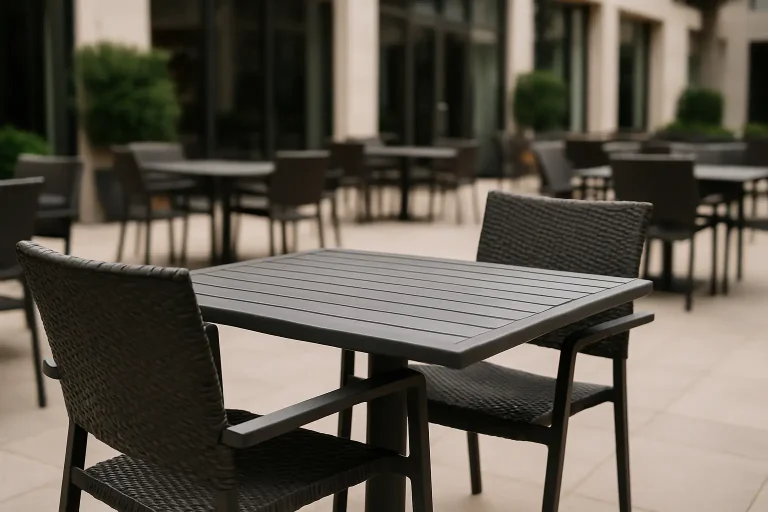
For primary dining areas, tables should be chosen around reset speed and flexibility. Square and two-top formats usually create the most efficient planning base because they can stand alone or be combined for larger parties. Round tops soften the layout and improve circulation in tighter footprints, but they can reduce planning precision if every inch matters.
Material choice matters just as much as shape. Sintered stone, compact laminate, treated aluminum, and high-performance ceramic-look surfaces tend to perform well in restaurant settings because they resist spills, sun exposure, and repeated cleaning. Natural wood can look excellent, but it often requires more maintenance discipline than operators expect, especially in humid or high-heat environments.
Chairs that balance comfort and stackability
A dining chair has to feel comfortable within seconds. Guests do not need residential softness, but they do need proper back support, stable seating, and arm clearance that works with the table height. Stackable designs often make the most operational sense for terraces because they simplify cleaning, event resets, and off-hours storage.
The right answer depends on the service model. A casual all-day dining terrace may benefit from lightweight aluminum or rope-accented chairs that move easily and dry fast. A fine dining terrace may require a more tailored upholstered look, but only if the fabric and foam package are built for outdoor commercial use. If upholstery is specified, removable covers and quick-dry construction are worth prioritizing.
Lounge seating works best when it has a clear business role
Many restaurants add lounge furniture because it looks inviting in photos. That is not enough reason to allocate square footage. Lounge seating performs best when it supports a defined use case such as pre-dinner drinks, rooftop bottle service, waiting zones, or a separate day-to-night hospitality program.
If the terrace is expected to convert between dining and social use, modular lounge systems offer more flexibility than fixed-format sofas. They allow operators to adjust layouts for events, group bookings, and seasonal traffic patterns. The caution is scale. Deep lounge seating can quickly reduce covers and complicate table service, so it should be placed where dwell time is intentional, not where turnover drives revenue.
Low coffee tables, side tables, and occasional pieces also need the same specification discipline as dining furniture. If they chip, stain, or shift too easily, the terrace loses its polished feel fast.
Material selection is where long-term value is decided
On restaurant terraces, material failure rarely happens all at once. It shows up gradually through fading, loose joints, corrosion, cushion distortion, and surface wear. That is why procurement teams should evaluate furniture by lifecycle performance, not just first cost.
Best-performing materials for commercial terraces
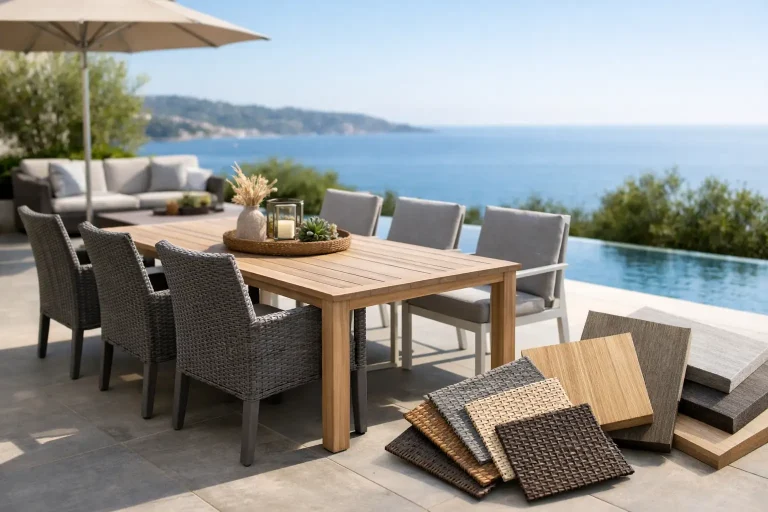
Powder-coated aluminum remains one of the strongest choices for restaurant use because it is lightweight, corrosion-resistant, and adaptable across dining and lounge categories. Synthetic rope and performance wicker can also work well when UV resistance and construction quality are properly controlled. Teak and other hardwoods bring warmth, but they need a maintenance plan and a clear expectation around weathering.
For cushions, quick-dry foam and solution-dyed outdoor fabrics are the baseline, not a premium add-on. Restaurant terraces cannot afford slow dry times or fabrics that lose color quickly. In hot climates, lighter fabric tones may stay visually fresher longer, but they can show food and beverage marks more easily. Darker tones hide stains better but can absorb more heat. It depends on the setting, service style, and cleaning protocol.
Layout efficiency is part of furniture specification
The best furniture choice can still underperform if the layout ignores service reality. Restaurant terraces need furniture dimensions that support both guest comfort and staff movement. This includes spacing between tables, chair pullback distance, and access routes for trays, bussing, and cleaning equipment.
Procurement decisions should be made with the floor plan open, not from the catalog alone. Standardized table sizes, coordinated chair footprints, and modular lounge dimensions make a terrace easier to scale across multiple sites. For hospitality groups and developers, that consistency has real value in replacement planning, warehousing, and brand control.
This is where project support matters. A supplier that can provide 3D drawings, mock-up approvals, material swatches, and practical planning input reduces avoidable mistakes before production and delivery. For larger restaurant groups, that level of control is not a bonus. It is part of risk management.
Shade and accessories should be planned as performance items
Terrace furniture does not perform in isolation. Shade solutions, side tables, planters, and lighting-adjacent accessories all influence how usable the space becomes across different dayparts.
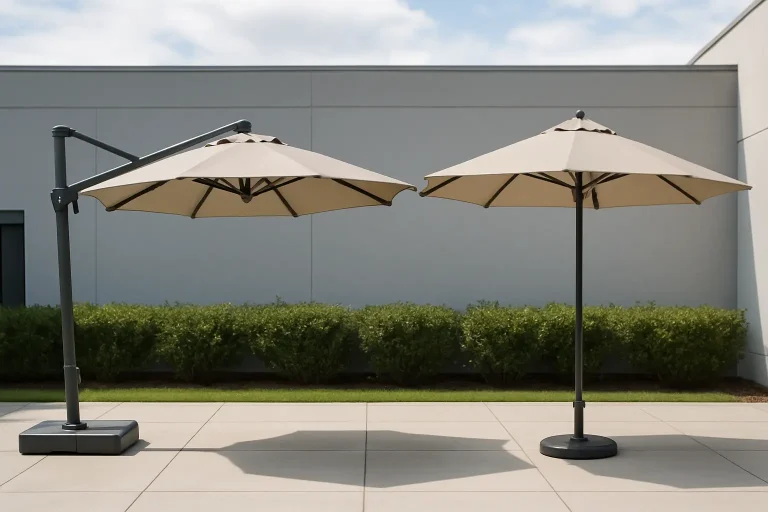
Umbrellas and shade structures should be coordinated with table placement and traffic flow from the start. A beautiful dining set under poor shade coverage will still underperform during lunch service or peak summer months. Likewise, accessory selection should support the operating model. Planters can help define zones and improve privacy, but oversized pieces can interfere with cleaning paths and sightlines.
Accessories should finish the terrace, not crowd it. In commercial projects, restraint usually creates a stronger result than over-layering.
How to compare suppliers for restaurant terrace projects
Furniture quality matters, but supplier capability matters just as much. Restaurants and hospitality groups are rarely buying one chair at a time. They are managing deadlines, approvals, freight coordination, installation windows, and often multiple stakeholders.
A strong supplier should offer contract-grade product breadth across dining, lounge, poolside, and accessory categories, along with clear specification data and finish options. Vertical integration adds another advantage because it improves control over production timelines, customization, and consistency. When a supplier can design, manufacture, and distribute under one operational structure, communication tends to be faster and execution more predictable.
PNZ Space Global fits this model well for buyers who need both design support and project-scale fulfillment. With in-house design services, 3D drawings, mock-up approvals, and a large manufacturing footprint, the process becomes more manageable for procurement teams that need accuracy and timely delivery at scale.
The best terrace furniture for restaurants is furniture that keeps working
There is no single universal set that qualifies as the best terrace furniture for restaurants. A compact urban terrace, a resort dining deck, and a rooftop lounge all ask for different proportions, materials, and seating strategies. What stays consistent is the selection standard: commercial durability, layout efficiency, comfort, maintainability, and supplier reliability.
The smartest restaurant terraces do not just photograph well on opening day. They continue to perform through weather, service pressure, and constant guest use without creating new problems for operations. If the furniture helps staff move faster, keeps guests comfortable, and holds its finish over time, it is doing exactly what it should.
When you specify terrace furniture like an operating asset rather than a decorative layer, the space becomes easier to manage, easier to scale, and far more likely to deliver value season after season.