Bulk Outdoor Furniture Pricing for Developers
A rooftop amenity deck can look fully resolved on paper and still miss budget by six figures once furniture is specified. That is why bulk outdoor furniture pricing for developers has to be evaluated as a project variable, not a line-item afterthought. The real number is shaped by product engineering, finish choices, freight planning, installation requirements, and how early procurement is brought into the development schedule.
For developers, the question is rarely, “What does one chair cost?” The better question is, “What is the total furnishing cost per space, per unit type, and per phase, and how much risk sits inside that number?” Outdoor packages for multifamily, hospitality, mixed-use, and residential communities behave differently than small retail purchases. They involve repeat quantities, specification control, weather exposure, brand standards, and turnover timelines that leave little room for sourcing mistakes.
What drives bulk outdoor furniture pricing for developers
The biggest pricing variable is specification depth. A powder-coated aluminum dining chair with contract-grade cushions, UV-stable rope, and stackable engineering will not price like a lightweight retail piece that only needs to survive one summer season. Developers are buying for lifespan, code considerations, heavy use, and visual consistency across multiple spaces. That shifts pricing toward durability, tested materials, and repeatable production quality.
Volume matters, but not in a simplistic way. Larger orders usually improve unit economics, yet the best pricing appears when quantities are consolidated across categories and phases. A buyer sourcing lounge seating, dining, poolside furniture, umbrellas, and accessories through one coordinated package often gets better pricing control than a team buying each category separately. Consolidation reduces handling, simplifies finish approvals, and cuts the administrative cost tied to multiple vendors.
Customization also changes the equation. Standard catalog items generally move faster and price more efficiently because tooling, materials, and production methods are already established. Custom frame colors, bespoke dimensions, branded upholstery, and modified seat heights can absolutely make sense for a signature property, but every deviation from standard production should be treated as a commercial decision. Sometimes customization creates strong long-term brand value. Sometimes it only increases lead time and approval friction.
Why the cheapest quote often becomes the most expensive
Developers do not buy outdoor furniture only for opening day. They buy for occupancy, operations, guest experience, and replacement cycles. A low quote can look attractive until the product arrives with uneven finishes, inconsistent dimensions, lower-density foam, weak welds, or materials unsuited to high-heat and coastal environments. At that point, procurement savings disappear into punch lists, replacements, and delayed handover.
This is especially true in outdoor settings where environmental exposure is unforgiving. Pool decks need materials that can tolerate moisture, chemicals, and direct sun. Rooftops face wind loads, heat buildup, and heavier movement. F&B terraces need pieces that clean quickly and maintain appearance under constant use. The right price is the one attached to the right performance standard.
There is also a scheduling cost to weak sourcing. If furniture arrives late or incomplete, opening dates slip or common areas launch unfinished. For hospitality and high-end residential projects, that affects revenue and perception immediately. A reliable supplier is not just protecting product quality. They are protecting the development timeline.
Pricing by category is more useful than pricing by piece
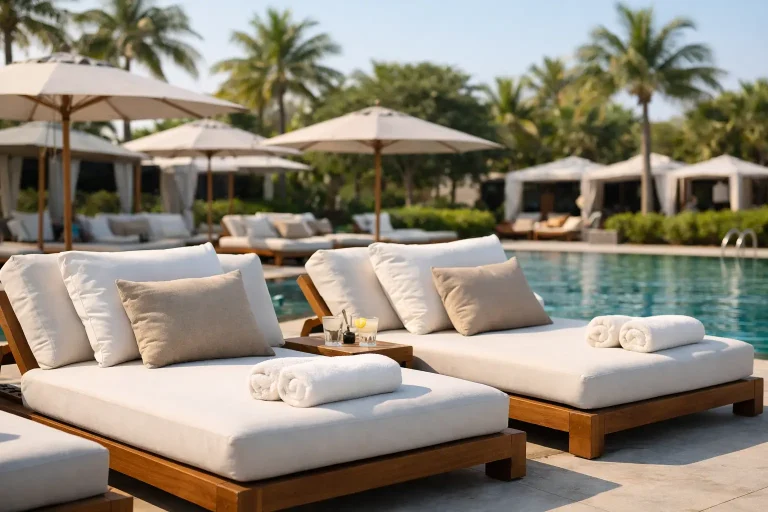
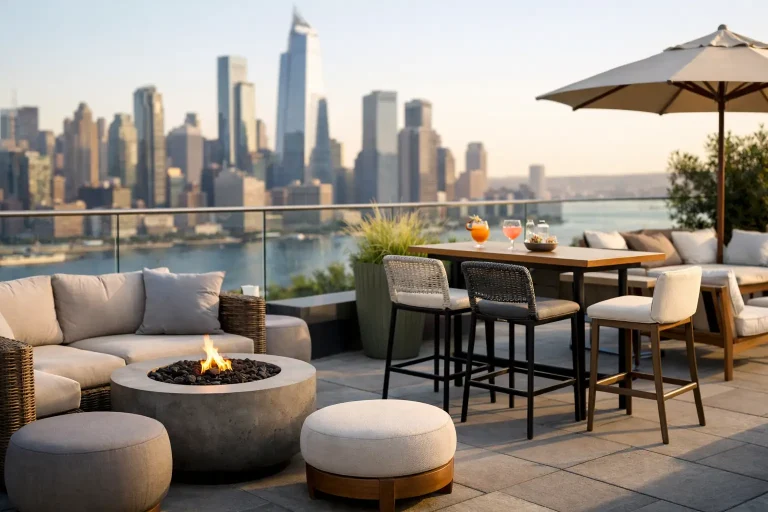
Developers usually get more accurate budget control when outdoor furniture is estimated by zone and category rather than single-item comparisons. A pool deck package, for example, may include loungers, side tables, umbrellas, towel stations, cabanas, and planters. A rooftop lounge package might combine modular seating, coffee tables, dining sets, bar-height pieces, and soft accessories. The total cost depends on how those elements perform together.
This is where procurement teams benefit from a catalog-first approach. Lounge, Dining, Pool, and Accessories are not just merchandising labels. They reflect how projects are specified, approved, and installed. When pricing is organized by use area, teams can see where budget is being concentrated and where value engineering is actually possible.
For instance, value engineering may work well by simplifying accessory selections or reducing finish complexity while preserving the hero pieces in public-facing zones. It may not make sense to downgrade primary seating in a hospitality courtyard that will absorb the highest wear. The smart move is targeted adjustment, not blanket cost cutting.
The variables that change your quote fastest
A developer should expect meaningful pricing movement when any of the following change: material grade, cushion specification, finish count, packaging method, quantity breaks, project phasing, installation scope, and delivery destination. None of these are minor details.
Material selection is one of the clearest examples. Teak, aluminum, rope, synthetic wicker, ceramic tops, sintered stone, and performance fabrics all carry different cost structures and maintenance profiles. A hospitality operator may accept a higher upfront material cost to reduce replacement frequency. A multifamily developer may prioritize a balanced specification that protects aesthetics while keeping reserve planning predictable.
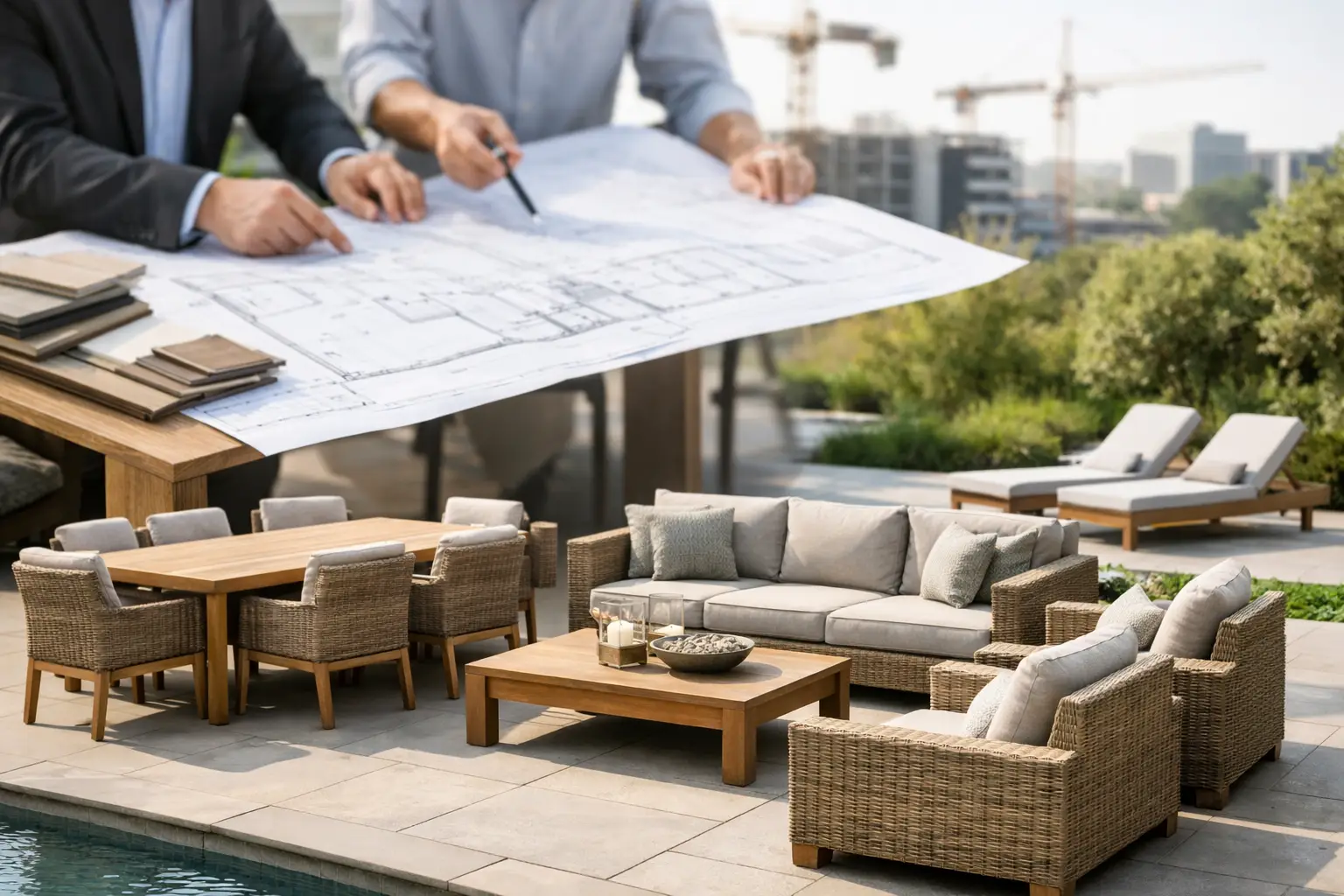
Lead time is another major cost factor. If a project team finalizes selections late and requests accelerated production or split shipments, pricing can rise quickly. The earlier furniture is integrated into design development, the more options remain open for efficient manufacturing and freight planning. Early engagement also improves mock-up approvals, finish sign-off, and 3D coordination with the broader project team.
Logistics should never be treated as a footnote. Bulk outdoor furniture is large-format cargo. Packaging, warehousing, customs handling, site access, phased delivery, and white-glove placement all affect final cost. Two quotes that look similar at ex-factory level can diverge substantially once delivery conditions are understood.
How developers should evaluate a supplier
The right supplier for a large outdoor project needs more than a broad catalog. They need operational control. That means manufacturing visibility, consistent quality systems, approval support, and the capacity to deliver repeat quantities without specification drift.
Vertically integrated suppliers generally have stronger pricing discipline because they control more of the process. Design, manufacturing, quality checks, and project coordination sit closer together, which reduces communication loss and helps maintain timeline accountability. This is particularly valuable when projects require 3D drawings, material swatches, mock-up approvals, and staged deliveries.
A supplier’s scale also matters. A 20,000-square-meter factory, growing SKU base, and documented high-volume fulfillment capacity tell developers something important: the vendor is built for contract work, not trying to adapt a retail model to a project environment. That reduces risk across multi-building, multi-site, and hospitality rollouts where consistency matters as much as creativity.
Developers should also ask how issues are resolved, not just how products are sold. Responsive communication, replacement protocols, quality escalation paths, and installation coordination are part of the pricing conversation because they shape total project cost when conditions change on site.
How to get better bulk outdoor furniture pricing without lowering standards
The strongest pricing outcomes usually come from better project structure, not aggressive quote pressure alone. Clear quantities, finish rationalization, early approvals, and consolidated purchasing all create savings without weakening the specification.
Standardization across unit types and amenity zones is one of the most effective levers. If a project can reduce unnecessary variation in frame colors, fabric groups, and table top materials, manufacturing becomes more efficient and approval cycles shorten. That does not mean every space has to look the same. It means the palette should be disciplined.
Developers also benefit from working with a supplier that can support design intent and execution in one workflow. When product selection, technical review, and delivery planning are coordinated, fewer revisions are needed later. That protects both schedule and cost.
For teams furnishing outdoor lounges, dining terraces, pool areas, and accessory packages at scale, it often makes sense to work with a single-source partner that can manage the full package. PNZ Space Global is positioned for that model through vertically integrated manufacturing, project support, and high-volume contract fulfillment tied to design consultation, 3D drawings, mock-up approvals, and white-glove logistics.
A practical way to budget with confidence
The most reliable budget starts with four decisions made early: what each zone needs to achieve, what performance level the furniture must meet, how much customization is truly necessary, and when approvals will be finalized. Once those answers are clear, pricing becomes more predictable and value engineering becomes more precise.
Developers who treat outdoor furniture as a technical procurement category usually outperform those who buy it as décor. The difference shows up in fewer replacements, cleaner installations, smoother openings, and spaces that still look intentional after heavy use. If the goal is to furnish at scale without losing control of cost, quality, or schedule, the smartest move is to price the whole project system – not just the chair.