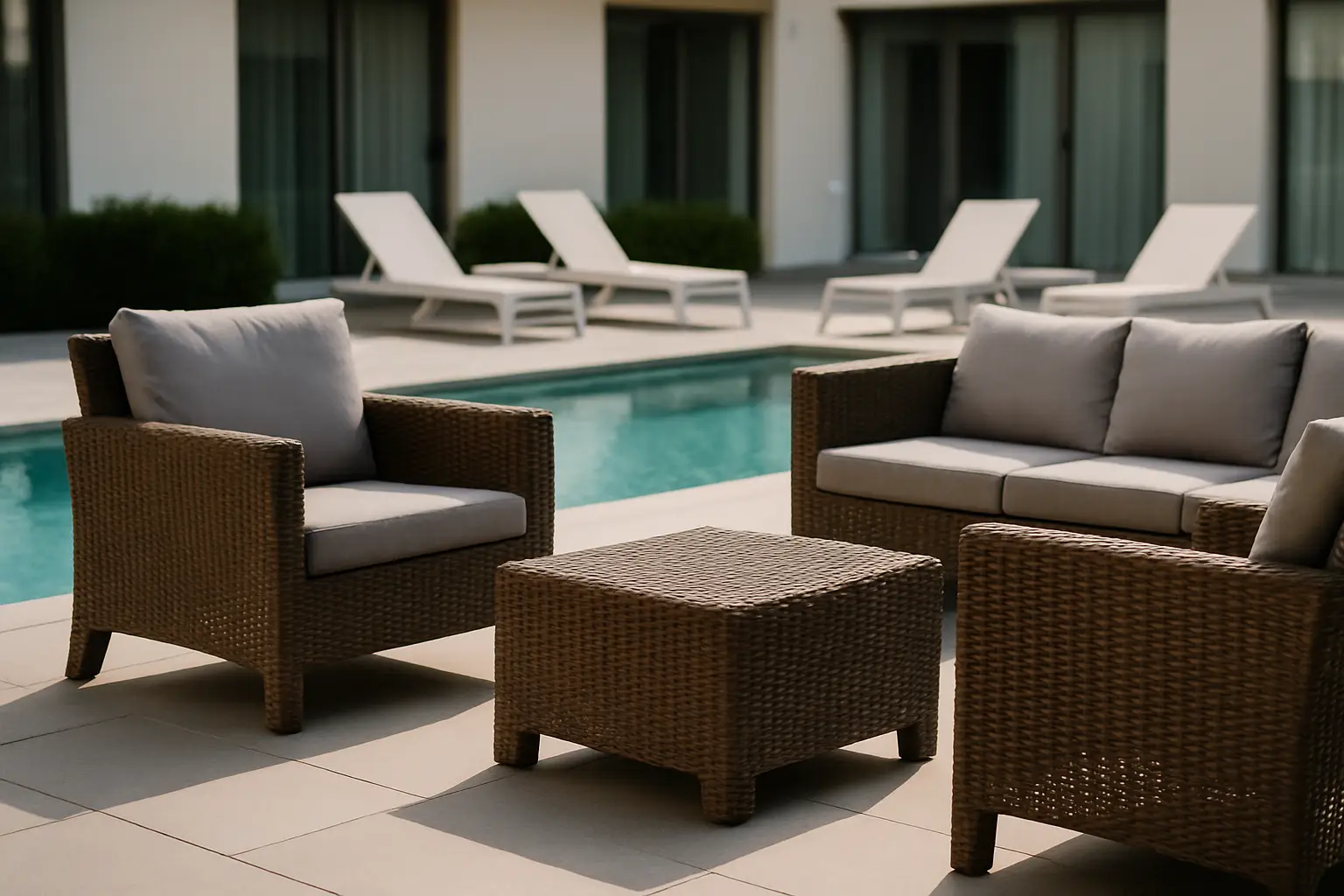
Outdoor Furniture Buying for Hotels That Last
A guest doesn’t remember your vendor list. They remember the wobbly chaise by the pool, the dining chair that snagged a dress, and the umbrella that failed on a windy afternoon. Outdoor furniture is one of the most photographed parts of a hotel – and one of the fastest to show wear when procurement decisions are made on looks alone.
Outdoor furniture procurement for hotels is less about “finding pieces” and more about building a repeatable system: clear specifications, predictable lead times, documented performance, and a supplier who can execute across phases and properties. When it’s done well, you get fewer change orders, fewer replacements, and outdoor spaces that stay guest-ready through heat, UV, salt air, and high turnover.
What makes hotel outdoor procurement different
Residential logic breaks quickly in hospitality. A villa patio set might see a few hours of use per week; a resort pool deck can see constant movement, sunscreen exposure, wet towels, staff stacking, and daily cleaning cycles. That reality changes the questions procurement should be asking.
First, the hotel’s “outdoor” is rarely one environment. You may be buying for a rooftop lounge with high wind load, a pool deck with chlorinated splash zones, beachfront seating with salt spray, and a breakfast terrace where furniture is moved twice a day. A single material choice won’t perform equally across all of it.
Second, hotels are judged on consistency. If you replace 20 chairs mid-season and the color drifts or the weave pattern changes, guests notice. Procurement needs continuity of materials and finishes, not just availability on a single purchase order.
Third, downtime costs real money. A delayed shipment, a failed coating, or a cushion fabric that mildews forces closures, comped experiences, and emergency buys that don’t match the design intent. The procurement plan has to protect operations, not just aesthetics.
Start with zoning, not catalogs
The fastest way to overbuy the wrong thing is to shop by product type before you map use. A tighter approach is to zone the property and assign performance requirements to each zone, then specify product categories.
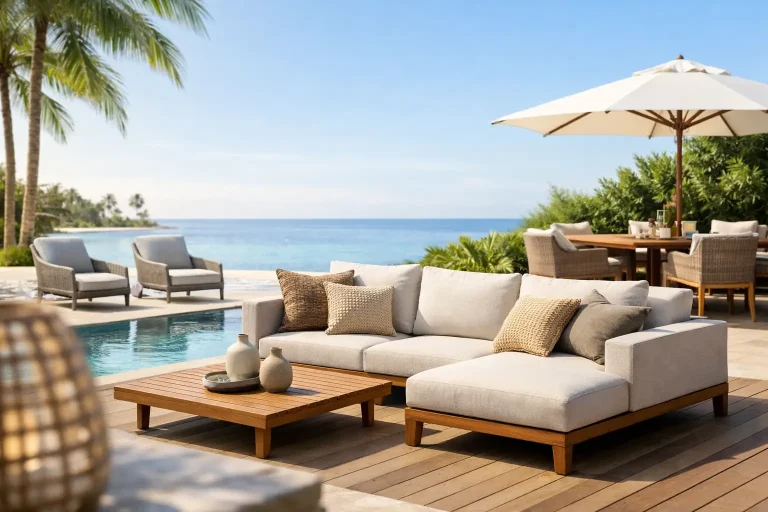
For poolside furniture, the priority is stability, comfort, and materials that tolerate constant moisture and chemical exposure. For dining sets, the priority is chair ergonomics, table top durability, and repeatable alignment for service. For lounge seating, it’s modularity, replaceable components, and fabric performance under sun and spills. For shade solutions, it’s wind rating, base weight, and maintenance access.
Once zones are defined, you can build a schedule that ties each zone to load expectations (hours of use, turnover rate), cleaning methods (pressure washing, chemical cleaners), and storage practices (stacking, covering, indoor storage). That schedule becomes the backbone of every quote comparison, sample review, and approval.
Specifications that prevent expensive surprises
Most outdoor failures aren’t mysterious. They’re predictable outcomes of vague specs. Hotels benefit from writing requirements in a way that a manufacturer can execute and QA teams can verify.
Frame materials should be tied to climate. Powder-coated aluminum is often a strong choice for corrosion resistance and weight, but coating quality and prep matter. In coastal environments, the wrong coating system can blister or creep at joints. Stainless steel can look premium, but it needs the right grade and finishing process to avoid tea staining near salt air.
For woven looks, distinguish between “inspired by rattan” and true contract-grade synthetic weave with UV-stable composition and consistent color. Ask how repairs are handled – can a single chair be re-woven, or does the whole piece get replaced?
Table tops deserve equal scrutiny. Sintered stone, compact laminate, tempered glass, and ceramic-coated surfaces each have trade-offs in scratch resistance, heat tolerance, weight, and edge durability. If your team moves tables daily, weight becomes a service issue. If guests place hot items directly on the surface, heat tolerance becomes an incident-prevention feature.
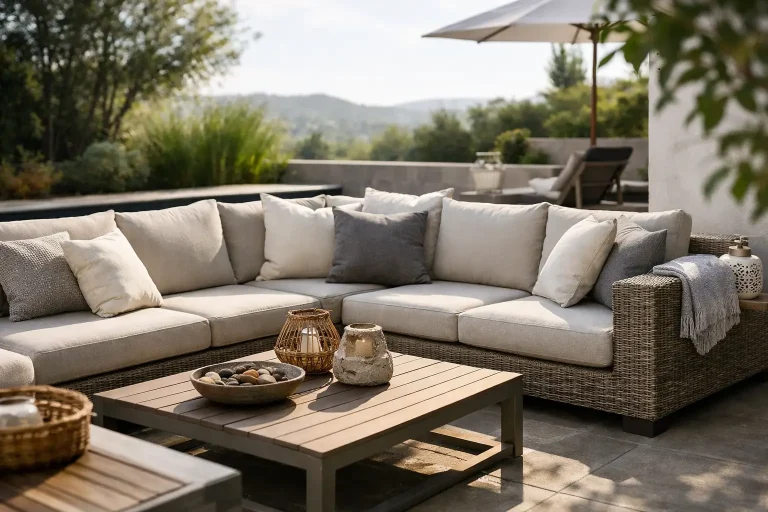
Cushions are where luxury becomes liability if you don’t specify correctly. Quick-dry foam, breathable liners, and removable covers can reduce mildew risk, but they must match housekeeping realities. If your operation won’t remove covers for washing, choose fabrics engineered for spot cleaning and frequent wipe-downs. If cushions are stored nightly, specify construction that survives compressing and handling without seam failure.
The procurement workflow that actually holds up
Procurement teams often inherit a timeline that’s already aggressive. The best way to protect it is to reduce decision friction early, not “push harder” later.
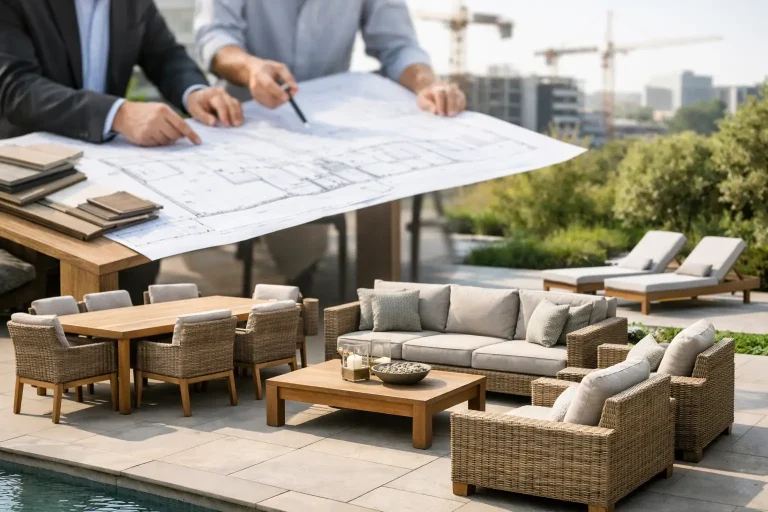
Start by locking three things: the design intent (silhouettes and palette), the performance standards (materials, coatings, fabrics), and the logistics plan (packaging, delivery windows, installation responsibilities). When those are agreed, you can move quickly through selection because each product is being evaluated against fixed constraints.
Sampling should be treated as a risk filter, not a formality. Request material swatches for frames, weave colors, and fabrics under the actual project lighting. If possible, approve a mock-up set in the highest-risk zone – typically poolside or beachfront – because that environment exposes the most issues in a short time. Mock-up approval also clarifies comfort, seat height, and table clearances in a way drawings can’t.
Then insist on documentation that supports reordering: finish codes, fabric SKUs, weave references, and component specs. Hotels reorder. Your future self will thank you when you can replace 10 loungers without starting from zero.
Choosing a supplier: control beats promises
Hotels don’t just buy product – they buy execution. That makes supplier evaluation less about who has the prettiest portfolio and more about who controls outcomes.
A vertically integrated supplier can reduce handoffs between design, manufacturing, and shipping, which often means fewer miscommunications on finishes, fewer last-minute substitutions, and clearer accountability when there’s a problem. It also tends to support large-volume fulfillment without splitting the order across multiple sources that may not match exactly.
Capacity matters, but so does process. Ask how quality is checked across batches, how color consistency is managed, and how packaging is engineered for long-haul delivery. If a supplier can’t explain their approach in operational terms, the project is taking on unnecessary risk.
Service support is part of the product. Your team may need 3D layouts to validate spacing, fast revisions when the operator changes counts, and responsive coordination when delivery must be staged by floor or by zone. That isn’t “extra” in hospitality – it’s the difference between a clean opening and a messy one.
For teams that want a single partner across lounge seating, dining, poolside furniture, shade solutions, and accessories – plus project support like 3D drawings and mock-up approvals – PNZ Space Global is built for contract-grade, high-volume outdoor furnishing with controlled manufacturing and white-glove logistics.
Budgeting beyond the unit price
Outdoor procurement gets distorted when teams compare only per-piece cost. The hotel pays for the total cost of keeping spaces guest-ready.
Higher-quality frames and finishes can reduce replacement cycles, but only if components are serviceable. A chair that’s slightly more expensive but has replaceable glides and standardized hardware can be cheaper over three years than a “deal” chair that gets thrown away after one season.
Also consider operational costs: stackability and weight affect labor, storage needs affect back-of-house space, and fabric performance affects housekeeping time. If staff dread moving the furniture, the space won’t get reset properly. That becomes a guest experience issue, not just an ops issue.
It can also be smart to split specs by zone rather than forcing a single standard everywhere. A premium rooftop lounge might justify higher-end upholstery and detailing, while a high-abuse pool deck may need simpler, tougher pieces with faster replacement capability. Consistency can still be maintained through a shared palette and silhouette family.
Timeline and logistics: where projects win or lose
Hotels rarely have flexible opening dates. Procurement should work backward from your required installation date and build a plan that includes manufacturing lead time, transit time, customs clearance where relevant, staging, and on-site placement.
The biggest avoidable delay is late specification lock. If the operator is still changing counts and finishes after production should have started, you’ll pay either in air freight, substitutions, or a partial install.
Packaging is an overlooked lever. Contract orders move through multiple touches – factory, container loading, port, truck, site, floors, zones. Good packaging reduces damage rates and speeds up installation because components arrive labeled, protected, and organized for the sequence your team needs.
Finally, plan for spares. For large properties, ordering a small percentage of extra glides, hardware, and a few matching chairs can prevent an emergency purchase later that breaks design continuity.
Designing for replacement without losing the look
Even with excellent specs, some pieces will get damaged. Smart procurement treats replacement as a feature, not a failure.
Choose collections that allow continuity across time. That means stable SKUs, documented finishes, and a supplier who can reproduce the same color and texture. It also means selecting cushion programs where covers can be replaced independently, and selecting tables where tops can be swapped without discarding bases.
If your hotel group manages multiple sites, standardizing a few core outdoor families can simplify procurement dramatically. You can still localize through fabrics, accessory colors, and layout, while keeping parts and service knowledge consistent across properties.
A strong outdoor space isn’t created by one perfect purchase. It’s created by a procurement system that keeps the space looking intentional on day 1 and still looking intentional after a thousand guests.
The best signal you’re on the right track is simple: your team can explain, in one sentence per zone, why those materials were chosen and how they’ll be maintained. When procurement decisions are that clear, design stays beautiful – and operations stays calm.