Cabanas vs Daybeds: Resort ROI in Real Terms
A resort pool deck has two kinds of real estate: the space guests photograph, and the space that quietly prints revenue per square foot. Cabanas and daybeds sit right at that intersection. They are not “nice-to-haves” – they’re programmable assets that influence spend, dwell time, staffing load, and the guest’s perception of what your property charges for.
Specifying cabanas and daybeds for resorts is less about picking a silhouette and more about designing a repeatable, maintainable experience at scale. The right choice depends on your climate, your service model, your guest mix, and how aggressively you intend to monetize premium seating.
Cabanas and daybeds for resorts: what changes operationally
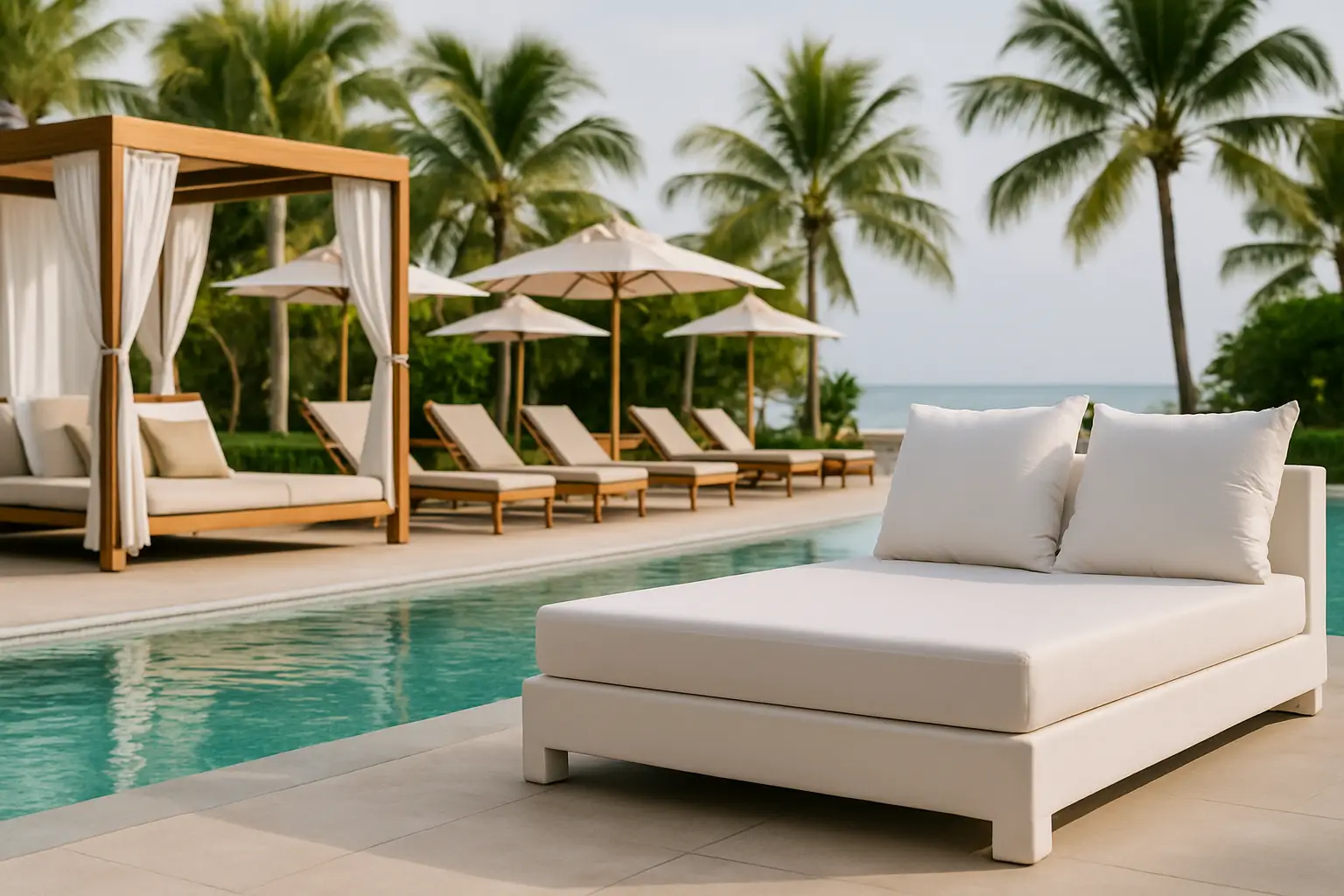
A cabana is a micro-room outdoors. It introduces shade, privacy, and a defined service zone, which tends to increase guest willingness to commit to minimum spend or day rates. It also adds operational complexity: more components, more cleaning surfaces, and more expectations (dry towels, call buttons, curtains that glide properly, and day-after-day alignment).
A daybed is closer to a high-value lounger cluster. It’s faster to turn, easier to reposition, and generally simpler to keep guest-ready. You can still upsell it, but the experience reads more social and visible – less secluded, more “pool scene.”
If your resort relies on premium privacy (honeymooners, VIPs, long-stay guests), cabanas will carry more brand weight. If your property drives volume and energy (family weekends, DJ sets, high occupancy), daybeds can outperform by staying filled and flexible.
The revenue question: sell the seat, or sell the stay?
Most resort teams evaluate these pieces through a single lens: “Can we charge for it?” That’s valid, but incomplete. The better lens is: “Does it increase total check size and protect uptime?”
Cabanas typically support higher fixed pricing because they package shade and status. Guests also tend to settle in longer, which can lift food and beverage attach rates when service is designed properly. The trade-off is turn velocity. A cabana that is booked once for the day can block multiple shorter opportunities.
Daybeds can be priced per half-day, per time block, or bundled with minimum spend. They can also be repositioned to match demand patterns – tighter on peak days, spaced out for calmer weekdays. If your operation needs optionality, daybeds are easier to “sell different” without reconfiguring the entire deck.
It depends on how you forecast demand. If you regularly sell out premium seating, cabanas can be a high-margin anchor. If demand swings with weather, events, or seasonality, daybeds often deliver steadier utilization.
Layout decisions that affect guest flow and service speed
Procurement teams often inherit a fixed footprint, but layout still has leverage. For cabanas, the biggest mistake is tucking them into dead corners with poor sightlines. Privacy is valuable, but guests still want to feel connected to the pool and the social center. When cabanas are too isolated, service slows, staff avoid the walk, and the space becomes “premium” only on paper.
Daybeds need a different discipline: spacing and pathways. If you crowd them to maximize count, you can unintentionally reduce perceived exclusivity and make it harder for staff to deliver without bumping frames or stepping over bags. A daybed zone works best when it feels intentionally planned – clear aisles, clean angles, and consistent orientation so the deck reads calm even when it’s full.
For both categories, design around service. Where do trays land? Where do ice buckets sit? Is there a stable surface that doesn’t wobble in wind? These details decide whether your premium product feels effortless or fussy.
Materials: what survives resorts, not showrooms
The fastest way to lose ROI is to specify for looks and then fight warranty claims, fabric fading, or frame instability for the next two seasons.
For frames, powder-coated aluminum remains a go-to for coastal and high-humidity environments because it’s corrosion-resistant and lightweight for staff to reset. For warmer, more residential aesthetics, teak can work well but needs a real maintenance plan and honest expectations about patina. If your resort promises “always pristine,” teak can become a staffing cost.
For cushions, quick-dry constructions and outdoor foams matter, but fabric selection is where resorts win or lose. You want high UV resistance, strong colorfastness, and a texture that reads premium while still being cleanable. Light colors are popular for the “resort white” look, but if your operation is high-traffic, a slightly heathered neutral can hide the day-to-day reality without looking busy.
For cabanas specifically, don’t treat curtains and canopies as decorative. They are functional shade and privacy elements that take direct sun load and constant handling. Hardware quality, glide systems, and replaceable fabric panels are practical requirements, not upgrades.
Shade strategy: fixed, flexible, or hybrid
Cabanas often come with integrated roofs, canopies, or pergola-style tops. Daybeds may rely on umbrellas or optional canopies. The right approach depends on wind, sun angles, and how often your team is willing to adjust setups.
Fixed shade is predictable for guests and staff. It also concentrates wind load and requires confidence in anchoring and structural integrity. Flexible shade gives you adaptability but can become inconsistent if staff are stretched.
A hybrid strategy frequently performs best: a set of cabanas with reliable coverage for guaranteed premium bookings, plus daybeds that can be shaded with umbrellas or detachable canopies to expand “premium” capacity on peak days.
Guest experience: privacy, visibility, and the social signal
Cabanas sell privacy and control. Families like the ability to stash bags, manage kids, and stay shaded. VIP guests like the boundary. But privacy can cut both ways – if the cabana feels too boxed in, it can read as separate from the resort’s energy.
Daybeds sell visibility. They’re often the most photographed seating on a deck because they sit closer to the action and communicate “I’m here for the day.” If your resort identity includes social momentum, daybeds can reinforce it better than full enclosures.
The decision is also cultural and market-driven. Some guest segments prefer a private basecamp; others want to be seen. Your best performers may not be the same across properties, even inside the same brand portfolio.
Maintenance and replacement planning: design for speed
Premium seating should not become a maintenance bottleneck. The most practical specifications are the ones that assume real life: sunscreen, spills, sand, humidity, and high-frequency cleaning.
Daybeds should allow quick cushion removal, clear drainage, and easy wipe-down surfaces. Cabanas should be modular enough that you can replace a single curtain panel or canopy section without taking the unit out of service.
Also think about how your team stores extras. If replacement cushions and fabric panels are not standardized, you’ll end up with mismatched colors and inconsistent guest-facing quality. Standardization is a brand experience decision as much as a procurement one.
Safety and compliance: the non-negotiables that protect uptime
Cabanas and daybeds invite guests to climb, lean, and move things. If a frame can tip, it will. If a canopy can flap loose, it will.
Specify for stability and anchoring. Confirm weight ratings. Avoid sharp edges and pinch points, especially around adjustable backs and sliding curtain tracks. For pool decks, specify feet and glides that won’t scratch surfaces and won’t skate when wet.
These details rarely show up in renderings, but they show up in incident reports and negative reviews.
Making it procurement-ready: what to ask before you buy
Before you commit, align on what “good” means for your project. You need clarity on performance, lead time, and the supplier’s ability to execute repeatably.
At minimum, confirm material specs (frame, powder coat standard, fabric grade), test expectations (UV, corrosion resistance where relevant), and what’s replaceable versus what forces full-unit replacement. Ask for mock-up approvals when the project scale justifies it, because small ergonomic misses compound quickly across 50 or 200 units.
You also want a partner that can support the full deck, not just one hero piece. Mixing vendors for cabanas, daybeds, loungers, side tables, and shade often creates mismatched finishes, inconsistent cushion heights, and longer coordination cycles – especially when you’re working across multiple sites.
For teams that need contract-grade outdoor seating plus project support like 3D drawings and mock-up coordination, PNZ Space Global is built around that procurement reality: vertically integrated manufacturing, a broad outdoor catalog, and logistics that are structured for high-volume hospitality rollouts.
The smart spec: choose for your operating model
If your resort monetizes privacy and predictability, lead with cabanas and treat daybeds as flexible overflow. If your resort monetizes energy and utilization, lead with daybeds and add a smaller cabana set where shade and privacy command a premium.
Either way, the win is not just selecting attractive furniture. The win is specifying cabanas and daybeds that stay guest-ready with minimal friction, keep your staff moving smoothly, and protect the one metric every resort cares about: consistent revenue from the same square footage, day after day.
Build for the real pool deck, not the photoshoot – and your guests will feel the difference the moment they sit down.