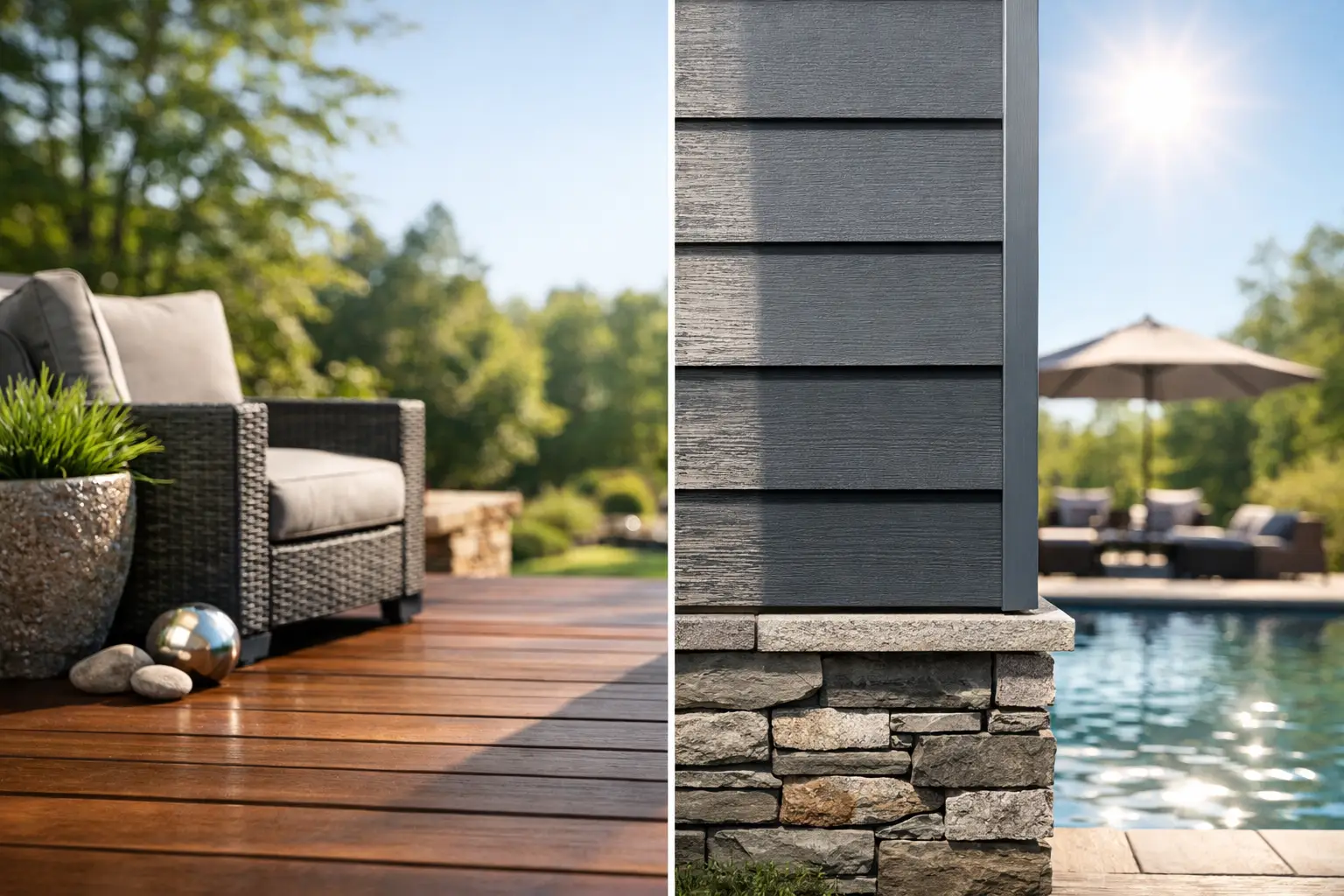
What Finishes Resist Fading in Outdoor Sun?
A rooftop lounge can look sharp at handover and tired six months later if the wrong finish was specified. That is why buyers keep asking what finishes resist fading in outdoor sun, especially for projects exposed to intense UV, reflected heat, pool chemicals, and daily commercial use.
For designers, developers, and procurement teams, fade resistance is not a cosmetic side issue. It affects replacement cycles, brand presentation, guest experience, and long-term operating cost. A chair frame that chalks, a table top that yellows, or cushions that lose color unevenly can make an otherwise well-designed outdoor environment look under-maintained long before the furniture has reached the end of its structural life.
What finishes resist fading in outdoor sun best?
The strongest performers are typically powder-coated aluminum, high-quality PVDF-based architectural coatings, solution-dyed acrylic fabrics, properly stabilized synthetic wicker, high-pressure laminate designed for exterior use, and naturally durable woods finished with UV-aware maintenance systems. Not all of these perform equally in every setting, and that distinction matters.
A beach club, shaded terrace, mountain property, and pool deck do not stress materials in the same way. Direct sun is only one variable. Salt air, chlorine, airborne dust, surface temperature, cleaning chemicals, and how often furniture is moved all influence how well a finish keeps its color and surface integrity.
That is why finish selection should be tied to project type, not just appearance on a sample board.
Powder coating remains the practical benchmark
For outdoor metal furniture, powder-coated aluminum is often the most dependable answer. It combines corrosion resistance with good color retention, and it performs especially well when the substrate preparation and coating process are controlled properly.
The phrase powder-coated does not automatically mean premium. Performance depends on pretreatment, coating thickness, curing consistency, and whether the powder formulation is rated for exterior UV exposure. A poorly applied powder coat can fade, chip, or lose gloss faster than buyers expect. A well-executed system, by contrast, holds up across dining chairs, lounge frames, side tables, and larger hospitality layouts where consistency matters across hundreds of units.
For high-volume procurement, this matters because the finish has to do more than survive sunlight. It also needs batch-to-batch stability, repairability in project planning terms, and visual consistency across repeat orders.
When powder coating is the right choice
Powder coating is a strong fit for aluminum dining sets, lounge seating frames, poolside furniture, and shade structure components. It is especially effective in darker neutrals, textured mattes, and architectural tones where slight surface wear is less visually obvious over time.
There is still a trade-off. Very dark finishes absorb more heat, which can increase surface temperature and put more stress on surrounding materials. In extremely hot locations, the color may hold while touch temperature becomes the operational issue.
PVDF coatings offer higher-end color retention
If the project calls for exceptional finish stability on metal, PVDF-based coatings are often a step above standard powder systems. These coatings are widely respected in architectural applications because they retain color and gloss well under prolonged UV exposure.
They are not always the default choice for every furniture line because they can affect cost, lead time, and production complexity. But for statement pieces, fixed exterior elements, or projects where long-term visual consistency is a priority, they deserve serious consideration.
For specifiers, the key point is simple: if the site has severe sun exposure and the finish is central to the design intent, the coating system should be evaluated with the same rigor as the furniture form itself.
What finishes resist fading in outdoor sun for fabrics?
Solution-dyed acrylic is one of the best answers for outdoor upholstery and cushions. Unlike surface-dyed fabrics, solution-dyed fibers carry color throughout the material, which improves fade resistance significantly.
This is why solution-dyed acrylic is common across premium outdoor seating, cabanas, daybeds, and hospitality cushions. It performs well in direct sunlight and generally handles cleaning and moisture better than lower-grade alternatives. For commercial settings, that translates into better color consistency across seat pads, backs, and replacement covers.
Not every outdoor fabric with a soft hand or premium look is equally fade-resistant. Printed fabrics, lower-cost polyesters, and blends that are not engineered for exterior use may look convincing at first but lose saturation quickly in exposed installations.
Fabric selection should consider maintenance cycles
Even high-performing fabric benefits from maintenance discipline. Dirt buildup can trap heat and affect appearance. Harsh cleaning agents can shorten the life of the finish or the fiber itself. In hospitality and shared-use settings, fabric performance is tied closely to housekeeping standards, not just the original specification.
That is one reason procurement teams often prefer suppliers that can provide clear material data, swatches, and replacement planning support rather than just broad claims about outdoor suitability.
Synthetic wicker can perform well, but only at the right grade
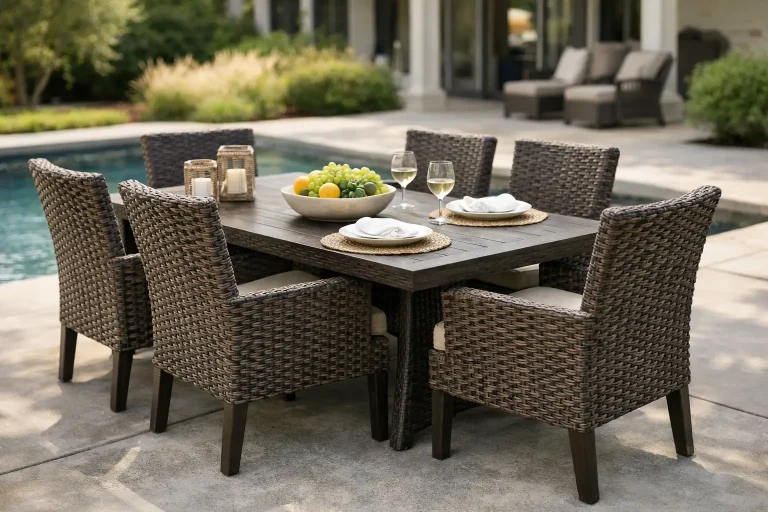
Synthetic wicker varies widely in fade resistance. The better versions use UV-stabilized polyethylene or similar engineered polymers designed for exterior use. These can hold color well in sunny climates and are a practical choice for lounge seating, dining chairs, and sectional formats.
The weak point is usually not the woven look itself. It is material quality. Lower-grade wicker can become brittle, lose color unevenly, or develop a dry, chalky surface after sustained exposure.
For commercial buyers, this means wicker should never be specified on appearance alone. Ask how the resin is stabilized, how it was tested, and whether the weave color remains consistent between production runs. A large outdoor program needs more than a good showroom sample.
Exterior laminates and ceramic surfaces are reliable for table tops
Table tops take intense punishment from sun, heat, food service, cleaning, and constant contact. For fade resistance, exterior-grade compact laminate and ceramic are two of the most dependable options.
Compact laminate built for outdoor use resists UV better than many decorative surfaces and offers good dimensional stability. Ceramic also performs strongly, with excellent resistance to fading, staining, and heat. Both are practical for restaurant terraces, pool bars, and hospitality dining where the surface finish must stay presentable under heavy turnover.
The trade-off is aesthetic warmth. These materials may not deliver the same natural character as real wood, which remains desirable in many premium settings. But where low maintenance and long visual consistency matter most, they are often the safer specification.
Wood finishes are more nuanced than buyers expect
Natural wood brings warmth and value to outdoor environments, but it is rarely the most fade-proof finish category. Teak, iroko, and other exterior hardwoods can perform very well structurally, yet their appearance changes in sun unless maintained consistently.
This is where project teams need to separate fading from weathering. Teak turning silver-gray is not necessarily failure. It is a normal aging response. If the goal is to preserve the original golden-brown tone, the wood needs a defined maintenance program using UV-inhibiting oils or sealers.
That can work well in private residential or managed hospitality settings where upkeep is part of operations. It is less ideal for projects that expect a static appearance with minimal maintenance input.
Clear coats on wood are not always the safest long-term bet
Transparent film finishes can look attractive early on, but when they break down outdoors, they often peel or fail unevenly. In high-UV conditions, penetrating systems are usually easier to maintain than thick surface films.
For procurement teams, the real question is not whether wood can be used outdoors. It is whether the site team is prepared to support the maintenance level required to keep the original tone intact.
The finish is only as good as the specification process
A fade-resistant material can still disappoint if it is paired with the wrong site conditions or approval process. This is where project support becomes operationally important.
Mock-up review, material swatches, and finish validation under actual light conditions reduce mistakes before bulk production begins. For multi-unit villas, hotel terraces, rooftop dining, or poolside rollouts, that front-end control is often the difference between a clean installation and a costly replacement cycle.
At PNZ Space Global, this is exactly why finish selection is treated as part of project execution, not an afterthought. When a supplier controls design support, sampling, manufacturing, and delivery in one pipeline, it becomes much easier to align finish performance with site reality.
How to choose the right fade-resistant finish
Start with exposure level. Full sun all day, partial shade, coastal air, chlorinated pool decks, and rooftop heat islands are not interchangeable conditions. Then match the finish to the product category.
For metal frames, prioritize exterior-grade powder coating or elevated architectural coating systems where required. For cushions, solution-dyed acrylic remains a dependable standard. For woven formats, choose UV-stabilized synthetic wicker with proven consistency. For tops, look closely at ceramic and exterior-grade compact laminate. For wood, decide early whether the project accepts natural weathering or requires active maintenance to preserve color.
The best outdoor environments are not built on broad claims like weather-resistant or outdoor-safe. They are built on precise specification. When finish performance, maintenance expectations, and project conditions are aligned from the start, furniture keeps its visual value longer and procurement becomes far more predictable.
If the goal is an outdoor space that still looks intentional after a long season of hard sun, the right finish is rarely the cheapest one on paper. It is the one that fits the site, the use case, and the operational standard the project actually needs.