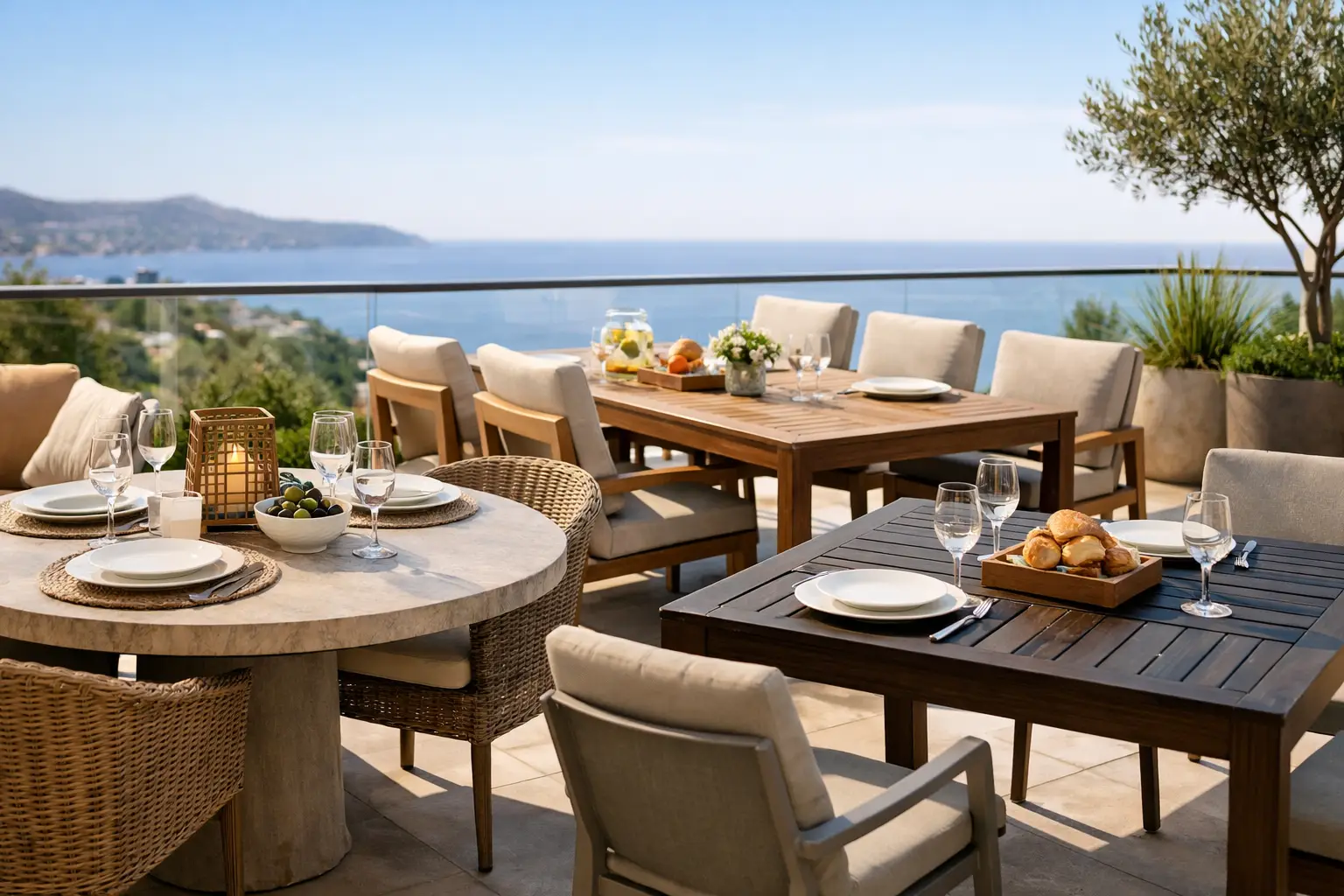
Best Terrace Dining Table Shapes to Choose
A terrace can lose capacity fast when the table shape is wrong. One oversized rectangle can block circulation to a service station. A round top can improve guest flow in a rooftop lounge but leave seats short for larger groups. When buyers ask about the best terrace dining table shapes, the real question is usually how to balance seating efficiency, clearance, and the visual language of the space.
For residential projects, that may mean fitting family dining into a compact balcony without making the layout feel crowded. For hospitality and commercial projects, it means protecting service flow, maximizing usable covers, and matching the table footprint to umbrellas, paving lines, and banquette geometry. Shape is not a styling detail alone. It affects how a terrace performs every day.
How to evaluate the best terrace dining table shapes
The right starting point is not the number of seats on paper. It is the terrace plan. Measure the true usable area after accounting for planters, columns, doors, shade posts, and perimeter setbacks. On many projects, the available footprint is materially smaller than the architectural drawing suggests.
Then consider movement. A dining table that technically fits can still fail if guests and staff cannot circulate comfortably. In hospitality environments, shape decisions should support clean approach paths, stable chair pull-back zones, and efficient table spacing. In private villas and rooftop residences, the same logic applies around outdoor kitchens, sliding doors, and lounge transitions.
There is also a specification issue. Different shapes place stress on bases and materials differently, especially outdoors. Large round tops need strong central support. Long rectangular formats may need dual pedestals or multiple legs to reduce wobble and improve knee clearance. That is why table shape should be reviewed early, alongside material selection, finish options, and intended use.
Rectangular tables: best for capacity and structure
Rectangular tables are often the default because they are efficient. They align well with walls, parapets, decks, and long terraces, making them one of the best terrace dining table shapes for projects where seat count matters. In restaurants, hotels, and multi-unit amenity spaces, they also make planning easier because they can be grouped, combined, or standardized across zones.
Their main advantage is predictable capacity. A rectangular table supports clear place settings, balanced chair spacing, and straightforward service access. It also works well with linear architecture, which is common in contemporary terraces and rooftop layouts.
The trade-off is circulation. Sharp corners can tighten walkways, especially in smaller terraces. On compact balconies or villa patios, a rectangle can feel dominant if the proportions are too deep. That is where a narrower top or a pedestal base can improve usability without giving up the shape.
For larger projects, rectangular tables also support procurement consistency. They are easier to standardize across a dining program, and they pair well with benches, armchairs, and modular seating plans. If the brief is high volume, repeatability, and clean planning, rectangular formats are usually the safest choice.
Round tables: best for conversation and flexible movement
Round tables change the way a terrace feels. They soften hard architectural lines and create a more social seating experience because every guest faces the center. For hospitality operators, this can be valuable in rooftop lounges, resort dining areas, and cafe terraces where dwell time and guest comfort matter as much as capacity.
They are also strong performers in tighter circulation zones. Without corners, guests and staff move around them more easily. That makes round designs one of the best terrace dining table shapes for compact terraces, curved edges, and layouts with multiple access paths.
Still, round tables are not always the most space-efficient. A round four-seat table can require more surrounding clearance than buyers expect, and very large diameters become harder to serve across. If the brief is to maximize covers in a narrow footprint, a rectangle may outperform a round option.
Base engineering matters here. A well-designed pedestal base gives better legroom and cleaner chair placement, especially in commercial settings where chairs are moved constantly. On exposed terraces, weight and stability should also be reviewed closely, particularly when tops are larger or materials are heavier.
Square tables: best for modular planning
Square tables are often underestimated, but they are highly practical in both hospitality and residential settings. In cafes, casual dining terraces, and mixed-use amenity spaces, they offer a strong balance between symmetry, flexibility, and compact sizing. They can stand alone for two or four guests, or be combined when group sizes change.
That modularity is their biggest strength. Procurement teams and operators value furniture that can adapt without disrupting the design scheme. A square table layout can be reconfigured for events, seasonal demand, or shifting guest patterns more easily than many fixed large-format options.
The limitation is scale. A square table works best when the seat count per table remains modest. As dimensions grow, corner reach becomes less comfortable and the table can start to feel oversized relative to the dining experience. In premium terraces, larger square tops may also read visually heavy unless the base and material palette are carefully handled.
Where square tables succeed is in disciplined planning. They create order, align neatly with paving grids, and support efficient repetition across larger projects.
Oval and racetrack tables: best for softening longer layouts
Oval and racetrack shapes sit between rectangular and round formats. They deliver the length of a rectangular table while removing hard corners, which improves circulation and softens the overall composition. For elongated terraces that need a more refined look, this can be a very effective solution.
These shapes are especially useful in upscale residential dining areas and hospitality settings where aesthetics carry real value. They feel less formal than a strict rectangle but still provide substantial seating capacity. In design-forward projects, they can also help bridge angular architecture with softer lounge elements.
The trade-off is specification complexity. Oval tables can be harder to pair with covers, table groupings, and some shade layouts. They also require careful sizing so the ends remain usable and service access stays practical. They are not the first choice for every project, but when the terrace is long and the design brief calls for a more elevated profile, they deserve consideration.
Which table shape works best by terrace type
On narrow balconies and compact private terraces, round and small square tables usually perform best because they preserve movement and reduce visual bulk. If the terrace is long but shallow, a narrow rectangular table can still work, provided chair pull-back and access points are protected.
For villa patios and family dining terraces, the decision often comes down to how the space is used beyond meals. If the area also connects to a pool, outdoor kitchen, or lounge zone, softer-edged shapes may improve flow. If regular large-group dining is the priority, rectangular formats usually win on capacity.
In rooftop restaurants and hospitality environments, rectangular and square tables often make the strongest operational case because they support repeatable layouts and efficient service planning. Round tables are useful as feature moments or in premium seating zones where guest experience is prioritized over maximum density.
For resort and hotel terraces, mixed-shape planning can be the smartest answer. Not every zone needs the same shape. A project may use rectangles for the core dining floor, rounds for edge tables with views, and squares in flexible overflow areas. The best terrace dining table shapes are often selected as a system, not one shape repeated everywhere.
Material and base choices still affect the result
Shape alone does not guarantee performance. Outdoor tables need to withstand sun, moisture, heat, and repeated use, especially in commercial environments. A large, attractive tabletop can fail operationally if the material expands poorly, stains easily, or places too much load on the base.
That is why specification should account for both geometry and construction. Contract-grade aluminum frames, engineered stone-look surfaces, compact laminate, teak, and ceramic tops all behave differently depending on table size and support design. A supplier with in-house design support, production oversight, and material flexibility can resolve these issues earlier, before they become site problems.
For larger programs, mock-up review is also useful. It gives designers, operators, and procurement teams a chance to validate clearances, chair pairing, and visual scale in real conditions rather than relying only on drawings.
The best choice is the one that keeps the terrace working
The strongest terrace dining plans do not start with shape preference. They start with performance: how many people need to sit comfortably, how circulation needs to function, how the furniture will be serviced, and how the layout supports the broader project concept. That is where experienced specification matters.
PNZ Space Global approaches these decisions with the same priority clients bring to every large outdoor project – getting the design right without compromising execution. If a terrace needs to look sharp, seat efficiently, and hold up over time, the right table shape is rarely a guess. It is a planning decision that pays off every day the space is in use.
Before locking the final selection, review the terrace the way guests and staff will actually experience it. That one step usually reveals the right shape faster than any trend does.