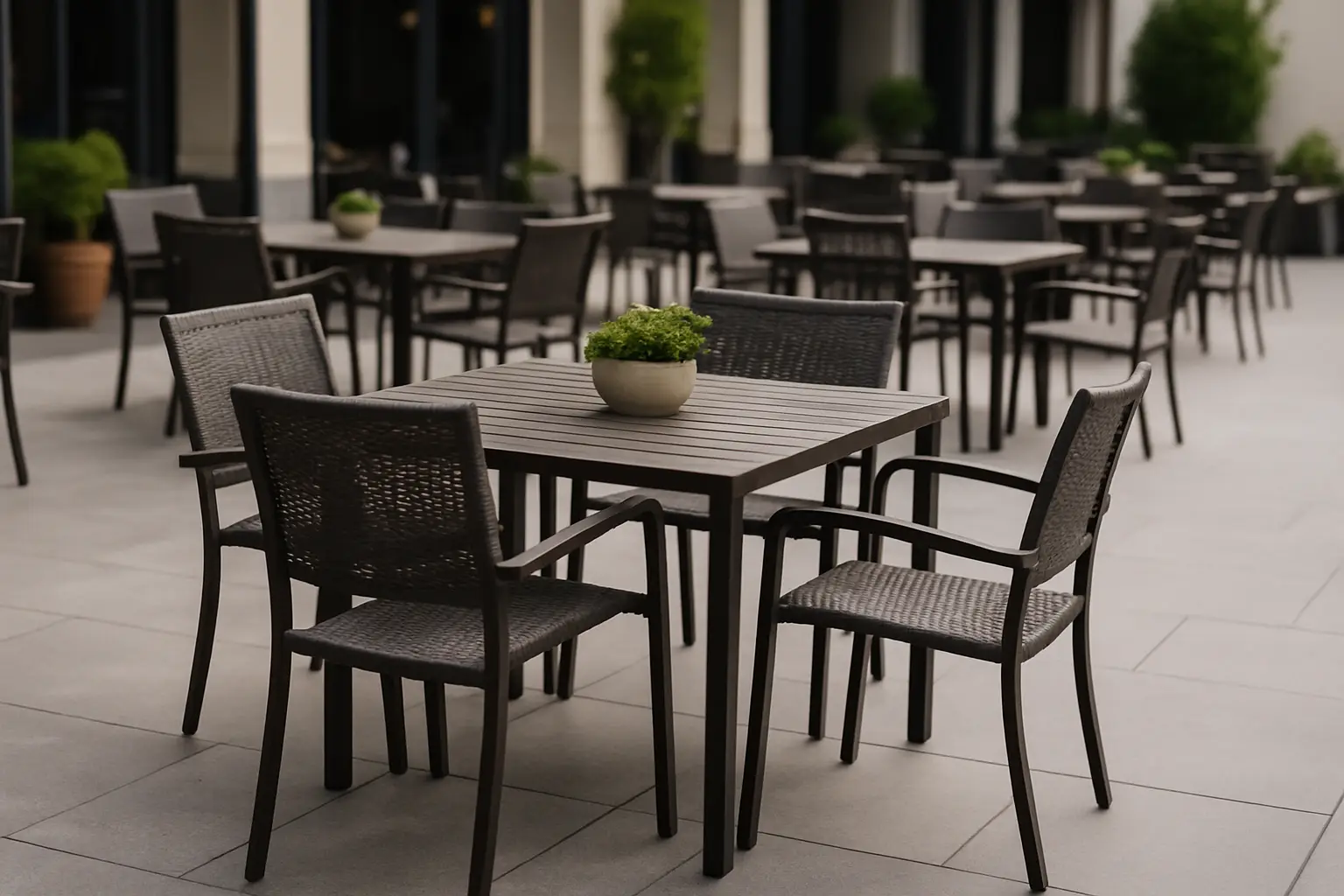
Outdoor Dining Sets That Work for Restaurants
A windy lunch rush is the real product test.
Not the showroom. Not the render. The moment a server drags a chair back one-handed, a guest leans into a two-top, and the sun hits the tabletop at full strength – that is when outdoor dining sets either earn their keep or quietly start costing you in wobble complaints, chipped finishes, and constant replacements.
If you are specifying outdoor dining sets for restaurants, you are not just buying furniture. You are buying seat count, pace of service, brand perception, and predictable maintenance. The best sets look intentional on day one and stay operational on day 900.
Start with the restaurant’s operating reality
Most outdoor failures happen because the set was chosen for aesthetics first and operations second. A restaurant patio is closer to a production environment than a living room: more movement, more cleaning chemicals, more UV, and far less mercy.
Begin by mapping three fundamentals. First, turnover: quick-service patios need chairs that slide cleanly and tables that reset fast, while destination dining can justify heavier, more sculptural pieces. Second, climate exposure: coastal air, high heat, sand, freeze-thaw, and monsoon rain each punish different materials. Third, staffing and storage: if your team stacks, moves, or reconfigures nightly, weight and stackability stop being “nice to have” and become a cost line.
Once those are clear, you can specify furniture like equipment – with design outcomes built in.
Outdoor dining set layouts that protect revenue
Seat count is a hard number, but usable seat count is the number that matters.
Two-tops and flexible joiners typically outperform fixed four-tops on busy patios because you can respond to party size without leaving dead space. If your concept runs on reservations and longer dwell time, larger tables can be worth it, but you still want a plan for awkward gaps that block service paths.
A practical approach is to standardize table footprints so they can combine cleanly. Square and rectangular tops make this easier than round, although rounds can improve circulation in tight corners and soften the look of hard architecture.
Also consider edge conditions: tables placed against a wall or railing can use bench seating on one side to increase density and reduce chair clutter, but benches reduce flexibility when guests arrive unevenly or need accessibility options. It depends on whether your patio is a “set it and forget it” space or constantly rebalanced during service.
Material choices: what holds up and what gives
Outdoor dining sets for restaurants live or die by material selection, and there are real trade-offs. The right choice is rarely the most expensive option – it is the option that performs under your exact abuse.
Aluminum: the workhorse for commercial patios
Powder-coated aluminum frames are a primary spec for restaurant dining because they are lightweight, corrosion resistant, and easy to move during resets. The key is coating quality and weld execution. Thin-gauge frames can feel unstable under lateral pressure, and poor coating prep shows up later as bubbling or early wear at touch points.
Aluminum is also one of the easiest frames to standardize across large orders, which matters when you want consistent finish lots across multiple sites.
Stainless steel: strong, but not always forgiving
Stainless can read premium and feels solid, but in coastal or high-salt environments it demands careful grade selection and cleaning discipline. Fingerprints and surface scratches show faster than on coated aluminum, so it can be better suited to concepts that prioritize a crisp, reflective look and have the staff process to maintain it.
Teak and hardwoods: high design, higher maintenance expectations
Natural teak can be a statement, and it ages beautifully if your brand allows for patina. But restaurant reality includes sunscreen, sauce spills, and aggressive cleaning schedules. If you want wood, align early on whether you are willing to re-oil, accept silvering, or require a protective finish system. Wood delivers warmth and differentiation, but it is not the lowest-effort path.
Resin, poly materials, and all-weather wicker: know the grade
High-quality commercial resin seating can be extremely practical: easy to clean, consistent, and often stackable. The risk is in low-grade materials that chalk, fade, or become brittle under UV. For woven looks, all-weather wicker can perform well when paired with a strong frame and tight weave, but it is not immune to snagging and impact damage in tight service lanes.
Tabletops: where most visible wear happens
Frames fail slowly. Tabletops fail loudly.
For restaurants, you want surfaces that tolerate heat, resist staining, and clean quickly. Compact laminate, sintered stone, and well-specified composite tops are common commercial answers. Natural stone can be beautiful, but porosity and edge chipping are real concerns. Wood tops can work if you accept maintenance. Glass is easy to wipe but shows smears and can create glare issues in full sun.
Whatever you choose, specify edge detail intentionally. Thin square edges chip more easily than eased or rounded profiles, especially when tables are moved and bumped.
Comfort is operational, not decorative
Guests will forgive a lot if the chair feels good.
Seat geometry matters more than cushion thickness. A dining chair needs stable posture for eating, not lounge angles that slow turnover and strain the table height relationship. If you use cushions, confirm attachment method and drying behavior. Loose cushions look great in photos and disappear in real life. Tied or secured cushions keep the patio consistent but must be easy to remove for weather events.
Also watch thermal comfort. Dark metal in direct sun becomes a usability problem. Sling fabrics and ventilated designs reduce heat retention and can dry faster after rain, but sling replacement is a lifecycle consideration if your patio runs seven days a week.
Specs that prevent the common restaurant complaints
Most “bad patio furniture” feedback boils down to a short list of avoidable issues.
Wobble comes from uneven floors, weak bases, or poorly matched table sizes to base geometry. Specify adjustable glides and choose bases sized for the top, not just for aesthetics. Stability is especially critical for round tops and for any table larger than a true two-top.
Chipping and finish wear often show first at chair arms and table edges. If your concept encourages guests to pull chairs by the back crest, that area needs reinforced coating performance.
Noise is another hidden variable. Metal-on-stone scraping can damage floors and create a harsh soundscape. Glides and floor protection are part of the dining experience, not an afterthought.
Cleaning, chemicals, and the real world
Restaurants sanitize. That is non-negotiable.
Make sure your outdoor dining sets are compatible with the cleaning agents your team actually uses, not the ones written in a manual. Certain solvents and harsh degreasers can dull finishes and weaken plastics over time. If you are running high-frequency wipe downs, choose surfaces that do not require delicate care to stay presentable.
Plan for weather events too. If you cover furniture nightly, choose sets that stack or nest without damaging the finish. If you store indoors, confirm doorway clearances and stack heights. These details drive labor cost every single day.
Brand expression without fragile choices
Your patio should look like your concept, not a generic rental set.
You can get there through silhouette, proportion, and finish consistency rather than fragile design tricks. A controlled palette, repeatable textures, and a clear table-to-chair relationship reads intentional at scale. For multi-site restaurant groups, standardizing a core kit with a few modular variations can preserve brand identity while allowing each location to respond to its architecture.
Customization helps, but it has to be operationally smart. The best customizations are finish and fabric decisions that are easy to maintain and easy to reorder later, not one-off parts that create long-term replacement friction.
Procurement: how to buy restaurant patio sets without surprises
When you are buying at scale, the furniture itself is only one part of the risk. The other parts are specification control, approvals, and delivery certainty.
Ask for material samples and finish swatches early, then lock them to a documented spec. Review load and stability expectations for chairs and table bases. Confirm stackability claims with real stack counts, not marketing language.
For larger projects, mock-ups matter. A single chair and table set, approved under real lighting, helps avoid expensive last-minute changes. If you are coordinating with designers and architects, 3D drawings help resolve spacing, ADA pathways, and table density before purchase orders go final.
If you are outfitting multiple restaurants or a large hospitality complex, insist on production planning that matches your opening schedule. “On time” is not a vibe – it is a delivery window tied to construction milestones and staffing ramp-up.
This is where a vertically integrated supplier can reduce variability because the factory, finishing, and packing standards are controlled end-to-end. PNZ Space Global (https://www.pnzspace.com) is built for that kind of contract workflow, pairing design support like 3D layouts and mock-up approvals with high-volume manufacturing and white-glove logistics for commercial outdoor environments.
A quick way to pressure-test your shortlist
Before you finalize outdoor dining sets for restaurants, run a simple scenario test.
Imagine a fully booked Saturday: chairs get dragged, tables get bumped, a drink spills, the sun shifts, and a surprise gust hits umbrellas. If you can see your team maintaining the setup without babying it, and you can see the set still looking credible after repeated cleaning cycles, you are close.
Then think about day 365. The best patio furniture is not the piece that impresses on install day. It is the piece that still looks like your brand when nobody is paying attention – because that is when your guests decide whether the patio feels premium or neglected.
Choose for that day, and the rest of the days get easier.