Resort Outdoor Cabanas That Perform
A cabana that looks impressive on opening day but fails after one high-traffic season creates the same problem every hospitality team wants to avoid – replacement costs, guest complaints, and operational disruption. Resort outdoor cabanas are not standalone showpieces. They are working assets on pool decks, beachfront terraces, rooftop lounges, and private villa settings, and they need to perform under constant exposure, frequent use, and demanding brand standards.
For designers, developers, and hospitality procurement teams, the real question is not whether to include cabanas. It is how to specify them so they hold up commercially, support the guest experience, and stay aligned with the broader outdoor furniture program. That decision affects layout efficiency, maintenance planning, visual consistency, and long-term return on investment.
What resort outdoor cabanas need to do
In a resort setting, a cabana is part shade structure, part lounge zone, and part revenue opportunity. It may serve as a premium poolside booking, a private retreat for villa guests, or an extension of a food and beverage program. That means the spec is doing more than solving for aesthetics.
A well-planned cabana needs to create visible comfort from a distance and actual comfort up close. Shade coverage matters, but so do airflow, privacy, access, and furniture proportions. A deep seat that feels luxurious in a brochure can become inefficient if circulation gets tight or if housekeeping cannot service the unit quickly between guests.
This is where commercial and hospitality projects differ from residential selection. In a resort, every outdoor element has to justify its footprint. If the structure is oversized, under-shaded, difficult to clean, or disconnected from the rest of the site furniture, it slows down operations and weakens the guest journey.
Design decisions that affect performance
The strongest resort outdoor cabanas start with a clear use case. A pool cabana serving day guests should not be specified the same way as a beachfront cabana in a windy salt-air environment or a rooftop unit exposed to stronger UV and intermittent event use.
Structure is the first performance decision. Aluminum remains a preferred option for many hospitality environments because it is lighter, corrosion-resistant, and easier to maintain at scale than heavier alternatives. Powder-coated finishes also allow better alignment with the rest of the outdoor palette, especially when projects need visual continuity across lounges, dining zones, and shaded relaxation areas. In some properties, teak or wood-look materials may be selected for warmth, but that choice comes with a different maintenance profile. The right answer depends on the brand positioning of the resort and the staff resources available to maintain the finish properly.
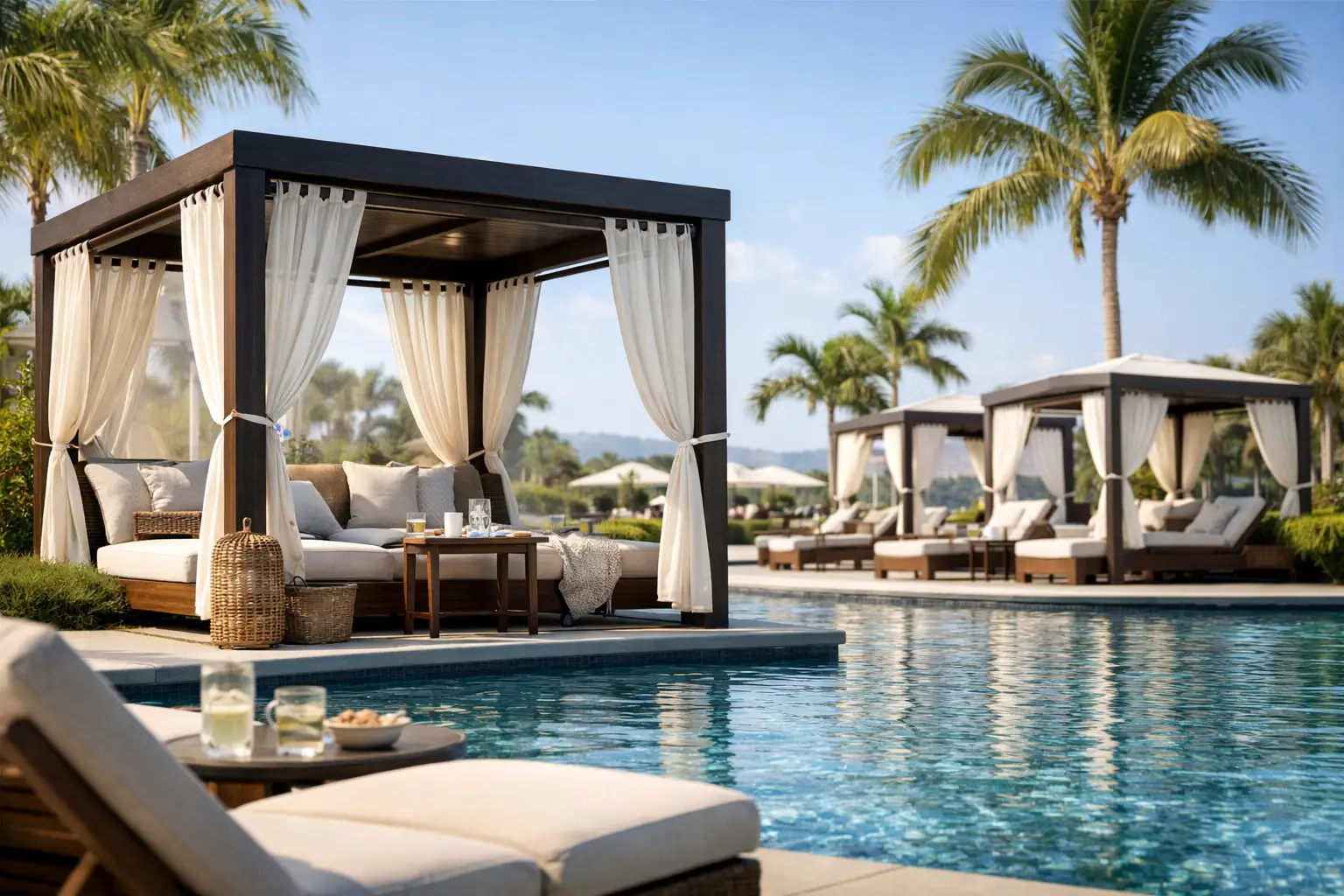
Canopy design is equally important. Fixed roofs can provide cleaner architectural presence and stronger sun control, while draped textile systems can feel softer and more exclusive. The trade-off is maintenance and replacement cycles. Fabrics need to be specified for UV resistance, fade performance, and cleanability, especially in food service or poolside applications where sunscreen, moisture, and spills are constant. If the visual concept relies on white or very light textiles, teams should make that choice with a clear understanding of cleaning frequency and replacement expectations.
Furniture integration often determines whether the cabana feels intentional or improvised. Loose lounge seating, platform daybeds, side tables, and storage elements should be scaled to the structure rather than inserted afterward. When cabanas are designed as part of a full outdoor program, there is more control over dimensions, material continuity, and guest flow. That matters on large hospitality projects where dozens of units may need to feel consistent across multiple zones.
Why layout matters as much as the cabana itself
A high-performing cabana does not start at the product level. It starts at the site plan. Placement affects privacy, views, staffing routes, and monetization.
If cabanas are packed too closely, guests lose the sense of exclusivity they are meant to pay for. If they are spaced too far apart, service efficiency drops and the pool deck can feel fragmented. Orientation also matters. A cabana facing the water may look ideal in renderings, but if the sun path leaves guests exposed during peak hours, the experience underdelivers.
Designers and project teams should also think through adjacency. A premium cabana zone near food and beverage service can support higher spend, but too much traffic nearby can reduce privacy. Units placed close to pools need surfaces and textiles that tolerate splash and chemical exposure. Beachfront locations require more aggressive material planning because salt, sand, and wind will shorten the life of poorly specified components.
This is where design support becomes valuable. 3D drawings, mock-up reviews, and material approvals help teams catch spacing issues, scale mismatches, and finish conflicts before procurement is locked in. On projects with multiple stakeholders, that visibility reduces costly revisions later.
Materials, maintenance, and lifecycle cost
Hospitality buyers know the cheapest option rarely stays cheap. Resort outdoor cabanas should be evaluated on lifecycle cost, not just unit price.
Frame durability is the obvious part, but soft components often drive replacement cycles. Cushions need commercial-grade foam and fabrics that resist mildew, fading, and water retention. Curtains and canopy textiles should be removable and replaceable without turning a simple refresh into a full structural replacement. Hardware matters too. In coastal or humid environments, weak fittings become a maintenance problem quickly.
Ease of cleaning should be treated as a specification requirement, not an afterthought. Smooth, wipeable surfaces reduce labor time. Modular upholstery components make repairs easier. Standardized finishes across the outdoor program simplify maintenance stocking and future replenishment.
For operators managing multiple properties or phased developments, consistency has financial value. A vertically integrated supplier with strong SKU depth and production control can support initial rollout and later reorder needs with fewer surprises. That matters when a resort needs to replace a portion of cabanas, expand a pool club, or align a new phase with an existing design language.
Customization without procurement drag
Customization is often necessary in hospitality. Resorts want a distinct identity, and cabanas are highly visible assets. But customization should not create specification risk.
The practical approach is controlled flexibility. Adjusting dimensions, finish colors, fabric selections, and accessory packages can deliver a tailored look without forcing a fully bespoke engineering process for every unit. For procurement teams, that balance keeps lead times more predictable and approval workflows more manageable.
It also helps to work with a supplier that can coordinate the entire outdoor environment, not just the cabana structure. When lounge seating, side tables, dining pieces, umbrellas, and accessories are being specified together, there is less chance of mismatch in materials, seat heights, finish tones, or delivery timing. The project runs cleaner because the package is being managed as a system.
For that reason, many commercial buyers prefer partners that can support design consultation, material swatches, mock-up approvals, and high-volume manufacturing under one roof. PNZ Space Global operates in that model, which is especially useful when projects need contract-grade consistency and a dependable path from concept to site delivery.
Common mistakes in resort cabana specification
The most common mistake is over-prioritizing appearance and under-prioritizing operations. A beautiful cabana that traps heat, collects dirt, or limits service access will not age well in hospitality use.
The second mistake is treating the cabana as an isolated product. It should be specified in relation to sun loungers, pathways, pool furniture, landscaping, and service patterns. Otherwise, the deck becomes visually disjointed and harder to manage.
The third is ignoring replacement planning. Textiles, cushions, and wearable components should be easy to reorder. If every replacement requires a custom process, downtime and costs rise. This is especially relevant for resorts with year-round occupancy or aggressive seasonal turnover.
How to evaluate resort outdoor cabanas for a project
A good evaluation process is straightforward. Start with the use case and guest profile. Then pressure-test every design choice against climate, maintenance capacity, installation timeline, and budget.
Ask whether the structure supports the level of privacy and shade the site needs. Confirm that materials match the environmental conditions. Check whether the upholstery, curtains, and finishes can be maintained with the labor model the property actually has, not the one assumed during concept design. Finally, evaluate whether the supplier can handle scale, approvals, and delivery without creating procurement friction.
That last point matters more on larger projects. A supplier may offer attractive visuals but struggle with lead times, finish consistency, or multi-site coordination. In hospitality, execution reliability is part of the product.
The best resort outdoor cabanas do not call attention to the compromises behind them. They simply look right, wear well, and support the way the property operates every day. When the structure, materials, layout, and supply chain are aligned, cabanas stop being decorative extras and become durable revenue-supporting assets. That is the standard worth specifying for.