Restaurant Terrace Furniture Specification Example
A terrace package can look perfect in a mood board and still fail in service by month three. The usual problems are familiar – finishes that chalk under sun exposure, dining chairs that wobble after heavy turnover, tabletops that stain, and layouts that ignore cleaning routes, stacking needs, or local wind conditions. That is why a strong restaurant terrace furniture specification example matters. It turns aesthetic intent into a purchasing document that protects performance, budget, and delivery.
For restaurant operators, architects, and procurement teams, the spec is not just a product list. It is the control document that aligns design, operations, and manufacturing. If the terrace is part of a hotel, rooftop venue, or mixed-use development, the need for clarity is even higher because approvals run across multiple stakeholders and delays become expensive quickly.
What a restaurant terrace furniture specification example should do
A useful specification should answer five questions before a purchase order is released. What is being supplied, where it will be used, what level of durability is required, what finish and material standards apply, and how the package will be delivered and approved.
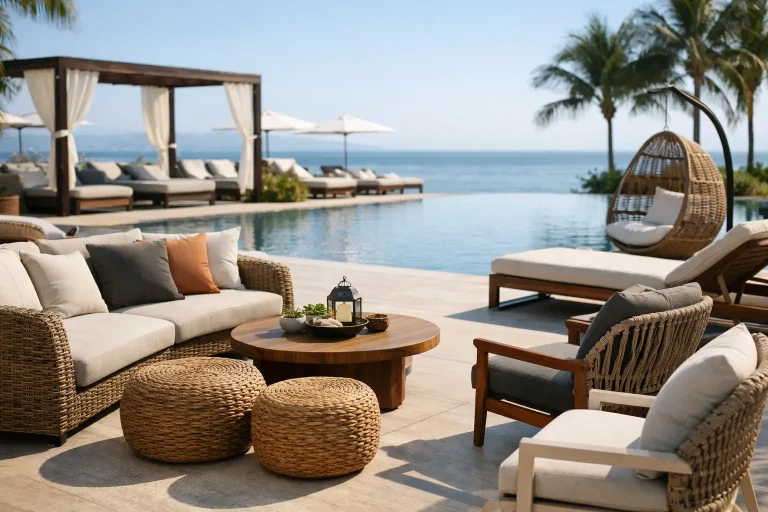
That sounds basic, but many terrace packages fail because the document only names a chair style and finish color. In commercial outdoor settings, that is not enough. The spec should define frame material, coating system, sling or cushion construction, foam grade, fabric performance, table core or top material, glide type, stackability if needed, and any maintenance constraints. It should also identify whether the terrace is fully exposed, partially shaded, beachfront, rooftop, or near a pool, because those conditions change the right material choice.
A good spec also reduces substitution risk. If a project is value-engineered late, the team can compare alternatives against clear benchmarks rather than visual similarity alone.
The core sections in a restaurant terrace furniture specification example
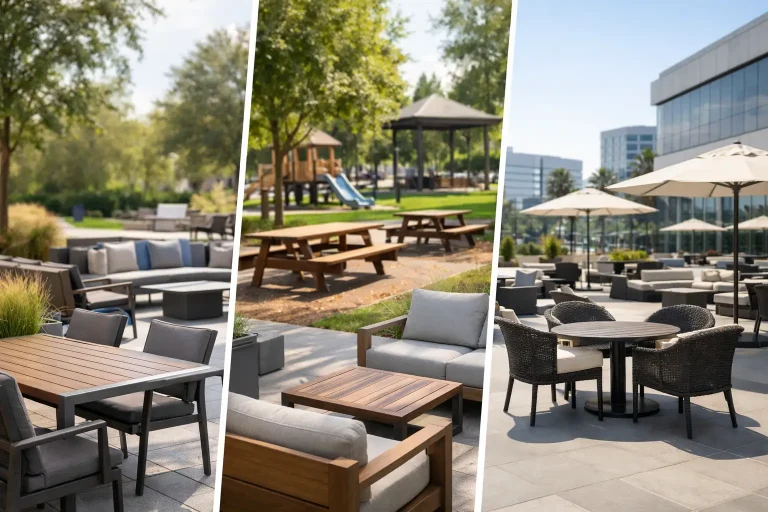
Most hospitality teams benefit from structuring the document by zone first and by product second. That keeps dining, lounge, waiting, and perimeter areas from getting mixed together.
1. Project and site conditions
Start with the terrace description. Include project name, location, operator type, service format, and exposure conditions. A street-facing terrace in a dry urban climate behaves differently from a coastal rooftop with high UV and salt exposure. If the venue expects frequent furniture movement for event resets, that should be stated early because weight, stackability, and floor protection become specification issues, not operational afterthoughts.
2. Product schedule by area
Each line item should identify the product category, intended use, quantity, and key dimensional requirements. For example, dining armchair, dining side chair, two-top dining table, communal table, barstool, host stand stool, lounge chair, sofa module, coffee table, planter divider, and umbrella base.
Dimensions matter because hospitality circulation is tight. Seat height, arm height, and table apron clearance affect comfort and accessibility. On a compact terrace, even a small increase in chair width can reduce seat count and change revenue potential.
3. Material and construction requirements
This is where the spec stops being decorative and starts being commercial. Powder-coated aluminum is often selected for its corrosion resistance and lower weight, but gauge, weld quality, pretreatment, and coating thickness still affect lifespan. Teak can perform well outdoors, but only if the client accepts weathering and maintenance expectations. Synthetic rope may suit a design direction, but fiber type, UV stability, and cleanability should be defined.
Cushions need the same discipline. The spec should state outdoor-rated foam, drainage or reticulation strategy, removable covers if required, and fabric performance criteria for UV resistance, colorfastness, and cleaning. In high-turnover restaurant settings, beautiful upholstery that cannot handle repeated spot cleaning creates cost later.
4. Finish control and sample approval
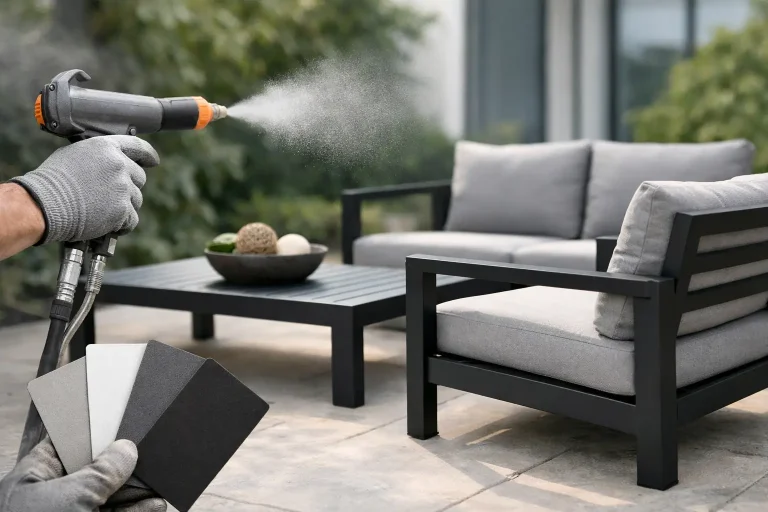
Commercial buyers should not rely on a single finish name. Charcoal can vary widely from one sample to the next. The spec should require approved physical swatches or mock-up signoff for frame finish, fabric, tabletop surface, and any woven elements. If multiple sites are involved, the same approval standard should apply across all locations to avoid variation.
5. Logistics, packaging, and installation
Furniture can be specified correctly and still arrive in a way that disrupts opening schedules. Include delivery requirements, floor-by-floor access limitations, protective packaging expectations, assembly scope, and staging sequence. This is especially important for hospitality projects with tight handover windows. Procurement teams should know whether pieces arrive assembled, partially knocked down, or site-fitted.
A practical sample format
Below is a simplified sample structure that can be adapted to a live schedule.
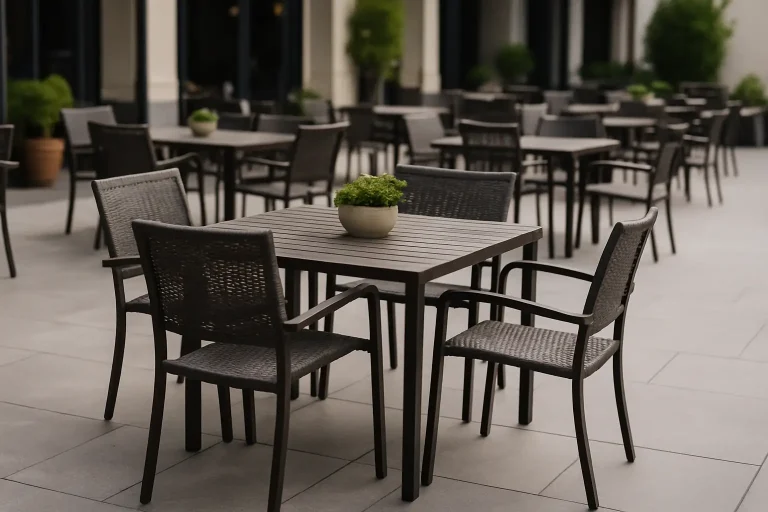
Restaurant terrace dining chair
Product type: Outdoor dining armchair Application: Main guest dining terrace Quantity: 48 Frame: Fully welded aluminum frame, outdoor-grade powder coat, matte black Seat and back: UV-stable woven rope in sand tone over aluminum subframe Cushion: Optional loose seat cushion, quick-dry outdoor foam, removable cover Fabric: Solution-dyed acrylic, light taupe, commercial outdoor rating Dimensions: Seat height 18 in, arm height compatible with dining table apron, overall width to suit 36 in aisle planning Performance: Suitable for heavy commercial use, stackable to 4 high if operationally required Glides: Non-marking outdoor glides for tile or stone terrace flooring Approval: Final frame, rope, and fabric swatches subject to design signoff
Restaurant terrace dining table
Product type: Outdoor dining table for 2 guests Application: Main terrace dining Quantity: 24 Base: Powder-coated aluminum pedestal base with weighted stability Top: Sintered stone or compact laminate top, stain-resistant, heat-resistant, easy-clean finish Dimensions: 28 in to 32 in square depending on final seating plan Performance: Commercial outdoor use, stable under frequent turnover, low-maintenance surface Notes: Base plate size to be coordinated with terrace slope and cleaning equipment clearance
That level of detail gives design, operations, and supplier teams something concrete to price, produce, approve, and install.
Material choices depend on service model
There is no single best material for every restaurant terrace. It depends on concept, climate, and turnover.
If the venue is casual dining with frequent resets and high daily volume, lightweight aluminum frames with easy-clean table surfaces often outperform heavier mixed-material designs. They are simpler for staff to move and usually easier to maintain. If the venue is premium hospitality with lower seat churn and a stronger design brief, teak, rope, and upholstered lounge elements may be justified, but only if the maintenance plan is realistic.
Rooftop terraces need another level of scrutiny. Wind load, furniture weight, umbrella coordination, and layout anchoring matter more there than in a sheltered courtyard. Beachfront settings shift the spec again toward corrosion management and fast-cleaning surfaces. The point is simple: a furniture schedule should reflect site behavior, not just brand styling.
Where specifications usually go wrong
Most weak specs fail in one of three ways. First, they are too visual and not technical enough. Second, they ignore operations. Third, they are written too late, after the design concept is already fixed around products that are hard to source at project scale.
A common example is specifying upholstered dining chairs across a full terrace because they look refined in renderings. If the restaurant has rapid table turns, frequent spills, and limited furniture storage, that decision may create an avoidable maintenance burden. Another is choosing beautiful natural stone tops without considering staining, weight, and table base compatibility.
This is where vertically integrated suppliers have an advantage. When design support, product engineering, mock-up approval, and manufacturing sit closer together, the spec can be corrected before it becomes a procurement problem. Teams can review dimensions, material swaps, finish options, and delivery sequencing earlier, which reduces revision cycles later.
How to make the spec easier to buy against
Procurement-friendly specifications are clear enough to invite competitive pricing, but controlled enough to protect intent. That balance matters.
If the document is too loose, suppliers will quote unlike-for-like products and price comparisons become meaningless. If it is too rigid without reason, lead times can suffer and cost may rise unnecessarily. The best approach is to lock the performance standards and design-critical details, then identify where equivalent options may be considered. For example, the exact fabric collection may be flexible if the abrasion, UV, and colorfastness standards remain fixed.
For larger projects, attach finish boards, 3D layouts, and mock-up approval notes to the schedule. That creates a stronger package for internal signoff and factory execution. It also helps multi-site rollouts maintain consistency.
At PNZ Space, this is typically where design consultation, material swatches, 3D drawings, and mock-up approvals add the most value – not as extras, but as controls that keep terrace projects aligned from concept to delivery.
Final thought
A restaurant terrace earns its keep every service, which means the furniture specification has to do more than describe a look. It needs to protect comfort, durability, maintenance, approvals, and timing all at once. When the spec is written with real operating conditions in mind, the terrace stands up better, opens faster, and stays closer to the original design intent.