Mockup Approvals for Outdoor Furniture That Hold Up
A rooftop lounge looks perfect in a rendering. Then the first shipment lands and the “warm gray” reads blue in sun, the cushion pitch feels wrong, and the table height is off by half an inch – enough to trigger change orders, delays, and awkward conversations with ownership.
That is exactly what a disciplined outdoor furniture mockup approval process prevents. For contract-grade outdoor environments, mockups are not a formality. They are the last low-risk moment to validate feel, finish, function, and serviceability before production ramps up.
Why mockup approval is a procurement control, not a design ritual
Outdoor furniture is specified against real-world variables: UV exposure, pool chemicals, salt air, wind load, heavy turnover, and cleaning protocols that are far harsher than residential use. On paper, two powder coats can share a color name. In a courtyard at noon, they can look like entirely different projects.
Mockups convert intent into evidence. They let the team confirm that a chaise drains correctly, a dining chair is stackable without scarring, a rope weave does not snag, and a cushion insert rebounds after repeated compression. They also expose packaging and logistics issues early, which matters when your timeline includes customs windows, phased openings, and multi-site rollouts.
The trade-off is time. A mockup cycle can add days or weeks if it is unmanaged. The goal is not “more reviews.” The goal is fewer reversals by getting the right people to sign off on the right details in the right order.
The outdoor furniture mockup approval process, end to end
Most projects move fastest when the mockup path is established before the first sample is built. You want clarity on what is being mocked up, what “approved” means, and who has authority to approve.
Step 1: Lock the specification baseline before anyone builds
Mockups fail when the team treats them like an early concept instead of a near-final test. Before sample production, align on the baseline spec: product selection (by SKU or drawing), dimensions and ergonomics, frame material, finish system, fabric category, foam and insert type, and any project-specific details like COM/COL, logo tags, or fire-rating requirements.
This is also where you decide what is truly custom versus catalog. Custom is powerful, but it carries longer lead times and more decision points. If your schedule is tight, keep customization focused on the highest-visibility pieces and standardize everything else.
Step 2: Define the mockup scope that actually reduces risk
A mockup plan should reflect the environment. Pool decks need different validation than a shaded terrace. For hospitality, prioritize pieces that get punished: loungers, dining chairs, barstools, side tables, umbrellas, and any modular lounge that must connect cleanly.
If the project includes multiple finishes or fabric palettes, mock the combinations that will ship, not just a single “hero” version. Approving one chair in one fabric does not protect you from a second fabric that reads glossy, pills under abrasion, or shifts color outdoors.
Step 3: Review pre-mockup submittals like a production team
Before the physical sample arrives, a strong supplier will circulate technical drawings and finish callouts for confirmation. Treat this stage seriously. Verify overall height, seat height, arm height, back pitch, table clearances, and any stacking or nesting requirements.
This is also the moment to catch “small” decisions that become expensive later: glide types for stone versus composite decking, adjustable feet for uneven surfaces, or protective elements to prevent metal-to-metal contact in stacking.
Step 4: Validate materials with swatches, not screens
Outdoor projects live and die by surface reality. Powder coat chips, sling tension, wood tone variation, and fabric hand cannot be approved from a PDF.
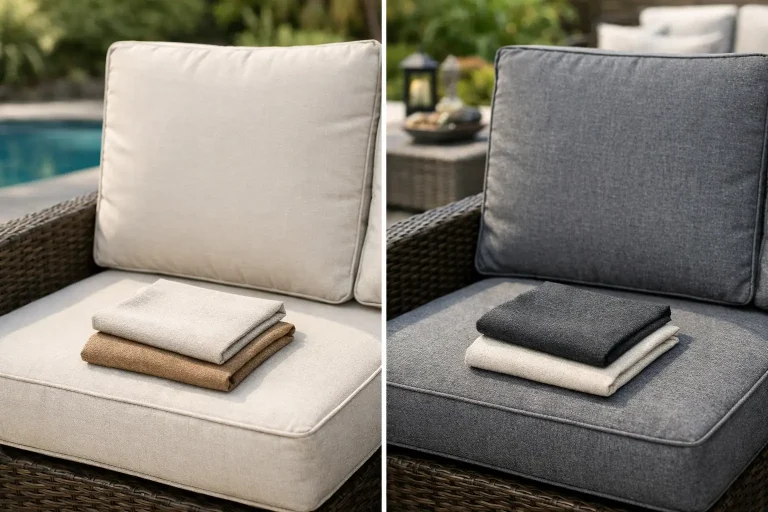
Bring swatches onsite if possible, and view them in the same lighting conditions where the furniture will live – direct sun, shade, and at night under the actual warm/cool lighting temperature. If the site is not accessible yet, replicate conditions as closely as you can and document them.
It depends on the project whether you should approve color “by sample” or “by standard.” For large rollouts, aligning to a documented standard (coded finish and fabric references) improves consistency over time. For one-off signature spaces, approving by physical sample can be safer.
Step 5: Evaluate the physical mockup like an operator
A mockup review should feel like a commissioning walk, not a styling session. Yes, confirm the visual language – but then sit, lean, drag, stack, wipe, and inspect.
Look for finish uniformity at welds and corners, clean joinery, consistent weave tension, and no sharp edges where guests and staff will contact the piece. Check cushion zipper placement, drainage strategy, and whether cushion ties or anti-slip solutions are appropriate for wind conditions.
For dining, confirm table stability and chair clearances with place settings. For loungers, check recline mechanism feel, pinch points, and how the chair behaves when repositioned by staff. For umbrellas or shade, test crank effort, tilt range, base stability, and whether the canopy shape holds its line.
Step 6: Document what “approved” means, in writing
Approvals that live in chat threads cause rework. A clean approval record should state: the exact configuration approved (finish codes, fabric codes, cushion construction, and any custom details), the measured dimensions if critical, and any agreed tolerances.
Also capture what is explicitly not covered. For example, you might approve the lounge set in Fabric A and say Fabric B is still pending. Or you might approve finish color but flag that texture level must match the sample.
When projects move fast, teams confuse “approved to proceed with procurement” with “approved for mass production.” If your project needs a pre-production sample or a golden sample retained at the factory, state it now.
Step 7: Handle revisions without resetting the entire schedule
Revisions are normal. The difference between a controlled revision and a timeline hit is how targeted the change is.
If the issue is purely aesthetic (tone, sheen, weave pattern), the fix may be limited to finish rework or fabric swap. If it is structural (seat pitch, arm height, instability), the fix can require retooling or new jigs. Treat structural feedback as high-impact and escalate it immediately.
Avoid “stacked feedback” where stakeholders hold comments and release them in waves. Set a clear review window, consolidate input, and issue one direction. You get speed by being decisive, not by being rushed.
Step 8: Convert the approved mockup into a control sample
The fastest way to protect consistency at volume is to create a control reference. That may be a retained golden sample, a signed finish board, and a documented QC checklist that mirrors what the project team cared about.
This matters for multi-batch production and for phased site deliveries. Without a control sample, Batch 2 can drift – slightly different weave tension, a different sheen, or cushion loft variation that becomes obvious when pieces sit side by side.
Step 9: Align mockup approval to packaging and logistics reality
Outdoor furniture doesn’t arrive magically. It arrives via cartons, pallets, containers, and site elevators. Mockup stage is when you confirm packaging approach, carton labeling, spare parts strategy, and assembly requirements.
If the project demands white-glove placement, confirm what “white glove” includes: uncrating, debris removal, assembly, placement per plan, and protection prior to handover. If pieces must fit into service elevators or tight corridors, validate packaged dimensions early.
Who should sign off (and who should not)
The approval chain should be short and authoritative. Typically, you want design to sign off on aesthetics and alignment to the concept, and procurement or the owner’s rep to sign off on spec compliance, durability requirements, and commercial terms.
Operations input is often the missing piece. Hospitality teams see problems designers don’t – stacking, cleaning access, replacement part logic, and how quickly a look degrades under real use. Bringing operations into the mockup review can prevent death-by-maintenance six months after opening.
Common failure points that delay production
Most delays are not caused by the factory. They are caused by ambiguity.
The first issue is approving a photo instead of a sample, then rejecting the physical reality. The second is changing the brief midstream – switching from “residential feel” to “commercial abuse-proof” after the mockup arrives. The third is uncontrolled customization: multiple fabric palettes, multiple frame finishes, and multiple cushion constructions without a master control document.
Another frequent issue is ignoring tolerances. Outdoor furniture is manufactured, not CNC jewelry. Specify what must be exact (table heights aligning to built-in counters) and where you can accept standard tolerance. This keeps feedback realistic and production moving.
How to keep the cycle fast without sacrificing control
Speed comes from front-loading decisions and minimizing handoffs.
Start with a clear mockup calendar tied to your site milestones, and reserve review time with the stakeholders who matter. Use a single approval form with attachments, not scattered messages. If your project includes multiple areas (pool, dining, lounge), approve by zone so you can release production in waves.
Working with a vertically integrated supplier also helps because design, manufacturing, and QC sit closer together. When the same organization controls drawings, sample build, production, and delivery sequencing, you reduce translation errors and shorten the time from feedback to corrective action. For teams that need design support, 3D visuals, and sample coordination under one roof, PNZ Space Global typically runs mockups as part of an end-to-end project workflow – from drawings through approval and bulk fulfillment.
A mockup is not there to slow you down. It is there to make sure the first large shipment is the right one – and that the space you open to guests looks intentional on day one and still looks intentional after a season of real use.