Choosing a Custom Outdoor Furniture Partner
You can spot a risky outdoor furniture order long before it arrives: no clear tolerance on dimensions, vague fabric names, “powder coat” with no spec, and a lead time that looks more like a hope than a plan. For villas, rooftop lounges, pool decks, and hospitality patios, those gaps turn into real costs – change orders, missed openings, warranty callbacks, and a visual mismatch across spaces that were supposed to feel intentional.
That’s why selecting a custom outdoor furniture manufacturer is less about browsing a nice catalog and more about verifying operational control. Custom work can be an advantage only when the supplier can protect specifications from design file to final installation.
What “custom” actually means in contract outdoor
In B2B procurement, “custom” can describe very different levels of control. At the simplest level, it’s a finish swap or fabric change on a standard frame. At the next level, it’s modifying dimensions to fit a tight terrace plan or aligning seat heights with an existing interior package. Full customization means a new frame, a new weave pattern, a unique tabletop, or a completely project-specific lounge concept.
The trade-off is straightforward: the more custom you go, the more the manufacturer’s process matters. Finish-only customization often ships quickly but may limit your ability to solve layout constraints. Frame changes solve the plan, yet they introduce engineering, prototyping, and more QA checkpoints. The right partner will tell you what level of customization is realistic for your timeline and quantity, and what requires a mock-up approval to protect you.
Vet the manufacturer, not the mood board
A clean render and a confident sales pitch do not guarantee consistency across 50, 200, or 1,000 pieces. For contract and hospitality work, you want evidence that the manufacturer can repeatedly hit the same spec.
Start with capacity and control. A vertically integrated operation that designs, manufactures, and distributes under one roof can typically manage tolerances better than a supply chain stitched together from multiple third parties. That matters when you need matching powder coat across lots, consistent cushion tailoring, and repeatable assembly.
Ask practical questions that force clarity: Who owns the drawings? Is there an internal engineering step? How are jigs set for repeat production? What’s the documented inspection process? A capable partner won’t treat those questions as friction – they’ll treat them as normal.
Materials are the project’s risk profile
Outdoor furniture lives in UV, heat, humidity, pool chemicals, and daily cleaning. “Good quality” is not a spec. A procurement-ready manufacturer should be able to talk in materials, coatings, densities, and construction details.
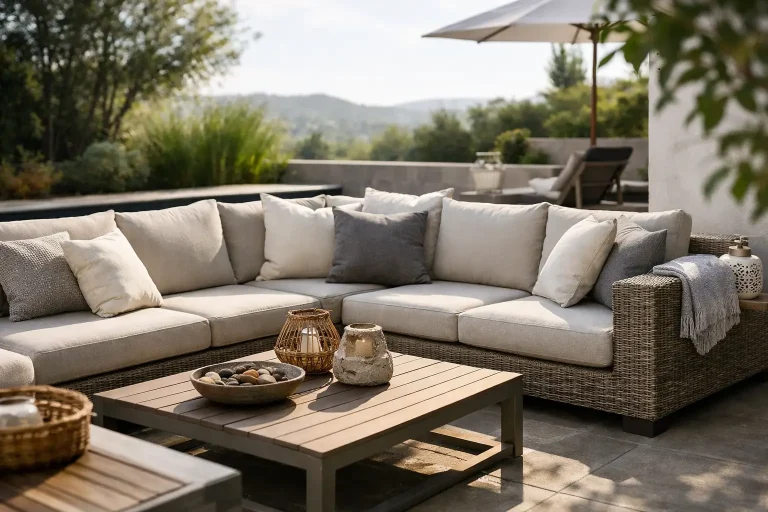
Aluminum is a common contract choice because it resists corrosion and keeps weight manageable for staff moving layouts. It still needs correct welding, surface prep, and a coating system suited for outdoor exposure. Teak and other hardwoods offer a premium look but require acceptance of natural movement and patina – that’s not a defect, it’s behavior. Synthetic wicker can deliver the woven aesthetic with easier care, but performance depends on resin quality and frame support.
Cushions and upholstery are where many projects quietly fail. Foam density affects not just comfort but how the product looks after months of use. Fabrics need clear UV and moisture performance characteristics, and zippers, piping, and thread choice determine whether the tailoring holds up under housekeeping cycles.
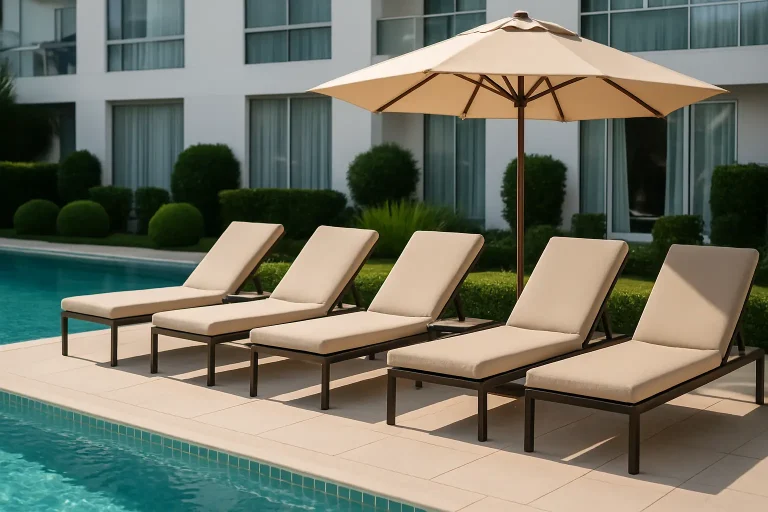
If your environment is poolside, the manufacturer should proactively discuss quick-dry constructions and drainage. If the project is a rooftop with high wind exposure, they should speak to stability, weight, and how sectional connectors are engineered.
Customization that helps – and customization that hurts
The best custom decisions solve an operational problem: awkward plan dimensions, circulation needs, storage constraints, or a design language that must align to brand standards across multiple properties. The worst custom decisions chase novelty at the expense of serviceability.
Here are a few “it depends” realities that experienced teams plan for:
If you customize an odd cushion size, confirm how replacement cushions will be ordered and how long they’ll take. Hospitality teams care about replenishment.
If you specify a unique finish, ask how it will be color-matched on a future reorder. “Close enough” becomes visible across a large terrace.
If you change seat depth for a particular concept, validate ergonomics with a physical sample or at least a detailed mock-up review. Beautiful proportions can still sit poorly.
A strong custom outdoor furniture manufacturer will guide you toward modifications that scale well – the ones that reduce site issues instead of creating maintenance headaches.
The real differentiator: drawings, mock-ups, and approvals
Custom work needs a disciplined approval path. The clearest indicator of a serious partner is whether they can support your process with detailed drawings and mock-up samples.
3D drawings are not a marketing extra; they’re a coordination tool. Designers use them to confirm proportions, procurement teams use them to lock specs, and project managers use them to prevent site surprises. When drawings are tied to manufacturing – not outsourced visuals – you get fewer translation errors between what was designed and what gets produced.
Mock-ups matter for two reasons. First, they validate comfort, scale, and finish under real light. Second, they create a standard that production can match. If a supplier discourages mock-ups because they “slow things down,” that’s usually a warning sign. The better approach is to plan mock-up timing early so the overall schedule stays predictable.
Lead time is a system, not a promise
Buyers in construction and hospitality have heard every version of “we can do it fast.” The question is whether the supplier can explain how.
A dependable manufacturer can break lead time into components: engineering and drawings, material procurement, frame production, finishing, cushion fabrication, assembly, packaging, and outbound logistics. They can also tell you which steps are on the critical path and which can run in parallel.
Customization increases planning requirements. If you need a specific tabletop material, confirm availability and batch consistency. If you’re selecting a special fabric, clarify whether it’s stock, made-to-order, or sourced from a third party with its own lead time. The goal is not just speed – it’s schedule control.
Quality assurance that shows up on site
Outdoor furniture QA is easiest to understand when you picture the receiving area: cartons being opened quickly, items being staged, and an installation crew trying to complete a punch list under time pressure. This is where packaging, labeling, and documentation become part of quality.
A contract-ready supplier should have an inspection routine that includes dimensional checks, coating and finish review, weave and joinery inspection where relevant, and cushion tailoring verification. They should also be able to package for the realities of shipping and handling – corner protection, abrasion prevention, and clear piece identification for multi-space installs.
For phased projects or multi-site rollouts, consistency is the QA target. You want confidence that the second shipment will match the first, even if it’s produced weeks later.
One vendor, full exterior scope: fewer handoffs, fewer gaps
Procurement friction often comes from managing too many vendors: one for lounge, another for dining, another for umbrellas, and then accessories and side tables from wherever you can find them in time. Each handoff adds spec drift and delivery risk.
A manufacturer with a broad outdoor catalog can reduce that complexity. When lounge seating, dining sets, poolside furniture, shade solutions, and accessories come through a single program, you’re more likely to get coordinated finishes, aligned lead times, and fewer surprises during installation. It also simplifies reorders because you’re not rebuilding specifications across multiple suppliers.
This is where operational scale matters, too. A larger SKU base and proven high-volume delivery indicate the systems are built for repeatable outcomes, not just one-off prototypes.
What to ask a custom outdoor furniture manufacturer
The fastest way to qualify a partner is to ask questions that connect design intent to manufacturing reality.
Ask how customization is documented: drawings, material schedules, finish codes, and cushion specs. Ask how approvals are captured and version-controlled so production doesn’t run on outdated files.
Ask what is truly manufactured in-house versus sourced, and how they manage consistency across those parts. Vertical integration can be a major advantage, but clarity is what protects your project.
Ask about after-install support: replacement cushions, touch-up guidance, and how warranty claims are handled. A supplier that expects long-term relationships will have clean answers.
A partner built for high-volume outdoor projects
For GCC-scale projects with international delivery expectations, PNZ Space Global operates as a vertically integrated supplier designed around contract-grade outcomes – from in-house design support and 3D drawings to mock-up approvals, manufacturing control, and white-glove logistics. If you need a single source across outdoor categories with customization and schedule accountability, start the conversation at https://www.pnzspace.com.
The best outdoor spaces feel effortless to guests, but they’re rarely simple behind the scenes. Choose a manufacturer that makes complexity boring – clear specs, clean approvals, predictable lead times – so your team can stay focused on opening day, not problem-solving on the loading dock.