How to Specify Outdoor Furniture for Hospitality
A rooftop lounge can look exceptional in a rendering and still fail within one summer service cycle. Cushions fade, frames corrode, dining chairs wobble under heavy turnover, and replacement timelines disrupt operations. That is why knowing how to specify outdoor furniture for hospitality is less about picking attractive pieces and more about controlling performance, maintenance, lead time, and brand consistency from the start.
For hospitality projects, specification is where design intent meets real-world use. Every decision affects guest experience, operating costs, and project delivery. The right specification supports occupancy, circulation, cleaning efficiency, and long-term asset value. The wrong one creates avoidable callbacks.
How to specify outdoor furniture for hospitality starts with the setting
Outdoor furniture should never be specified as one broad package. A pool deck, beachfront restaurant, shaded terrace, rooftop bar, and private villa lounge can all sit under the same project umbrella, but they behave differently in service. Sun exposure, humidity, salt air, wind load, drainage conditions, and traffic patterns all change what will perform.
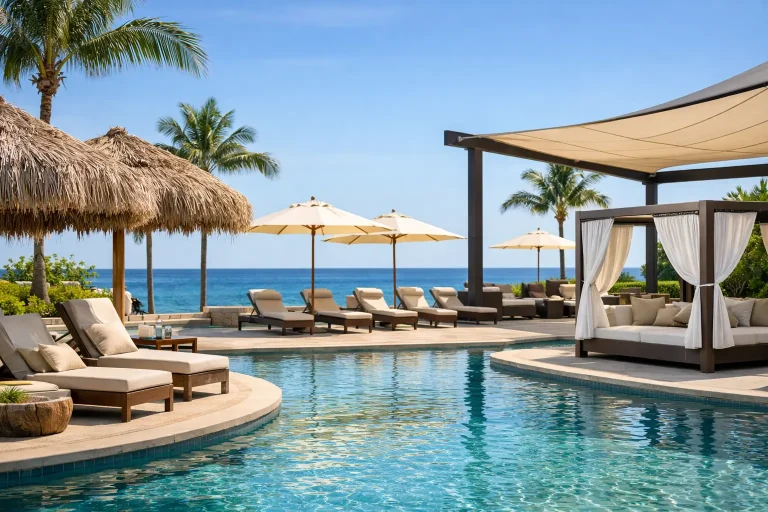
Start by breaking the project into use zones. Lounge seating near a pool needs different priorities than dining furniture in a high-turn restaurant. Poolside pieces may need quick-dry construction, easy mobility for staff, and finishes that tolerate chlorine exposure. Dining areas need stable table bases, chair ergonomics for longer dwell times, and surfaces that clean quickly between seatings. A rooftop venue may put more pressure on weight, stackability, and wind resistance than a ground-level courtyard.
This early zoning step helps prevent a common mistake: specifying one material language everywhere without testing whether it fits each operational condition. Consistency matters, but not at the expense of performance.
Specify for hospitality use, not residential appearance
Many outdoor collections look suitable for commercial use but are not built for hospitality turnover. That distinction matters. Contract-grade specification should account for repeated daily use, staff handling, frequent cleaning, and the need for replacement continuity across phases or properties.
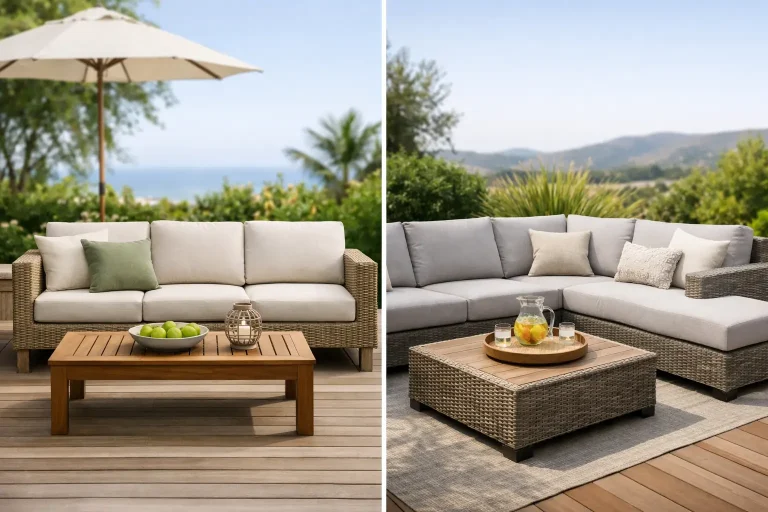
Frames should be assessed for structural strength, finish durability, and suitability for the climate. Powder-coated aluminum is often preferred because it balances corrosion resistance, manageable weight, and design flexibility. In some settings, teak or synthetic wicker may fit the visual direction, but each brings trade-offs. Teak weathers naturally and can age beautifully, yet it requires a clear maintenance stance from the operator. Woven materials can soften a space visually, but quality varies widely, and weak construction shows up fast under commercial use.
Cushion specification deserves equal scrutiny. Fabric selection should reflect UV resistance, stain performance, drying speed, and ease of replacement. A luxury resort may accept higher cushion depth and a more tailored upholstery package, but if covers cannot be cleaned or swapped efficiently, operations will feel that decision quickly.
The point is simple: specify to the service model, not just the mood board.
Match materials to climate exposure
Hospitality projects across hot, coastal, or high-UV environments need material decisions grounded in exposure data. Salt air accelerates corrosion. Direct sun degrades lower-grade polymers and textiles. Sand, sunscreen, food spills, and aggressive cleaning products all test finishes over time.
This is where experienced manufacturing guidance matters. Material samples should be reviewed not only for look and hand feel but also for suitability in the exact environment. If the property includes multiple outdoor exposures, it may be smarter to standardize silhouette and vary materials by zone rather than force one construction method across the entire site.
Think about maintenance before approval
A chair can be visually perfect and still be wrong if it is hard to clean, hard to stack, or expensive to reupholster. Hospitality operators care about labor as much as they care about aesthetics. Smooth wipeable surfaces, replaceable cushion components, and finishes that hide minor wear can outperform more delicate options over time.
Good specification includes a realistic maintenance conversation before approvals are signed. That saves friction later between design teams, owners, and operators.
Plan layouts around revenue, comfort, and service flow
Outdoor furniture is not just a product category. It is part of the operating plan. In hospitality, layouts should support seat count, circulation, privacy, staff movement, and the intended pace of use.
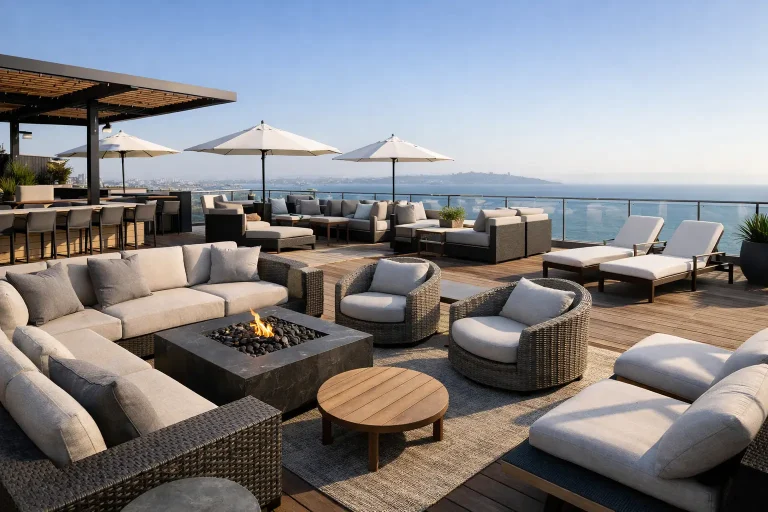
A restaurant terrace needs enough table spacing for service and guest comfort without losing covers. A lounge area may benefit from modular seating that allows event reconfiguration. Sunbeds should account for side-table access, towel placement, and the path of attendants moving through the deck. Bar-height seating may increase views and energy in one venue while reducing accessibility or comfort in another.
This is why drawings and mock-up reviews are so valuable during specification. Two-dimensional plans can confirm density, but 3D studies and sample setups reveal proportion, sightlines, and practical movement in a way product cut sheets cannot. On larger projects, that process reduces approval risk and helps align owners, designers, and procurement teams before production begins.
Build the specification package with fewer weak points
A strong outdoor furniture specification package does more than list products. It records dimensions, materials, finishes, fabric references, performance requirements, quantities, and application by zone. It also clarifies alternates, approval benchmarks, and replacement expectations.
Where many projects lose time is in fragmented sourcing. One supplier handles lounge, another handles dining, another covers umbrellas, and the result is inconsistent lead times, finish mismatch, and more coordination pressure on the project team. For hospitality buyers working on tight programs, a broader category supplier can reduce those weak points significantly.
A one-stop specification approach is especially valuable when the project includes lounge seating, dining sets, poolside furniture, shade solutions, and accessories. It makes finish coordination easier, simplifies logistics, and improves visibility on production schedules. If custom requirements are involved, integrated design support and factory-side oversight become even more important.
Customization should solve a project problem
Customization is useful when it improves fit, branding, or performance. It is less useful when it adds complexity without operational benefit. Custom dimensions may help maximize rooftop capacity. A specific finish may be necessary to align with brand standards. A modified cushion build may improve drying time or comfort in a given climate.
But every custom decision should be weighed against cost, lead time, approval cycles, and reorder simplicity. Hospitality groups with repeat projects often benefit from controlled customization – enough flexibility to suit the property, with enough standardization to make future procurement faster.
Evaluate supplier capability as part of the specification
Furniture selection is only half the decision. The supplier’s operating model affects whether the specification can actually be delivered as planned. For hospitality projects, buyers should look closely at manufacturing control, SKU depth, project support, and delivery reliability.
A vertically integrated supplier has a practical advantage here. When design, manufacturing, and fulfillment are coordinated under one structure, there is generally better control over timelines, material consistency, and issue resolution. That matters when you are furnishing a hotel terrace, a resort pool program, or a multi-site rollout where delays are expensive.
Project support also matters. 3D drawings, mock-up approvals, material swatches, and responsive communication are not extras on hospitality work. They are tools that reduce change orders and improve decision speed. PNZ Space Global approaches specification this way because large outdoor projects need more than catalog breadth – they need execution support from concept through delivery.
Don’t overlook logistics, installation, and replacement planning
A well-specified package can still run into trouble if logistics are treated as an afterthought. Access routes, elevator dimensions, rooftop lifting requirements, installation sequencing, and site protection all affect what should be specified and when it should ship.
Replacement planning is just as important. Hospitality furniture will experience wear, and some level of attrition is normal. Buyers should think ahead about spare quantities, future availability, and whether the collection can be replenished without obvious variation. This is especially important for properties rolling out in phases or operators standardizing across several locations.
White-glove delivery can be a major advantage on projects where timing, site coordination, and finish protection are critical. It reduces handling risk and helps keep the last stage of procurement aligned with the quality standard expected earlier in the process.
The best specifications stay flexible where it counts
There is no single formula for how to specify outdoor furniture for hospitality because every project has its own balance of brand goals, climate demands, budget pressure, and operating realities. A luxury beach club may prioritize tactile materials and deep comfort even if maintenance inputs are higher. A high-volume restaurant may value stackability and fast cleaning over softer design gestures. Both can be well specified if the decisions are intentional.
The strongest hospitality specifications are the ones that hold up under procurement review, survive operational scrutiny, and still deliver the atmosphere the property promised. If you can align material performance, service flow, supplier capability, and delivery planning before orders are placed, the outdoor space stands a much better chance of performing as well as it photographs.
That is the standard worth specifying for.